
BTC and The Future of Crypto


While we have been busy in the recent few months with site upgrades and machine overhauls and with it all culminating in a massive past week at the farm in the Mid West of WA I thought I'd put together something to surmise Bitcoin and explain the importance of mining and investing in BTC.
(Here are some images of us at the mining farm)

BTC is the OG and King of crypto. There has been much talk over which crypto has the capability to take its crown and whether it will ever be knocked off the top spot.
Bitcoin is Dead
There have been multiple times over the history of Bitcoin that it has been pronounced dead and I have written about this misconception a few times over the years..... There has traditionally been a misunderstanding of Bitcoin and what it is and how it works. Bitcoin has emerged and become more than a fad and is now an established asset class. The way it looks now and for the foreseeable future Bitcoin is certainly not dying any time soon, momentum is building and adoption of the asset has only grown.
Despite this there are always headlines almost every day detailing that a crypto market demise is on the horizon and BTC will crash.....

Is a Cryptocurrency Market Crash on the Horizon?
There's always something to worry about, but that doesn't mean you should.
On a long-enough timeline, another crypto market crash is certain. But having certainty about it happening someday is very different from having clarity about the chances of it happening someday soon.
Right now, the balance of evidence suggests the market is more likely to wobble before resuming its upward trajectory than it is to crash and burn. Here's what's going on and why fears of a crash are a bit overblown at the moment.
What would actually crack the market
Crashes rarely happen without a catalyst. The simplest catalyst for a crash would be a sharp macro shock that sucks liquidity out of risk assets, like cryptocurrencies.
Central banks are generally not tightening their policy rates today. The European Central Bank (ECB) cut its interest rate in June and is signaling patience, not a fresh squeeze, which reduces one common crash trigger. The U.S. Federal Reserve may still be debating its next step, but many are anticipating that it will lean toward cuts later this year, which is not crash fuel either. And, for the record, if for some reason the Fed decides to hike interest rates in the name of controlling inflation rather than leaving them alone or delivering the cuts that the market is expecting, it might cause a painful downturn in crypto, but even then it probably wouldn't spark an outright crash.
Another route to a crash would be a policy reversal, for which there is no evidence of presently.
In the U.S., regulators in the new Trump administration have backed broader access and clearer rulebooks, and they have also repudiated the idea of crackdowns as being the preferred approach to regulating the crypto industry. Even where the Securities and Exchange Commission (SEC) has tapped the brakes, as it has recently with the approval of certain exchange-traded funds (ETFs), the story is more about timing and getting enough breathing room to craft sensible policies, not a return to outright prohibition.
Still, investors should watch for pockets of froth that can amplify routine pullbacks or potentially provide the kernel of instability that could lead to a crash in the future. We might see small pockets of froth and volatility but nothing at this stage to signify any excessive froth and overpriced assets. When the market gets too frothy then it is a clear sign of an impending market top..... we are nowhere near that yet.... there is still a way to go. There may be some small tops for various projects along the way and some crypto projects may run early and not hit the same highs again this cycle (or ever), others will run multiple times and then pullback and run again on the next cycle. BTC is one such asset that has proven history and market position to sustain multiple runs, multiple highs and further strength and gains into the next cycle.

Owning just a small share of Bitcoin is becoming an ever-important thing, with more and more investors and speculators joining the ranks along with the more informed and astute investors. We have seen influential investors who shied away from BTC previously beginning to turn toward and adopt BTC as part of their investment portfolio. We have seen complete backflips from the skeptics and we are seeing an ever-increasing adoption by governments and global companies and with this more and more institutional investment. We are even seeing investment firms and financial planners beginning to embrace BTC and other crypto assets as they now more and more freely talk about it and follow it.
With all of this and with all the systems being built around and for crypto it is very clear that this asset class is here to stay and investing in Bitcoin is becoming more the norm rather than exception.
We have just recently seen a massive leap forward from the US in its pursuit of more favorable crypto policies and other governments have also been doing similarly over the recent 2-3years. Even Australia's government are making some inroads (although very slowly - but nothing ever moves quickly in Australia).

Blackrock
BlackRock, the world’s largest asset manager, has been hitting the headlines again with substantial Bitcoin (BTC) and Ethereum (ETH) net inflows recorded on July 11, 2025.
According to Arkham Intelligence, BlackRock’s IBIT Bitcoin ETF (IBIT) acquired approximately 613 BTC, valued at around $66.75 million.
In addition, the fund saw an inflow of another 9,680 ETH on the same day, worth about $25.3 million in total.
We all know Blackrock have been making a major play on Bitcoin for the past few years and they are not slowing down any time soon.
Bitcoin headed for 36 more public companies by year-end: Blockware
The corporate Bitcoin adoption race is “mostly being spearheaded by brand new companies or dying companies you’ve never heard of,” says Blockware. So while we can see some of the largest major companies adopting Bitcoin and holding influence there are many more that fly under the radar.
Blockware Intelligence predicts that by the end of 2025, at least 36 more public companies will have added Bitcoin to their balance sheets.
“This is just the beginning. In the next 6 months, we expect at least three dozen more public companies to add Bitcoin to their treasury,” Blockware said in its Q3 2025 market update report. This would represent around a 25% increase from the current total of 141 public companies holding Bitcoin, according to the firm’s data.
Public company Bitcoin adoption surges 120% in 2025
The intelligence unit, which is the research arm of Bitcoin mining company Blockware Solutions, reported that in 2025 alone, the number of publicly traded companies holding Bitcoin on their balance sheets surged 120%. “Bitcoin Treasury Companies are the aforementioned ‘bridge’ connecting equity and debt markets to Bitcoin,” the firm added.
According to BitcoinTreasuries.net data, Michael Saylor’s Strategy leads the pack with 597,325 BTC, holding approximately 12 times more than the second-largest holder, Bitcoin mining firm MARA Holdings, which has 50,000 BTC.
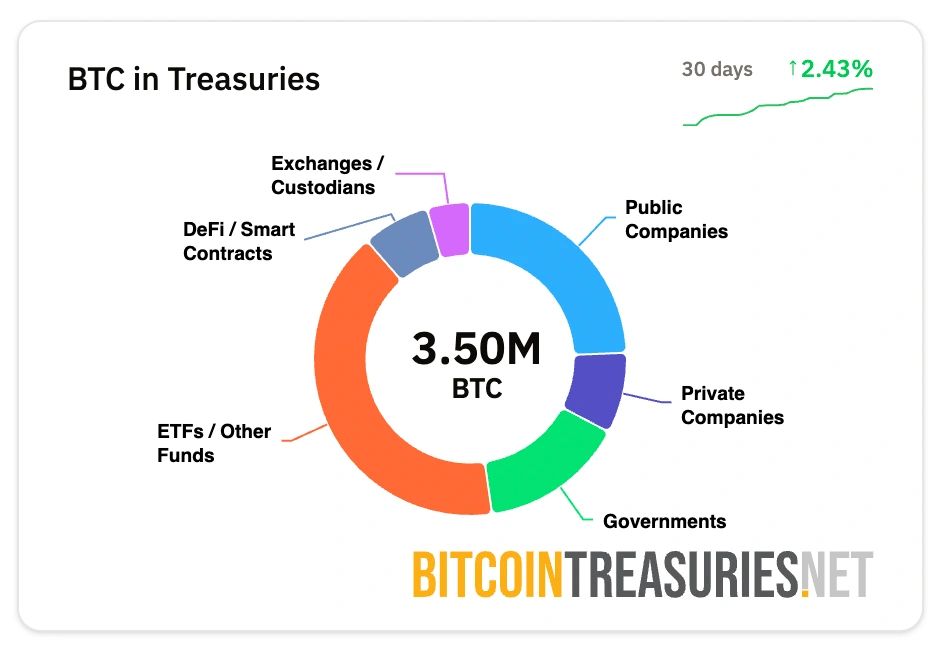
Over the past 30 days there has been a 2.43% uptick in Bitcoin treasury holdings. Source: Bitcointreasuries.net
Over 150 publicly-traded companies now collectively hold roughly 1 million Bitcoin—a trend that's dropping exchange supply below 15% and igniting speculation around a supply crunch and higher prices.
Why It Matters?.... Growing institutional custody of crypto signals rising demand—and scarcity could support next cycle gains.
Blockware said that the increasing number of companies joining the ranks is either newly established or facing operational challenges.
“The corporate Bitcoin adoption race is mostly being spearheaded by brand new companies or dying companies you’ve never heard of.”
Blockware said this isn’t necessarily a negative. “Companies with struggling core businesses (low growth, dying markets) have a much easier time recognizing the simplicity of investing retained earnings into BTC and earning 40 to 60% CAGR without the operational risks of running a business,”
“The market is sending a strong signal: securitized Bitcoin exposure is here to stay,”
Bitwise Asset Management recently reported that corporate interest in Bitcoin reached new highs in the second quarter of 2025, with companies adding a record 159,107 BTC to their balance sheets.
However, not everyone is optimistic about the significant number of companies adopting Bitcoin.
Glassnode lead analyst James Check recently warned that the easy upside may already be behind new companies entering the space.
“My instinct is the Bitcoin treasury strategy has a far shorter lifespan than most expect,” Check said on July 4.
On June 29, venture capital firm Breed argued in a report that only a few Bitcoin treasury companies will stand the test of time and avoid the vicious “death spiral” that will impact BTC holding companies that trade close to net asset value (NAV).
Meanwhile, crypto trader Saint Pump said in a post on X that “I’m also pretty confident they’ll play a key role in the next bear market.”
“The music stops when the NAV premium starts to slowly fall (or even turn negative with ATMs), and raises become smaller or fail altogether,” the trader added.
While this may be true to some degree there is no doubt that there can be benefit to companies adding some Bitcoin to their balance sheets as a way of divestment and security over the long term. Just as you would your own investments or superannuation, holding some level of Bitcoin and select crypto assets may prove to be very worthwhile over time.

A silent transfer of control is reshaping the $US2.1 trillion bitcoin market.
A steady stream of sales by long-time whales – miners, offshore funds and anonymous wallets – is being met almost one-for-one by demand from institutional players like ETFs, corporates and asset managers.
Underneath the surface, long-dormant whales have been trimming positions and taking profits just as institutions ramp up their buying. And this switchover is gradually recasting bitcoin’s identity from a high-octane trade to a slow-burn allocation.
Over the past year, large holders (Bitcoin whales), have offloaded more than 500,000 bitcoin – worth over $US50 billion at current prices – according to data compiled by 10x Research, a firm that analyses digital asset trends.
That’s roughly equal to the net inflows into the wildly successful US exchange-traded funds since their approval. And it’s not far off from the $US65 billion amassed over the past five years by crypto treasury pioneer Michael Saylor and his firm, now known as Strategy.
Many of these whales trace back to Bitcoin’s earliest cycles, when it traded far below current levels. In some cases, whales aren’t simply selling, they’re swapping tokens for deals tied to the stock market, bypassing the open market.
“What we’re seeing is a churning in the base,” says Edward Chin, co-founder of Parataxis Capital. “A less covered driver and potential reason for the churn and increasing network activity seems to be driven by whales converting their BTC into equity exposure through in-kind contributions of BTC into financing transactions tied to the public markets.”
Institutions – from ETFs and Saylor’s Strategy to dozens of corporate imitators – now control about a quarter of all bitcoin in circulation. Back in 2020, researcher Flipside Crypto estimated that about 2 per cent of the anonymous ownership accounts that can be tracked on the cryptocurrency’s blockchain controlled 95 per cent of the digital asset. The power dynamic is shifting fast.

“Crypto is becoming less of an outlier and more established as a legitimate asset class,” says Rob Strebel, head of relationship management at the trading firm DRW, which includes crypto-focused arm Cumberland. Alongside that shift, “we expect to see a compression in volatility”.
That appears to be already taking place, dampening one of the most alluring aspects of bitcoin to many traders. A closely watched measure of price swings has declined to the lowest level in about two years, according to Deribit’s BTC Volatility Index. The gauge monitors the 30-day forward-looking annualised expectations of volatility.
While the whales cut exposure, ETFs, treasury companies and other institutions combined have absorbed nearly 900,000 coins in the past year, according to 10x Research. These players now hold about 4.8 million coins, out of about 20 million bitcoin in circulation.
But even as institutions bring stability and legitimacy to the asset class, some observers warn they’re also providing the long-awaited exit ramp for whales, raising the risk that it’s retail and retirement investors left holding the bag if crypto sentiment falters.
“The goal for a long time has always been to make bitcoin a palatable asset for institutional investors to provide exit liquidity in volume, so the whales could cash out,” says Hilary Allen, a law professor at American University’s Washington College of Law, a long-time crypto sceptic.
After two straight years in which the price more than doubled, Bitcoin was recently still hovering around levels reached at the start of the year, despite President Donald Trump’s pro-crypto agenda. It then made some significant jumps to new ATH's before currently retracing slightly with a healthy pullback.
Some analysts now expect Bitcoin’s appreciation to be capped at 10 per cent to 20 per cent a year. That’s a far cry from 2017’s almost 1400 per cent surge that pushed the token into the mainstream.
“Bitcoin is probably more like boring dividend stock over time,” said Jeff Dorman, chief investment officer at Arca. “On average it goes higher every year, but by less and less amount. It becomes more of an attractive retirement asset.”
Still, the picture is incomplete. Not all whale activity is visible, and bitcoin could prove ever-volatile soon enough, especially if a new market catalyst emerges.
Regardless, one big risk right now is imbalance: if bitcoin whales resume selling at scale while institutional flows plateau, the market could tip into steep declines. Outflows of just 2 per cent in 2018 and 9 per cent in 2022 triggered bitcoin price drops of 74 per cent and 64 per cent respectively, according to 10x Research.
“We are nearing a point where the market is hitting its peak,” says Fred Thiel, chief executive officer of Bitcoin miner Mara Holdings, which has yet to sell any of its bitcoin holdings. “My personal belief, however, is we are in a very different market dynamic today.”
All told, the shift from anonymous whales to institutional allocators may help sustain the current market dynamic for an extended period.
“This can go on for a long time – years,” says Markus Thielen, CEO of 10x Research. “It’s more of a slow grind, where bitcoin becomes more of a 10 per cent to 20 per cent asset. The nature of bitcoin really changes.”
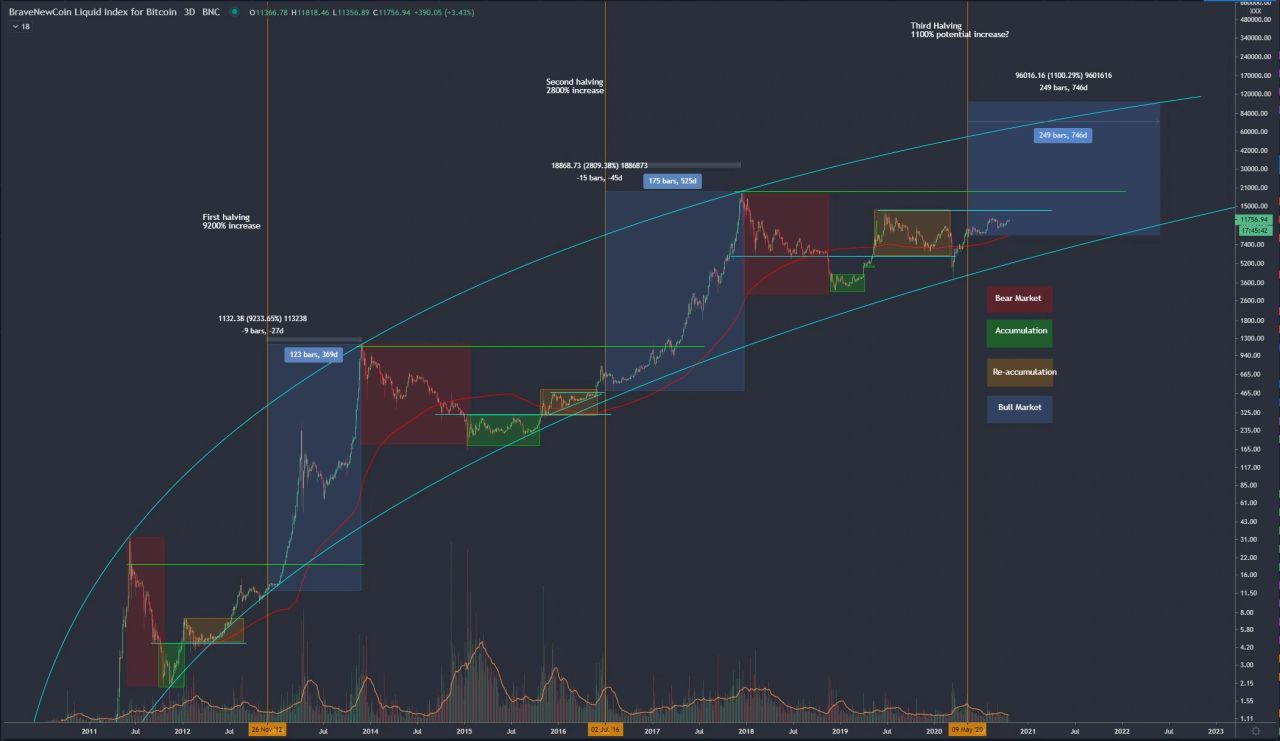
I do believe that we will see BTC as a less volatile asset over time and we have seen this shift begin to emerge in this market cycle. We have already begun to witness a slight change in the market in this crypto Bull Market season, and I have no doubt that this will be our last of the more traditional crypto cycles with the halvings playing less of a part in pricing structure.
The future of crypto
We are on the verge of crypto hitting the mainstream and with increased institutional adoption and more favorable global governmental policies it could aid in more of a transition towards the mainstream markets. We are witnessing increased blockchain adoption across industries and we are seeing a larger influence in the digital space with crypto bridging Real world assets.
With the pricing of key cryptocurrencies we expect lower highs and higher lows with a narrowing band and less overall volatility..... for the mainstream and established projects at least like BTC and ETH and a select few others, they may become more of a slower burn asset. However, for the newer and more experimental projects and the more emotional or meme crazes I don't think we will ever see these truly settle into a more predictive and less volatile asset and that will remain part of the fun and frustration of crypto!
In all be wise, don't bet the cattle station and please always do your own research and seek appropriate financial advice.... Enjoy the ride towards the market top!
Happy Mining
Rusty Rigs

Disclaimer: The content on this site and in this communication should not be considered investment or financial advice. Any investing or crypto mining is speculative. When investing your capital is at risk, please do your own research and invest and make your decisions wisely. Mining profits are not guaranteed and may vary over time depending on the market performance and network hashrates. The views and opinions expressed by the author are for informational purposes only and do not constitute financial, investment, or other advice.