
Which Altcoins May Have The Biggest Profits this Crypto Altseason

In this blog I will provide a comprehensive guide to some of the best projects for this market cycle and beyond….. This is a big read so get comfy, grab a cuppa and get ready to take some notes….. It may take you some time to read and digest this, enjoy your weekend reading and research for this Altseason – Crypto Bullrun!
The overall crypto market capitalization lost over $440 million last week; on Monday, it reads $2.66 trillion. The reaction to Trump’s announcement of the Strategic Bitcoin Reserve wasn’t what many expected as the market continued to correct. Moreover, in a Fox News appearance on Sunday, Donald Trump acknowledged that the economy could see short-term pain from his policies.
Total crypto market capitalization dipped to $2.61 trillion
This downturn triggered a wave of liquidation, wiping out $3.64 billion in total liquidation, according to Coinglass data.
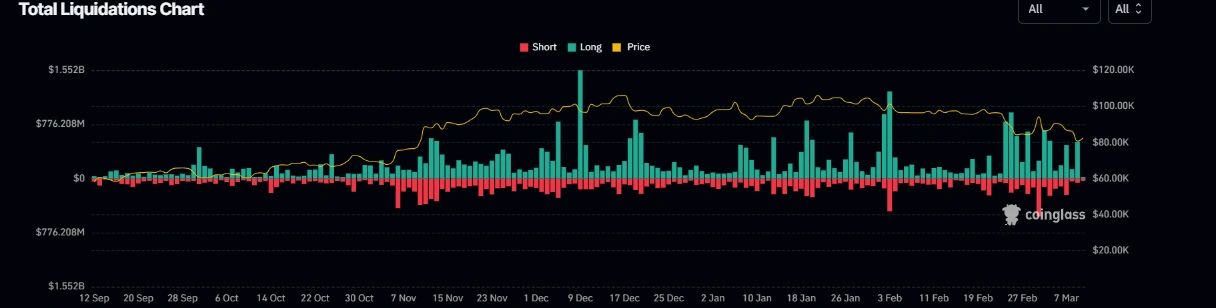
Multiple events fueled this market crash as major coins like Bitcoin (BTC), Ethereum (ETH), Ripple (XRP), and Solana (SOL) faced a double-digit decline last week.
President Donald Trump’s heated Oval Office exchange with Ukrainian President Zelenskyy and the potential for new US tariffs added even more uncertainty. The White House crypto summit and the announcement of a US Bitcoin reserve sparked a reaction that defied widespread expectations.
In an exclusive interview, Ian Balina, founder and CEO of Token Metrics, said, “The announcement about the Strategic Bitcoin Reserve is not what the market was hoping for. Many expected the Reserve to buy new Bitcoin, but instead, they stated they would not sell any of their existing Bitcoin or confiscated Bitcoin. While this is a positive move, it caused a sharp decline in Bitcoin’s price. Moreover, our market indicator for Bitcoin remains firmly bearish and has not shifted to a bullish stance despite this latest news.”
There are bigger factors at play and the market has potentially more downside at this point before we see the upside. While there is an expectation of an upswing later this month, it will not be until May and July that we see the larger moves. How large those moves are will depend on the macro landscape and the amount of free and available cash and the sentiment of the people. Check out this Video from Lark below
So while America is worried about recession and consumer confidence has dropped Australian households are feeling more financially confident than they have in years after a long slump.
Consumer confidence has risen following the Reserve Bank’s cash rate cut, with sentiment returning to May 2022 levels (before rate hikes began flooding in), according to the Westpac–Melbourne Institute Consumer Sentiment Index.
There was a 4 per cent rise in consumer sentiment in March, lifting to 95.9 per cent from 92.2 last month, the survey found.
A recession in the United States would impose large losses on the sharemarket portfolios of Australians but only a modest direct impact on the local economy, which has a successful history of resilience during US downturns.
That’s the view of economists who say the bigger risk facing Australia is the fallout in its No. 1 trade partner, China, from Donald Trump’s threatened trade war with Beijing. China’s indebted economy, dragged down by an ailing property sector, was already slowing before Washington and Beijing imposed tit-for-tat tariffs.
Trump’s refusal at the weekend to rule out a possible US recession this year as the economy adjusts to tariffs and cuts to government spending has spooked investors and led to steep falls in share prices around the world.
The increasing exposure of the country’s biggest superannuation funds to US sharemarkets has driven the biggest fall in the value of their assets in nine months.
Much of the decline was due to falls in the US S&P 500, which has fallen 8.6 per cent from its February peak, in line with the ASX 200 decline, and the US Nasdaq, which slumped more than 10 per cent as uncertainty from Trump’s tariff plans swept the market.
Huw McKay, a former BHP chief economist now based in Canberra, said Australia avoided recession during the 2001 American technology stock bubble bursting, 2008 global financial crisis and Trump’s first trade war with China from 2018.
The risk of an imminent US recession was overstated, but if the American economy did contract, the impact on Australia would depend on how China and other Asian trading partners responded with possible stimulus.
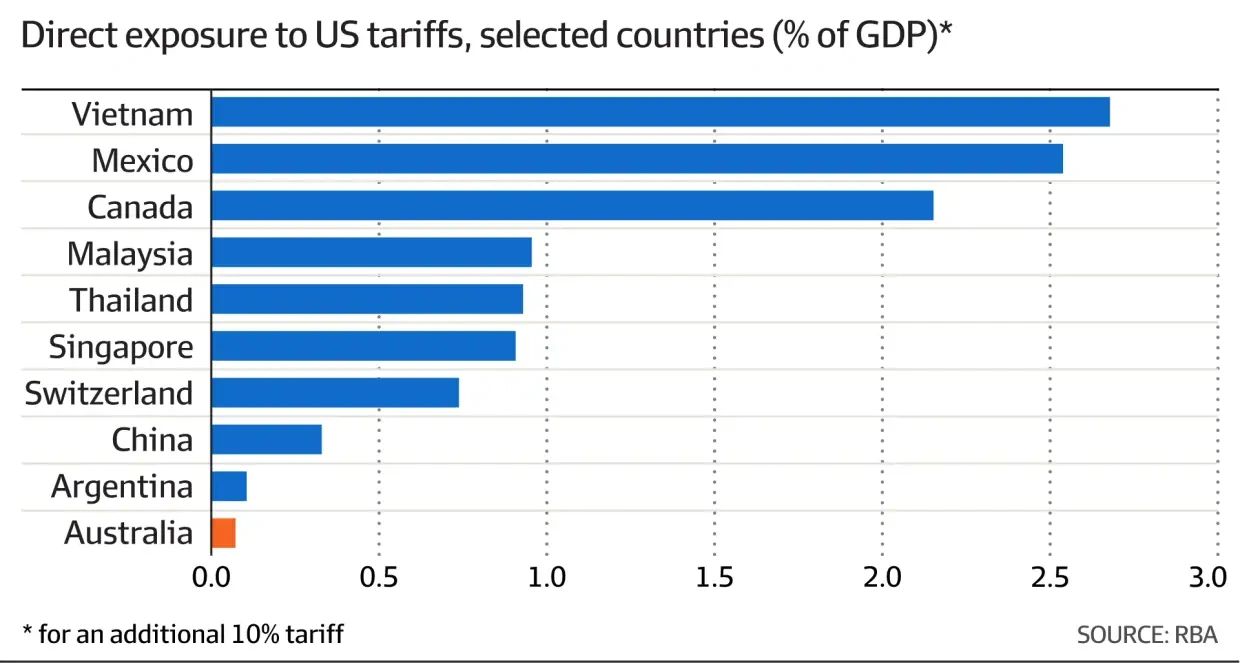
Australian National University economist Warwick McKibbin, who has conducted detailed economic modelling on Trump’s policies, said the uncertainty fuelled by Trump’s tariffs could make AAA-rated Australia more attractive for global investors.
“Eventually, the US dollar is going to have to drop and this capital getting pulled out of capital markets could come to Australia as a relative safe haven.” This could bode well for Australia’s economy and provide increased funds to continue to drive our economy forward.
I have no doubt that Trump and his government have plans to improve Americas financial position and there are no doubts that there will be some manipulation of markets to suit that agenda. Trump is certainly pro crypto and will attract a great deal of investment for crypto in America over his term. This will assist to propel the American economy forward, he is also promoting increased drilling and oil and gas activity and again this will see some large profits coming back into America where over previous terms of government they have been stripped away and reduced. These workings could in fact propel the crypto bull run cycle into a super cycle that lasts longer, many have stated that the landscape has changed, the market is maturing, and it feels different this time. That very well might be the case, further additions of ETF crypto projects, further relaxing of restrictions and the dropping of various lawsuits such as that against XRP could see an influx of funds enter the market and propel the overall market cap to the heights required to see BTC exceed the $150-250k USD price range predicted.
Cayman Islands Introduces New Crypto Licensing
Bitcoin may benefit from US stablecoin dominance push
US stablecoin policies may drive Bitcoin adoption and investment as regulators push to maintain the dollar’s dominance, benefiting BTC and institutional crypto growth.
Bitcoin may benefit from US stablecoin dominance push
2025 – Alt Season

As we dive into 2025’s altcoin landscape, several promising tokens have emerged, showcasing potential for significant profits. Here are some categories and specific altcoins to consider.
I obviously have a few favorites when it comes to Altcoins and of those I am a big fan of Kaspa and its potential. I have written quite a significant amount on Kaspa over the months and it certainly is one that is worth holding in your portfolio. Outside of Kaspa I would have to also favour Doge and both Kaspa and Doge are easily mineable coins. Kadena is another mineable coin that Andy and I have and if it performs half as well as it did last market cycle then it could prove very rewarding although I do not see KDA breaking through its previous ATH, I do see it rising significantly from its current levels. I also like Solana, Matic, Avax, Link, Stellar, Hbar and XRP and have those in my mix.
I mentioned many of these in my last monthly crypto market wrap but let’s take a look at my list of top 20 coins for my portfolio this cycle…. well 21 or 22 maybe….
1. Bitcoin – definitely worth having this in your bag, I don’t really need to explain this one. The only coin that’s not an Altcoin, BTC holds the largest market cap and influence over the crypto market. Holding a balance of BTC even if it’s only .1 or .25 BTC is worth it over time as we expect BTC to reach 1 Million USD in the near future. This cycle could see BTC reaching between $150-250K USD according to most predictions by top analysts and I would tend to agree. The technicals do not lie.
American entrepreneur Tom Lee, also the managing partner at research firm Fundstrat, has predicted that market-leading digital asset Bitcoin will hit a price tag of $250,000 by the end of 2025, hitting new all-time highs. Lee’s bullish take on BTC remains unfazed by the recent Bitcoin crash, which saw the cryptocurrency drop below $90,000 for the first time in 2025.
The entrepreneur highlighted during a recent interview that Bitcoin is down roughly 15% from its all-time high of $108K, “which, for a hyper-volatile asset, is a pretty normal correction.”
Bitcoin to $70K?
Lee is bearish on Bitcoin in the short term, adding that technicians working for his firm predicted that BTC could witness a drop to $70,000. The cryptocurrency is following global liquidity, said Lee while emphasizing that as per his beliefs, “we’re pretty early in this having cycle.” While the entrepreneur could be bearish in the short term, Lee predicted that Bitcoin will be one of the best-performing assets in 2025.
When asked if Lee really believes BTC will drop to $70,000, he explained how that is possible via the concept of Fibonacci retracement levels. Lee said that assets pull back from where they rally, and the $70K region is one retracement level, while another level for BTC is at around $50K.
Bitcoin could be significantly higher this year, maybe $200-$250K, so … I think around $90K is still a good entry point. RSI levels for Bitcoin are still bullish on a longer time frame. The RSI is valued at 60.86, which suggests that bulls are still in control, there is a high degree of possibility that further price declines could occur. This is a great time to buy and a great time to add additional mining units for any Proof of Work coins while prices are cheaper.
BTC has the very real potential to sit between $150-250k at the peak of this Bull Run season.
Bitcoin ‘Monte Carlo’ model forecasts $713K peak in 6 months

2. Solana – my pick for the eventual number two spot for market cap (until Kaspa takes its place in another cycle or two). There is so much to like about Sol and some solid charts and information. Definitely worth examining and adding to your mix if not already. ETF potential for Sol is also a consideration for further growth. While we have seen significant growth in SOL between its launch in 2020. Solana was launched in 2020 by Solana Labs, which was founded by Anatoly Yakovenko and Raj Gokal in 2018. Since its mainnet launch in 2020, the Solana ecosystem has experienced massive growth across multiple fronts — expanding network capacity, increasing user adoption, and launching innovations. Since that time it has grown into a solid top 10 ranking project and appreciated from an initial price of $.04 USD. The price of one SOL token at the start of the seed sale was $0.04. Early users and supporters of the project were able to buy a lot of SOL at this low price, setting themselves up for possible future gains as the network grew and more people joined. Those early adopters will be sitting pretty right now. The Solana ATH is $293.31 USD on Jan 18th 2025. With price projections ranging from $520 to $1500 by the peak of the market in 2025 and so much to like about the project this is certainly one coin I am bullish on.
3. XRP – finally breaking free of the SEC chains and has some serious upside potential and could hold the top two spot briefly before SOL overtakes it. Also an ETF potential. Can XRP dethrone ETH?
For the past four months, XRP (CRYPTO: XRP) has easily been one of the top performers in the crypto market. Over that time period, XRP is up a staggering 400% and was recently trading around $2.50 USD.
But the best may be yet to come. XRP holders may soon get some fantastic news about an important Securities and Exchange Commission (SEC) lawsuit that has dragged on for more than four years now. If the case is finally dismissed, XRP could soar in value.
The SEC versus Ripple
If you haven’t been following the long, drawn-out legal proceedings involving XRP, Ripple (the company behind the XRP token), and the SEC, consider yourself lucky. The case, which started in December 2020, has taken so many twists and turns that it has been almost impossible to keep up. Just when the case seems to be over, it somehow extends even longer.
At its core, the lawsuit comes down to a single question: Is XRP a security or a commodity? And, believe it or not, to answer that question, the courts are using a legal precedent (known as the Howey Test) from a 1946 Supreme Court case involving a company selling Florida orange groves. That might help to explain why the case has dragged on so long: If you think comparing apples to oranges is difficult, what about comparing cryptos to oranges?
The good news is that it looks like a final decision is coming between now and April 16, which is the next anticipated court date for the case. After more than four years of countless legal back-and-forth, we might have a final resolution. And there’s nothing the market likes better than certainty.
Factors in XRP’s favor
Thus far in 2025, the SEC has already dismissed several high-profile crypto lawsuits. But after filing an appeal in January, it has been strangely silent about the one involving Ripple.
Given the clear pro-crypto emphasis of the Trump administration, the thinking now is that, whatever happens next, it will be in XRP’s favor. As hard as the SEC has been pressing its case, it simply doesn’t hold the right cards any more.
Even if the SEC finds a way to extend this case beyond April, the Trump administration has several important levers it can pull to end this once and for all. Some have speculated that Trump could send Elon Musk and DOGE to look into activity at the SEC. Or he might encourage the recently formed Senate Crypto Subcommittee to investigate the SEC for regulatory overreach. And if that doesn’t work, he might simply sign an executive order.
How high could XRP go?
The sky’s the limit for how much higher XRP might go. In a best-case scenario that involves only the final resolution of the SEC court case, it’s possible that XRP could reclaim its all-time high of $3.84.
But let’s think bigger. XRP could be included as part of the new Crypto Strategic Reserve proposed by the Trump administration, so it’s easy to find price forecasts as high as $10 for XRP. In fact, some analysts think that XRP might eventually soar as high as $100 as long as the entire crypto market moves higher.
Moreover, there’s another factor that could send XRP higher: the launch of a new spot exchange-traded fund (ETF). The likelihood of XRP getting a spot ETF this year will be enhanced considerably if the regulatory cloud over Ripple and XRP lifts. The launch of a new spot ETF is key, because it ensures a fresh new influx of investor money into XRP.
Right now, Bloomberg projects the likelihood of a spot XRP ETF at 65%. That was based on the understanding that there’s no way the SEC would approve an ETF if there are still regulatory issues swirling around XRP. So if the SEC case gets resolved by April, it becomes highly likely that a spot ETF might arrive later this year.
SEC vs Ripple: XRP Lawsuit Wrapping up as Negotiations Reach Final Stage—Report – Regulation Bitcoin News
The end of regulatory risk?
What you need to know as an investor is that a very big catalyst is coming within the next 45 days, and it makes XRP very attractive as an investment target right now. So keep your powder dry. The lifting of the regulatory clouds over the crypto industry is creating plenty of new investment opportunities with significant upside potential.
As of March 2025, XRP’s price stands at $2.49, with a market cap of $145.04 billion. Despite a significant decline from its all-time high of $3.84 in January 2018, XRP has seen consistent growth due to Ripple’s ongoing partnerships and technological advancements. The cryptocurrency’s current price reflects a bullish sentiment in the market, driven by Ripple’s successful implementation of its XRP Ledger, which facilitates faster, low-cost international money transfers.
As for reaching $5, which has been heavily talked about, this price point is certainly achievable in the near future, especially if XRP’s adoption continues to grow at a rapid pace. A surge to $5 could potentially happen by mid-late 2025, particularly if Ripple makes further strides in building partnerships with major financial players, has a favorable verdict in the lawsuit and gains ETF approval and US reserve approval. However, achieving $20 or $100 would require a much more significant shift in both adoption and market dynamics. While XRP’s future is promising, such high values would depend on widespread adoption, technological breakthroughs, and favorable regulatory developments.
Breaking: SEC Delays XRP ETF Decision

4. Kaspa – Some serious potential with a project like this, I have written about it multiple times, and this is a coin that we mine. This has potential to be a top 20 coin very soon and a high probability to be a top 10 coin this cycle. I honestly see this as an eventual Top 5 market cap coin in coming cycles and I am not alone in my thoughts on that, with many crypto traders and professionals sharing that same view.
Is Kaspa the Next Ethereum?
Kaspa (KAS) is turning heads in crypto, with some folks drawing parallels to Ethereum (ETH).
Lee the Captain, a top analyst, reckons Kaspa’s got something special going on—blazing speed, room to grow, and a design that’s a bit different from the rest. He’s making a case that it could stand toe-to-toe with Ethereum as an option worth watching.
The chatter around Kaspa digs into what makes it tick: its edge in performance, how it might carve out a spot in the market, and the hurdles it could face as it finds its footing.
Not everyone’s sold on the hype, and there’s some healthy doubt floating around. Still, Lee’s sticking to his guns with a positive take, hinting that Kaspa might just shine when the next big crypto wave hits.
Kaspa’s Potential to Rival Ethereum
According to Lee the Captain, Kaspa offers a more dynamic and efficient alternative to Ethereum. He believes Kaspa could become a premier blockchain for future projects. Ethereum has long dominated the space, but its ongoing scalability issues have left room for competitors.
“Eventually, people are going to choose something like Kaspa because it’s a very dynamic place to be for a project,” he stated. Ethereum struggles with the blockchain trilemma. This involves balancing decentralization, security, and scalability. According to reports, Kaspa handles scalability natively, whereas Ethereum depends on Layer 2 solutions like Optimism and Arbitrum.
“Ethereum has good decentralization and security, but scalability is its main drawback,” the analyst noted. “When it comes to Kaspa, it can do that straight out of the box.”
Kaspa distinguishes itself with a Directed Acyclic Graph architecture. This enables parallel block processing and near-instant confirmations. This system allows transactions to be finalized faster than traditional Proof-of-Work blockchains.
“Kaspa is around 600 times faster than Bitcoin despite being Proof-of-Work like Bitcoin,” the analyst pointed out. This approach provides Bitcoin-level security while drastically increasing transaction speeds, making Kaspa a potential game-changer in blockchain efficiency.
Market Potential and KAS Price Prediction
Lee the Captain predicts Kaspa could reach $10 in the next bull run, a move that would push its market cap to $258 billion. This projection represents a 131x increase from current levels. He compares this to Ethereum’s past performance, which saw a market cap of $550 billion in 2021.
“Ethereum is always going to have better adoption than Kaspa, but Kaspa could be a viable alternative,” he remarked. The possibility of Kaspa capturing some of Ethereum’s future market share fuels speculation about its long-term prospects.
Despite its strengths, Kaspa faces notable challenges. Limited exchange listings could slow adoption, as some traders prefer assets available on major platforms. “It’s not the best, but still pretty good considering it’s an emerging project,” the analyst commented.
Additionally, market sentiment and corrections remain a concern. “Nothing fundamentally bad happened to Kaspa, but market sentiment shifts affect price,” he stated. He maintains his optimism, pointing out that there are currently over 600 million crypto owners worldwide and that adoption is still growing.
Similar to Ethereum in its early stages, Lee the Captain is still optimistic about Kaspa. He continues to accumulate KAS, confident in its long-term potential. “All I can do is dollar-cost average, acquire, hold, and wait,” he said. With its scalable Proof-of-Work model, Kaspa could emerge as a leading blockchain in the next market cycle.
This video below explains the current state of affairs well and Kaspa’s potential.
Excuse the AI voiceover here that sounds like the guy from Law and Order. The content of this video is on point though and explains Kaspa extremely well.
Can Kaspa (KAS) Reach the Top 5 Cryptos This Bull Run?
Crypto Archie posted a video discussing whether Kaspa (KAS) can reach $5 during the current crypto bull run. The speaker has conducted calculations to estimate Kaspa’s potential market cap and price.
Market Cap and Price Calculations
A crypto only had to have a market cap of around $80 billion to be in the top 5 in 2021. A lot has changed now, and more money has entered into the market.
The speaker predicts a 2-3x increase in total market cap from the last bull run, estimating around $7.5 trillion. In this cycle, a crypto needs to be in the top five around $160-240 billion market cap to be in the top 5.
Kaspa (KAS) currently has a market cap of $4.3 billion. To reach the top five, Kaspa would need to increase by approximately 37-55x, translating to a price of $6-10 per Kaspa coin.
The speaker’s realistic prediction for Kaspa is between $3-4 during this bull run, potentially reaching the top 10 but not the top five. A 15-20x increase from the current price is seen as more likely.
Influences and Market Sentiment
He cited some influencers like Da Vinci Jeremy, who has expressed bullish sentiments about Kaspa for long-term holding.
Influencers like Michael Saylor or Cathie Wood expressing support could impact the price positively.
Long-Term Outlook
In the long term, the speaker is highly bullish on Kaspa, predicting it could be in the top five in a couple of bull runs. He advises holding some Kaspa for the long term, beyond just this bull run.
The analyst still emphasized the importance of diversifying investments and not holding a large percentage of one high-risk asset.
Kaspa (KAS) is a cutting-edge blockchain that combines quick confirmation times, high block rates, and the security of the Proof-of-Work (POW) method. Kaspa has the potential to grow into a significant force in the crypto space thanks to its distinctive features and dedication to scalability. Will KAS coin rise in price to reach $100? It’s highly probable that KAS will reach somewhere up towards $100 between 2030 and 2040….. But forst lets see when it can make that $10 milestone!

5. Optimism – There is a lot to like about the chart on this coin. The project is solid and built on the ETH blockchain. There is a great amount of upside with this coin this cycle.
Optimism’s (OP) commitment to innovation is highlighted by its support for Layer-3 solutions. These solutions enable the development of decentralized applications (dApps) on top of Layer-2 chains, which contributes to the expansive Optimism Superchain.
The platform’s initiatives, including introducing custom gas tokens and Plasma mode aimed at reducing onboarding and operational costs, make it more accessible for new users and developers. As the market closely watches the price movements and growth trajectory of the token, can Optimism reach $10 soon?
Will OP recover?
A recovery is possible, but we fear the overall bearish sentiment makes a short-term rebound unlikely. However, as the market consolidates, we expect reduced volatility, which may lead to a breakout in either direction, depending on market dynamics.
Will Optimism reach $10?
Yes, Optimism has the potential to reach $10 this cycle should market conditions be favorable and Ethereum has a successful bullrun. It is projected to close up on $10 by 2028/9 in a more conservative estimation.
Will OP reach $50?
Reaching $50 for Optimism (OP) would be an ambitious target, requiring a significant increase in its price. This level would likely only be achievable in a highly favorable market environment, with substantial advancements in Ethereum adoption, widespread use of Layer 2 solutions, and strong overall market growth.
Is Optimism a good crypto investment?
Optimism (OP) could be a good investment if you believe in Ethereum scaling and the growth of Layer 2 solutions. However, like all crypto, it’s risky, and its value depends on adoption and market trends. Only invest what you’re willing to lose!
Arbitrum vs Optimism: The Ultimate Comparison | CoinMarketCap

6. Stellar – This one has run already in the early phase like SOL but has so much more potential. There are many projects built around this project and this is one that can rival XRP. I expect some great things from this project this cycle.
XRP Rival XLM Could Explode 300%, Says Trader
- Ali Martinez, a key figure in crypto analysis, has identified a bullish setup in Stellar, a leading challenger to Ripple’s XRP.
The cryptocurrency market continues to experience volatility, with Stellar Lumens (XLM) and Ripple’s XRP standing out as two of the most closely watched digital assets. Both assets have shown impressive gains recently along with the wider market gains in November, December and January. XLM has been one of the standout performers.
In an X post, Ali Martinez explained that “Since November 2024, Stellar appears to be forming a bullish flag. The 600% rally seen in November created the pattern’s flagpole, and the consolidation phase we have seen since then is forming the pattern’s flag. Now, a sustained break above the $0.42 resistance could trigger a bull run to $1.60 , representing a 300% price increase.”
A bullish flag is a classic technical pattern where a strong price rally (flagpole) is followed by a consolidation phase (flag), before another potential surge. If XLM breaks past $0.42, traders could see a significant upside in the coming weeks.
Back in mid-February, Finbold’s artificial intelligence (AI) price prediction tool, leveraging various models, set an average price target of $0.330 for XLM for March 1. The prediction was almost right on the money — Stellar reached that price a day later, on March 2, and subsequently surged all the way up to $0.36052.
The cryptocurrency did feel the sting of the recent market-wide pullback. In spite of recent challenges, XLM remains in a strong position for a rebound and further growth in 2025. On February 19, Stellar Development Foundation CEO Denelle Dixon announced that the network is ‘feature complete’ for the next decade, and that the focus going forward would be on scaling.
While the output of AI models (even advanced ones) cannot replace due diligence and personal research, it’s worth noting that OpenAI’s ChatGPT predicted that, under favorable conditions, XLM could reach prices as high as $1.75 to $2 by late 2025. If met, those forecasts would equate to a 502.65% and 588.75% rally, respectively.

7. HBAR – This one is another of my favorites and has some solid potential to push to a significantly higher ATH this cycle. Certainly, worth holding and certainly worth accumulating for the long term.
Hedera (HBAR), which also boasts high transaction speeds and low costs like XLM, is also an appealing alternative to XRP. Despite being launched 6 years after XRP, HBAR has managed to become a popular blockchain solution for numerous businesses because of its enterprise-grade governance model.
The affordable token has seen prices decrease by 17.16% since the start of the year. We generally see affordable token have the capability to gain significantly more of a percentage increase through Bull markets than some of the more expensive coins such and BTC and ETH. this is largely due to their low price point for entry and the capability to receive more coins for your dollar as opposed to more expensive coins. This in itself can see greater returns due to the larger volume of coins in your portfolio.
In addition, Canary Capital filed for a spot Hedera exchange-traded fund (ETF) back in November, showcasing a significant degree of institutional interest in the token, not only in terms of utility, but as a speculative asset. There are more following suit and it is highly anticpated that more HBAR ETF’s could be in the pipeline with increased applications
Grayscale’s Hedera ETF Proposal Confirmed by SEC—What’s Next for HBAR? – Crypto News Flash
Hedera’s relative strength index stands at an even-keeled 47 — indicating the absence of a strong trend. In late December, AI models set a price target of $0.50 to $0.75 for HBAR, citing the myriad use cases that Hedera secured in the realm of real-world asset tokenization (RWA). Those price targets imply a 112.70% and 219.05% upside compared to current prices.
Is HBAR a good investment?
Hedera Hashgraph distinguishes itself with its Hashgraph consensus algorithm, which promises higher speed, security, and scalability than traditional blockchain technologies. This positions HBAR as a potentially innovative player in distributed ledger technology, catering to various applications, including smart contracts and decentralized applications (dApps). These notable features could spur HBAR to new highs in the coming months and years, making it a profitable investment tool.
Will HBAR reach $1?
Hedera Hashgraph (HBAR) reaching $1 is possible but depends on several key factors, including market conditions, adoption rates, and overall crypto sentiment. HBAR has strong fundamentals with its fast, low-cost transactions and backing from major enterprises.
If adoption grows within industries like DeFi, NFTs, and enterprise applications, demand for HBAR could push prices higher. However, competition from other layer-1 blockchains and regulatory factors may slow its growth. A bullish crypto cycle and wider institutional interest would be necessary for HBAR to reach $1. While achievable, sustained utility and investor confidence are crucial for long-term price appreciation.
Can HBAR reach $20?
HBAR reaching $20 would require an extraordinary market rally and widespread adoption, making it highly unlikely in the near future. For context, with HBAR’s current circulating supply of around 33 billion tokens, a $20 price would push its market capitalization to $660 billion, placing it among the largest cryptocurrencies, rivaling Bitcoin and Ethereum.
A $20 price tag might seem a long way off right now and in my opinion so does a $10 price tag but with continued market investment, continued project growth and adoption, an increase in overall crypto market cap through this and following cycles, these price points may very well be achievable within the coming years and market rallies.
Certainly a $1 – $2 price point this market is more than achievable under the right market conditions.
Predicting HBAR’s price during a bull run is speculative, but some analysts suggest a potential for HBAR to reach $1-3, with a possible “moonshot” target of $5, depending on market conditions and adoption.
Based on historical patterns and potential for growth, some analysts believe HBAR could reach a price between $1 and $3 during the bull run. A “Moonshot” Target if HBAR experiences exceptional growth and adoption, a price of $5 is a possible, though more speculative.
The actual price trajectory of HBAR will depend on various factors, including overall market sentiment, the adoption rate of Hedera Hashgraph technology, and any regulatory changes.

8. Cardano – Another project similar to XRP and a major rival to XRP, has some potential for larger profits if it repeats its previous cycle pattern.
Cardano is on its way to a bullish resurgence, and the past week has been proof of that. A massive surge in the ADA price, up to 30%, has lifted Cardano into the top 10 crypto tokens rank, and the Cardano price prediction has taken a turn for the better.
Sentiments among traders also indicate that ADA could reach $100 billion in market cap even before the pioneer meme coin, DOGE. With a new DeFi project in the offing, things are already looking up for the decentralised finance sector.
It’s been a week of massive development on Cardano, and it’s testament to the resilience of the DeFi coin. Cardano, like other DeFi projects, was trapped in a bearish trend for weeks. However, a recent surge over the past week has shifted its fortunes, with ADA currently priced at around $0.7692.
The change couldn’t be better timed, too. Cardano has jumped in value while most of the crypto market is still struggling with rough times on their token charts. And with more analysts like Ali Martinez giving positive forecasts on ADA, the Cardano price prediction could pack a punch.
Martinez’s prediction doesn’t come without a catch, however. He has hinged Cardano’s spike to $2 and its subsequent rise to $100 billion in market cap on the resistance level at $1.14.
If Cardano can overcome the resistance in its current bullish wave, the token could be well on its way to $2.
Is $10 Realistic Target for Cardano This Bull Run? ADA Price Prediction
Speculations have been flying about how high the price of Cardano’s ADA can rise in this bull run. Many holders are hopeful it could spike significantly and grow substantially, while some think that high figures like $10 aren’t realistic for the coin.
To address these thoughts, Lee the Captain, a YouTube channel with more than 36k subscribers, made a video to explain what he thinks about these predictions.
Lee the Captain delves into the question of whether a $10 price target for Cardano’s ADA is realistic during the current bull run. While he expresses skepticism about reaching such a lofty price, he notes that this discussion is not financial advice.
What if BTC Price Hits $500k?
The analyst references Charles Hoskinson’s bold prediction of Bitcoin potentially hitting $500,000. He implies that such a monumental rise in Bitcoin could indirectly spur significant growth for ADA as well.
If Bitcoin were to reach $200,000, the analyst believes that a $10 valuation for ADA wouldn’t be out of reach. He supports this viewpoint with the adage that “a high tide raises all ships,” suggesting that Bitcoin’s ascent could elevate the entire cryptocurrency market, including Cardano.
How $10 Could Be Possible for Cardano Price
Reflecting on Cardano’s past achievements, he recalls its journey from a mere $0.03 to over $1, and then to $2. He asserts that if ADA can surpass intermediate price points like $3 or $5, it may create the momentum needed for it to reach $10. He draws parallels with ADA’s previous performance, noting how it struggled to break the $1 barrier but surged past it rapidly once momentum built.
The analyst also acknowledges that reaching a $10 price would imply a market cap of around $350 billion for Cardano—still less than Ethereum’s previous all-time high. This context reinforces his belief that such a target is plausible.
Cardano’s Tech
Highlighting Cardano’s technological advancements, the analyst emphasizes the deployment of its first zero-knowledge smart contract, which he views as a significant milestone in blockchain capabilities.
He explains that this technology enhances scalability, allowing the blockchain to accommodate increased user demand without sacrificing performance. Additionally, it bolsters privacy by reducing the amount of information shared during transactions.
In comparing Cardano with other blockchain platforms, he points out Ethereum’s technical limitations, particularly regarding scalability. He suggests that Charles Hoskinson’s decision to leave Ethereum and develop Cardano stemmed from recognizing fundamental constraints in Ethereum’s underlying architecture.
Lee The Captain also points out Solana’s reliability problems, citing multiple network outages and questioning its focus on meme coins, which he believes distract from more meaningful blockchain applications. Cardano, in contrast, is portrayed as a project dedicated to building real-world partnerships and technological advancements.
The analyst further critiques the BNB Smart Chain for its weaker security, referencing a report that indicated a notable percentage of crypto hacks in 2023 occurred within its ecosystem. He lauds Cardano for its robust security fundamentals and long-term reliability, emphasizing its focus on technological growth rather than speculative trends.
In his overall assessment, the analyst positions Cardano as a strong contender in the blockchain space. He argues that its combination of scalability, privacy, and security makes it one of the most promising projects available, suggesting that a $10 price for ADA during a bull market is indeed achievable under the right conditions.
Many coins under $1 can tend to surge the most during Bull Run Markets due to their ease of entry with favorable price points for new investors.

9. Doge – This one goes without saying, expectation is everything and Doge is on everyone’s lips. Trump even has a government department called DOGE. We will see a new ATH for Doge the question is simply how high. Long term holders and miners can expect some very big pay days from this coin.
Dogecoin Price Prediction shows that DOGE may reach $8 this year. Many experts, in their predictions, say DOGE could rise to that level if it crosses the $1 milestone. Some experts predict that Dogecoin could rise by 234.49% and reach $0.658972 by April 7, if market conditions improve. If history repeats we could easily see the market pick up in May and Doge shoot past the $1 milestone and on its way to $3 and beyond.
While it’s impossible to predict the exact price Dogecoin (DOGE) will reach during this market cycle, some analysts predict DOGE could see a significant price surge, potentially reaching $20 or even higher, based on historical trends and the potential for a strong bull run.
Here’s a breakdown of the predictions and factors to consider:
Analyst Predictions:
Javon Marks predicts DOGE could reach over $20 in this cycle, citing its previous bull run performance and the potential for a 306x increase.
Ali, another analyst, suggests DOGE could climb to $30 if it continues to follow its historical price trends.
Some analysts suggest DOGE could see a price increase of 2X to 7X, potentially reaching $2.69 or higher.
Influencer Ash Crypto predicts DOGE could hit $3 by May 2025.
Factors to Consider:
Historical Trends: DOGE has shown impressive exponential growth in previous bull runs, with a 90x increase in 2017 and a 305x increase in 2021.
Market Sentiment: Strong positive sentiment and increased adoption could drive DOGE’s price higher.
Elon Musk’s Influence: Elon Musk’s tweets and support for DOGE have historically had a significant impact on its price. You cannot take away the Elon Factor, along with the wider influence of trump and more favorable crypto policies we could see the right policies and media coverage propel Doge to new ATH’s far surpassing previous highs.
Technical Analysis: Technical analysis suggests DOGE could be heading towards a significant breakout, with some analysts targeting a price of $15 or higher.
Important Note:
Past performance is not a guarantee of future results, and various factors can affect DOGE’s price.
While DOGE has the potential for significant growth, it’s crucial to remember that cryptocurrency markets are volatile, and any price predictions should be viewed with caution. There are wide ranging predictions and my advice would be to err on the side of caution and watch the technicals as the market progresses.
In prior bull cycles, DOGE saw exponential growth: 3,000% in 2017 and an astonishing 8,000% in 2021. If Dogecoin follows a similar path in the current bull market, Analyst Tardigrade believes it could rally to as high as $20.68 this cycle.
The ride to a new ATH will be volatile as investors pull profits so set a realistic target and follow the signals, don’t be emotional and don’t be greedy. Let’s hope we can all pick the correct timing to take profit at or near the peak of this coming Bullrun!

Market Expert Says Dogecoin Could Surge 11,486% to $23 on Elon Musk’s Influence

10. Litecoin – From one Scrypt coin to another – This coin has been a solid performer even through the bear market and should we see an ETF approval then it is highly likely that we will see a new ATH and price action between $500-$750 would not be out of the question.
Scrypt mining has been one of the most rewarding over multiple market cycles and remains that way today.
The cryptocurrency market shows Litecoin (LTC) as an important contender, which analysts describe through the comparison of Bitcoin’s gold to Litecoin’s silver. Expert analysts expect a price increase for Litecoin (LTC) starting from Q2 2025, where the projected price target stands at $250. Over the past months, Litecoin has demonstrated stability when facing market price swings. The price predictions for 2025 show LTC trading within the range of $99.2 to $191.1, while some analysts extend the prediction to $255 in case critical resistance levels are surpassed. Recent market sentiment alongside technical indicators has strengthened the cryptocurrency while causing a major increase in trade volume.
The support level at approximately $100 has proved its significance through multiple points of buyer-driven verification. An analyst indicates that Litecoin will move into the $175-$240 price territory if it stays above $135 resistance and continues following Fibonacci retracement zones.
The rally receives additional backing because Litecoin functions autonomously from Bitcoin movements; thus, it can thrive independently from widespread market behaviors. The low correlation value of 0.12 indicates LTC would maintain strength despite adverse conditions for Bitcoin.
Several circumstances show promise for Litecoin’s upcoming market performance.
The current price movements of LTC can be directly attributed to larger institutions actively investing in cryptocurrencies. More financial institutions participating in digital assets will create significant advantages for Litecoin. Litecoin ETF’s may propel this coin far past the $250 price target. Having reached $266 USD in the previous market cycle many expect a price point this cycle to exceed $500, with some suggesting that $750 is within reach.
A price rise to $500 requires significant changes in the cryptocurrency market. Analysts predict Litecoin adoption and renewed institutional interest will overcome its previous all-time high price of $266 established in May 2021.
The path for Litecoin to reach $500+ depends heavily on intense market boosts that resemble Bitcoin’s notable price patterns. The price trajectory of crypto depends heavily on the pace of regulatory changes, macroeconomic patterns, and technological advancements that happen within the cryptocurrency space.
11. Kadena – The price is cheap right now and the project has so much potential, miners for it are cheap as well. this project has some massive potential but still has a way to go. I don’t expect to see an ATH this cycle but I do expect to see it climb back above $10 and that will bag some great returns from where it sits right now.
Kadena’s All-Time High:
The highest price paid for Kadena (KDA) was $27.64, which was recorded on Nov 11, 2021.
Is Kadena Dead
No, Kadena (KDA) is not dead; it’s an active blockchain project with ongoing development and community engagement. KDA is far from dead but there is no doubt that it has been struggling to reclaim its market position.
Kadena is a blockchain platform focused on enabling global finance and is known for its scalability and throughput. Kadena is working on new releases, including Kadena Spirekey for simplified crypto management, Hyperlane Bridge for enhanced interoperability, and ZK for improved security and privacy.
Kadena has projects across DeFi, NFT, gaming, and other applications, and the ecosystem is growing. I like the fact that it is growing at a slow and steady rate and not attracting the fluff of other projects, this promotes more security in my opinion, it seems less likely to be a pump and dump project. I think we saw that in the previous market cycle where KDA was influenced by various online influencers and this saw it reach a premature and false ATH. Coupled with the imense amount of cash that was pumped into the system and people with more time on their hands in lockdowns it was a recipe for a massive pump and dump.
Kadena’s Mission:
Kadena aims to revolutionize smart contract blockchain technology, offering speed, security, privacy, and cost reduction benefits for businesses. There are discussions on Binance Square regarding Kadena, with some users expressing concerns about its future, but others are optimistic about its potential.
Kadena is a project that we feel has significant potential over the long term. Its technology and design lends it as one of the best projects in the space and if the team can pull together the right projects to get on board with KDA then we could see a massive rise in this project and its ecosystem.
This is definitely a coin worth holding for the long term. As a PoW minable coin it has a certain level of stability and credibility compared to some other PoS projects. It’s not a project that has been designed to make a quick buck and disappear, there is a sound and competent team behind the project and is a project that has scalability, security, privacy and is extremely fast.

12. Nervos Network – CKB – This is one that Andy and I have been mining for a long time and has been brilliant for us. The team behind it are great and the project is sound. Momentum has been building slowly and without fanfare. Mining it has been profitable for a long time and it certainly has the potential to climb to a new ATH this cycle and an even higher ATH next cycle as the project develops. It’s worth a look and adding to your mix.
What is Nervos Network (CKB)?
Nervos (CKB) is a utility token of an open blockchain “Trustware” platform for decentralized applications.
Nervos is a set of scalable and interoperable protocols and the open blockchain “Trustware” platform for decentralized applications. “Trustware” goes beyond distributed ledgers and smart contracts.
Nervos uses the “Common Knowledge Base” to support universal computing and storage, provides better scalability and balanced economic incentives, and is mobile-friendly.
DApps in the CKB use Types to determine the appropriate data structure and store application data in cells. The application logic is implemented using Generators, and the state validation logic is implemented using Validators. Generators work on the client-side to create new states that are packaged in transactions and transmitted throughout the network. The consensus nodes in the CKB network first verify the authenticity of the sender of the transaction, then check the new states in the transaction using the Validators and place the actual transactions in the pool. As soon as a new block is generated and accepted, new states in the block are added to the CKB.
In this way, Nervos developed a radically separate decentralized platform to provide several ways of scalability, transaction reliability, and low local latency.
CKB’s Launch price (Nov. 20, 2019) $0.007917 USD, CKB has an ATH of $ 0.0474.
Its current price is around $0.004785 USD and this represents great value to buy before we see the price increase through this cycle. If CKB was to move up towards its ATH and pick up just one decimal place this represents a massive gain for investors.
While CKB currently sits outside of the top 100 coins for Market cap there is a high probability for it to regain a top 100 slot within coming months.
Best Days and Months to Buy Nervos Network
We examined the Nervos Network price history and found the lowest prices on certain days, months, quarters, and weeks in the year, indicating the best times to buy CKB.
Generally, the best day of the week to buy CKB – Saturday
The Best Timing during most years is February/March
CKB ASIC miners have recently dropped in value due to the overall market slump and this represents a great time to buy these units and add to your hashrate while prices are low. We have seen some great results mining CKB over the years from its inception.
With many analysts predicting CKB to move into a range between $.27 – $.37 USD between now and the following Bullrun it is certainly a project worth considering.

13. SUI
New crypto projects pop up all the time, each trying to solve problems like speed, scalability, or cost issues of the Ethereum blockchain. Some are simple to use, while others are built for dapps or games. Sui is a similar layer-1 blockchain with a unique “Move” programming language. I really like SUI and think it has some huge potential.
- SUI is predicted to have three major upward waves from 2024-2025, potentially reaching $180-200 from an initial $1.5.
- Historical L1 blockchain performances, like ETH and SOL, provide insights into potential price patterns and correction ranges for SUI.
- Factors such as ecosystem development, market sentiment, and regulatory changes could significantly impact SUI’s predicted bullish trajectory.
What Is Sui (SUI)?
Sui is a Layer 1 blockchain launched in 2023, designed for high speed and scalability, built by former Facebook Libra team members.
- The use cases of the Sui blockchain are focused on decentralized apps (DApps) like trading and lending and NFT marketplaces, all using its Move programming language.
- The Sui network works using a unique DAG architecture and Mysticeti consensus, processing up to 300,000 transactions per second with low fees of about $0.01 per transaction.
Sui is a layer-1 blockchain built for speed, scalability, and low-cost transactions. It launched its mainnet on May 3, 2023. Unlike Ethereum or Bitcoin, which process everything in a single line, Sui processes transactions in parallel. This means it can handle many tasks at once, making it super quick – up to 300,000 transactions per second (theoretically).
The blockchain runs on a delegated proof-of-stake system, so people can stake their SUI with validators to earn rewards. Sui also uses the Move programming language, which started at Meta. Move keeps smart contracts safe by stopping errors like double-spending. Another cool feature is its object-centric model. This treats assets like NFTs or tokens as objects with their own rules, making them easier to manage.
Transaction fees stay low – often less than a cent. The network hit a peak of 9,029 transactions per second in July 2023, showing it can handle real-world use. Sui aims to bring Web3 to billions of people, focusing on fast, cheap, and secure digital ownership for things like games, payments, and social platforms.
Sui was created by Mysten Labs, a company started in 2021 by five ex-Meta engineers. The team includes Evan Cheng, Sam Blackshear, Adeniyi Abiodun, George Danezis, and Kostas Chalkias. They worked together at Meta’s Novi division, building the Diem blockchain and Move language before Meta shut it down.
- Evan Cheng leads as CEO. He spent over 10 years at Apple and Facebook, focusing on tech platforms.
- Sam Blackshear, the CTO, invented Move while at Novi, bringing his coding skills to Sui.
- Adeniyi Abiodun, the CPO, led product teams at Oracle and VMware before joining Meta.
- George Danezis, Chief Scientist, teaches security at University College London and has 20 years of experience.
- Kostas Chalkias, Chief Cryptographer, worked on cryptography at Meta and R3.
Mysten Labs raised $36 million in December 2021 from Andreessen Horowitz and others. Later, in September 2022, they got $300 million more from investors like FTX Ventures and Binance Labs, valuing the company at $2 billion.
How does Sui work?
Instead of lining up every transaction in one slow chain, Sui sorts them into two types: simple and complex.
Simple ones, like sending SUI tokens, get handled instantly by validators without waiting for the whole network to agree. Complex ones, like smart contracts, use a consensus system but still move fast.
1. Move programming language
Sui uses the Move programming language to create secure and flexible smart contracts. Move was originally built by Meta for the Diem blockchain, but Sui adapted it for its needs.
The language treats everything as objects, like tokens or NFTs, with clear rules about who owns them and how they can change. This makes it harder for developers to accidentally introduce bugs or security flaws, unlike Ethereum’s Solidity.
Move also supports programmable transaction blocks, letting users bundle up to 1024 actions into one transaction. This cuts costs and speeds things up. For example, a game developer can update multiple player assets in a single move.
2. Parallel transaction execution
Sui executes transactions in parallel to boost speed and capacity. Most blockchains process transactions one after another, which slows things down as demand grows. Sui looks at each transaction’s objects – like a coin or an NFT – and checks if they overlap.
Transactions that don’t affect the same objects run at the same time across different validators. This is possible because Sui’s object-centric model tracks dependencies clearly.
In tests with 50 nodes, Sui hit over 300,000 tps without clogging up. Simple transfers finish almost instantly, while complex ones, like trading on a shared pool, still process quickly. This parallel setup means Sui can handle more users and apps without slowing down.
3. Object-centric model
Sui’s object-centric model changes how data works on a blockchain. Unlike Ethereum’s account-based system, where balances update in one big ledger, Sui treats everything as an object with its own details and ownership.
A token, an NFT, or a smart contract is an object that can be moved or changed independently. This makes tracking easier and cuts the need for constant network-wide updates.
Objects fall into two types: single-owner, handled quickly without consensus, and shared, needing validator agreement. This split lets Sui process unrelated transactions at the same time. The model also simplifies sharding – splitting data for efficiency – since objects don’t need global sync. In practice, this helps Sui scale and keeps fees under $0.01, even during busy periods.
4. Consensus mechanism: Narwhal & Bullshark
Sui’s consensus uses Narwhal and Bullshark to balance speed and reliability. Narwhal acts as a mempool, collecting transactions and organizing them into a Directed Acyclic Graph (DAG).
This setup lets validators share data quickly without waiting for a strict order. Bullshark then decides the final order for transactions that need it, like those involving shared objects. It uses Byzantine Fault Tolerance to ensure agreement, even if some validators fail.
Simple transactions bypass this and settle in under a second. Together, they push Sui’s throughput past 300,000 tps in tests, with latency around 2 seconds for complex cases. This duo makes Sui robust and quick, handling faults while keeping the network decentralized through its Delegated Proof-of-Stake validators.
5. Horizontal scalability
Sui scales horizontally, meaning it grows stronger as more resources join in. Traditional blockchains struggle when busy because every node processes every transaction.
Sui spreads the work across validators, and adding more machines boosts capacity. Each validator can handle multiple tasks at once, thanks to parallel execution and the object-centric model. If demand doubles, validators can add workers – extra computers – to keep up.
Storage scales with a fund redistributing fees to cover costs. This flexibility means Sui can support massive apps, like gaming or finance, without hitting a ceiling, unlike chains limited by fixed designs.
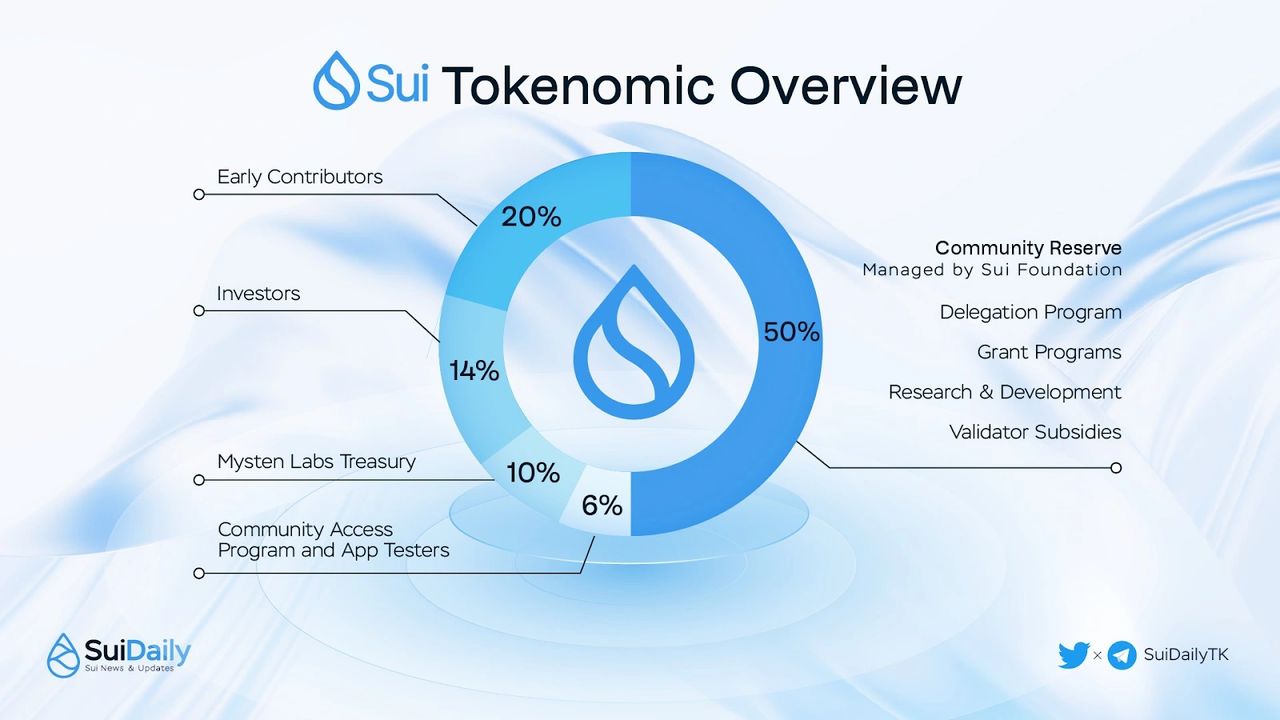
Tokenomics
Sui’s tokenomics explains how SUI tokens are distributed and managed. The total supply is 10 billion tokens, and this number won’t change. At launch in May 2023, only about 5% of the tokens, around 528 million, were circulating.
Today, the circulating supply has grown to roughly 3.08 billion, according to live data from CoinMarketCap. The rest are locked and will be released over time until 2030.
Here’s the breakdown of the initial plan:
- Community Reserve (50% or 5 billion SUI): Managed by the Sui Foundation, this chunk funds grants, research, and validator rewards. It releases slowly to support the network long-term.
- Early Contributors (20% or 2 billion SUI): This goes to Mysten Labs’ team and early workers. Most of it is locked and vests monthly until 2030.
- Investors (14% or 1.4 billion SUI): Big backers like Andreessen Horowitz and Binance Labs got these. They’re also locked, unlocking gradually.
- Community Sale and Launchpool (6% or 594 million SUI): Sold to early supporters and exchange users in 2023.
- Treasury (10% or 1 billion SUI): Held for future use, like emergencies or extra funding.
Utility of SUI: What are SUI Tokens Used for?
SUI tokens are the backbone of the Sui blockchain, handling multiple roles to keep the network running smoothly. They let users pay for services, stake to secure the system, and even vote on its future.
- Gas fees: SUI tokens pay for gas fees, which are the costs of processing transactions on the Sui network. Every action, like sending tokens or running a smart contract, uses a small amount of SUI—often less than $0.01—because of Sui’s efficient design.
- Staking & security: You can stake SUI tokens to help secure the network through a Delegated Proof-of-Stake system.
- Governance: SUI holders can use their tokens to vote on changes to the network, shaping its rules and upgrades. This governance power is tied to staking, so those with more SUI locked up have a bigger say.
- DeFi & liquidity: SUI tokens fuel decentralized finance (DeFi) on Sui, letting users trade, lend, or provide liquidity in pools. Platforms like Cetus use SUI for swaps and staking.
- NFTs & gaming: SUI powers NFTs and gaming on the blockchain thanks to its object-centric model and low fees. Developers mint and trade unique digital items – like art or game assets – using SUI, with transactions settling in under a second.
Sui crypto offers an exciting option for investors and blockchain users in 2025. Its fast network, handling up to 300,000 transactions per second, makes it stand out from other blockchains.
Popular DApps like Cetus and DeepBook are building on Sui, which could drive its value higher. Sui might not be the next Solana yet, but its unique features make it worth watching.
Where might SUI sit during this market cycle?
Firstly, due to the big bull market conditions, as a standard feature of big bull markets, SUI will have at least 3 major upward waves in this cycle, similar to ETH in 2017, LUNA and DOT in 2021. However, because this halving cycle sees a more mature overall crypto market, coupled with the approval of Bitcoin spot ETFs and large-scale institutional involvement, this bull market might be a slow bull market. In other words: the duration of the bull market will increase, but the number of dramatic ups and downs will decrease. Therefore, the consolidation time after each upward wave will increase, but the correction range will also decrease.
Bullrun Market Waves
October 2024 – March 2025, as the first major upward wave, this is the time for the crypto market bull run to start and along with other projects SUI’s own ecosystem to enrich, this period will normally see a 1-2 month correction and consolidation, with a minimum correction to around a 50% correction range. We are currently sitting within that phase now.
May 2025 – August 2025, as the second major upward wave, also possibly the time when this halving cycle enters a frenzied phase, SUI might rise from the correction low of $8-10 to between $100-120, a maximum increase of about 14 times over 4 months; at that time, due to the market’s frenzy, the correction and consolidation period might last at least 2 months, with a minimum correction to between $60-72.
November 2025 – December 2025, as the third major upward wave, which might also be the last wave of this halving cycle, the market enters the final sprint stage, but due to SUI’s previous surge, its market cap will already be quite large, so the increase won’t be too significant, possibly rising from the correction low of $60-72 to between $180-200, a 2-3 times increase.
Market developments will be influenced by many factors, including but not limited to: SUI’s own ecosystem building, market FOMO sentiment, regulatory policies, the broader economic environment such as the US Fed’s rate cut pace and global economic conditions, and even potential black swan events. These factors could all disrupt the above predictions and slightly adjust these waves.
Analysts Predict 500% Rallies For Sui, Cardano and Solana Prices As ETF Approval Expected To Speed Up After Crypto Reserve | CoinGape

14. Polygon (MATIC)
Polygon (MATIC) continues to be a key player in the Layer 2 scaling space, driving Ethereum’s scalability. Predictions suggest significant price growth for MATIC, fueled by increasing adoption and ecosystem development.
Polygon (MATIC) has carved a niche, with a significant user base and a thriving ecosystem. As we move through 2025, a burning question grips investors: will MATIC continue its ascent or face a bumpy road ahead?
What Is Polygon (MATIC)?
Polygon is a blockchain network built on top of the Ethereum blockchain. Polygon functions as a sidechain to the Ethereum blockchain. This sidechain architecture offers a layer 2 scaling solution that directly tackles the challenges of scalability faced by the Ethereum network. As a connected sidechain, Polygon interacts with the Ethereum mainnet through a two-way peg, facilitating seamless interoperability between the two systems. Sidechains like Polygon alleviate network congestion and gas fees by processing transactions of the main Ethereum chain, ultimately enabling faster and more cost-effective transactions for users.
To enhance Ethereum’s scalability, Polygon, along with other projects, leverages two distinct layer 2 scaling solutions: Optimistic rollups and ZK rollups. Optimistic rollups operate under the assumption that transactions are valid unless proven fraudulent, utilizing optimistic execution to streamline computational costs.
Conversely, ZK rollups employ zero-knowledge proofs to consolidate multiple transactions into a single, verifiable proof. This approach not only boosts scalability and privacy but also upholds the security of the Ethereum network. These layer 2 solutions play a critical role in optimizing Ethereum’s transaction throughput and minimizing fees, paving the way for a more efficient and user-friendly experience within the realm of decentralized applications (dApps).
MATIC is the native cryptocurrency of the Polygon network. Think of MATIC as the toll you pay to use the faster lane on the highway (Polygon network). Users pay transaction fees and participate in network governance by using MATIC tokens.
Essentially, Polygon (MATIC) provides a smoother and more affordable way to interact with the Ethereum blockchain, making it an attractive option for developers and users. This growing user base and functionality contribute to the potential value of MATIC as a crypto asset.
Will Polygon Go Past All-Time Highs?
The all-time high for Polygon (MATIC) was $2.92, achieved on December 27, 2021. Experts suggest that MATIC may surpass this previous all-time high by around 2030, but several hurdles could impact this growth trajectory.
Firstly, Polygon faces stronger competition from newer layer 2 solutions like Optimism (OP) and Arbitrum (ARB). With significant potential for growth in the upcoming bull run which of these will outperform the other? The strong market sentiment, positive technical analysis and recent price gains position Optimism and Arbitrum as formidable contenders, potentially overshadowing Polygon’s market share.
Moreover, issues such as transaction execution failures, reported on platforms like Reddit’s r/ledgerwallet and the Polygon Community Forum, could undermine investor confidence. Additionally, broader market dynamics, including regulatory challenges and fluctuations in investor sentiment, might hinder MATIC’s ability to reclaim its previous highs.
Despite these challenges, Polygon’s layer 2 solutions, along with its dominance in decentralized finance (DeFi) and non-fungible tokens (NFTs), provide a solid foundation for future growth. The recent launch of Polygon AggLayer, a protocol connecting Layer 2 chains within the Polygon network, could serve as a significant catalyst. This interoperability protocol, first used by Astar zkEVM on February 23, 2024, enhances liquidity and chain interaction, potentially boosting MATIC prices. While Polygon has solid fundamentals and innovative advancements like the AggLayer, reaching its all-time high again will require overcoming substantial competition and market challenges.
Polygon (MATIC) reached its all-time high of $2.92 on December 27, 2021. This peak reflects substantial growth and heightened market interest in the platform’s capabilities.
Currently, the price is significantly lower at $0.6942 indicating potential room for growth. The lowest recorded price for MATIC was approximately $0.003012 on May 10, 2019. Compared to this all-time low, the current price is about 17,163% higher, showcasing the significant appreciation in value over the years.
Despite the recent fluctuations, Polygon has shown resilience and a promising potential for future growth. Its focus on enhancing scalability and reducing transaction costs on the Ethereum network positions it well to capitalize on the increasing demand for efficient layer 2 solutions. ADA, SOL, ARB, OP, AVAX and NEAR are the projects on MATIC’s list of major competitors.
This strategic focus is crucial as the Ethereum network faces congestion and high transaction fees. In terms of competition, Polygon faces significant challenges from other layer 2 solutions such as Optimism and Arbitrum. These platforms also aim to improve Ethereum’s scalability and transaction throughput, positioning themselves as key competitors.
Many analysts predict that Polygon’s price may reach an average of $1.61 by 2026, rising to $3.17 by the end of 2025 narrowly surpassing its previous ATH. Additionally, projections that by 2030, Polygon could reach $6.14, representing a significant increase compared to its current value.
However, these prices may only be achievable if Polygon (MATIC) becomes the dominant scaling solution or liquidity layer for Ethereum.
15. AVAX
While the Avalanche ecosystem has been making strides, the AVAX price has left investors particularly questioning its trajectory. Will AVAX go up? Is AVAX a good investment? Let’s explore these and more.
AVAX is correcting from its highest last year; the crypto market capitalization is also bearish. The drop in AVAX value could be attributed to the general market sentiment.
As 2025 unfolds, we anticipate it will trade between $19.06 and $36 USD. AVAX will likely trade higher in the years to come. However, factors like market crashes or difficult regulations could invalidate this bullish theory. Chart analysis suggests that Avalanche is recovering and currently gearing up for a closer move to $27 USD despite the overall momentum remaining bearish.
Recent news
A district administration for a town in India, Dantewada District Administration of Chhattisgarh, has digitized all land records dating back to the 1950s and stored them on the Avalanche blockchain in a move toward tamper-proof and transparent land governance.
The Avalanche Foundation and Rain, a Visa Network issuer, have introduced the Avalanche Card, allowing users to spend cryptocurrencies like USDC, USDT, AVAX, and wAVAX wherever Visa is accepted. This card provides a way to use digital assets for everyday transactions, making cryptocurrency spending as straightforward as traditional fiat payments.
This development is part of a larger trend of bringing blockchain technology into mainstream financial services. It gives users more ways to manage their crypto holdings.
It’s news like this and adoption of this nature that can propel AVAX and other projects significantly higher over time.
A History of AVAX
- In July 2020, Avalanche completed its public sale, raising $42 million in less than $4.5 hours. The tokens were distributed after the mainnet launch in September.
- On Dec 31, 2020, it fell to an all-time low of $2.788.
- In September 2021, the Ava Labs Foundation received a $230 million investment from Polychain and Three Arrows Capital Group by purchasing the AVAX cryptocurrency.
- In November 2021, following an agreement with Deloitte to improve US disaster relief funding, AVAX moved to the top 10 cryptocurrencies by market capitalization. At that time, AVAX moved to its all-time high at $146.22.
- In Aug 2022, whistleblower ‘crypto leaks’ published a report accusing Ava labs of secret deals with a law firm to destabilize its competitors. Ava Labs CEO Emin Gün Sirer denied any dirty deal with Roche Freedmen law firm.
- In 2023, AVAX maintained a bullish trend between January and May, after which bears overwhelmed the market. It resumed the positive momentum in October, rising to $49.96
- In 2024, it crossed the $60 mark in March.
- The rise coincided with a record high in AVAX inscriptions, with over 100 million ASC-20 minted since their introduction in June 2023.
- The uptrend reversed in April 2024; by July, it had fallen to $24.40. In August, it was at $21, and in September and October, it was at $27.
- It turned bullish in November 2024, rising from as low as $23 to as high as $55 in December.
- It later corrected and traded at $42 into 2025. The drop continued into January, and by March, it had fallen below $22.
Currently trading at around $18.77 USD AVAX represents good value, While it may not appear to be able to reclaim its ATH this cycle it could prove possible by the following cycle and this would represent a great opportunity to pick up AVAX during the dips and hold AVAX for the longer term gains.
While its competitors may see larger gains this cycle Avalanche (AVAX) is an established project and sits in the top 30 by market cap. The coin is expected to make significant gains in the long term, making it a good investment. With the right market conditions during this Bullrun we may see AVAX exceed our expectations, but as an established project holding it for the longer term could prove extremely beneficial as the crypto market evolves and grows and the overall crypto market cap increases in coming cycles.

16. ARB
Arbitrum (ARB), which has been the target of criticism since its launch, may make a name for itself in the coming days. The lack of interest in Tier-2s and Ethereum’s performance below expectations dragged Arbitrum into the bear market. After reaching $ 2.5, the ARB price fell to $ 0.32 with a downtrend.
With a market capitalization of $1.4 billion, Arbitrum has close to $2.5 billion in total assets locked (TVL). According to experts, Ethereum will lead the next bullish cycle, and Ethereum’s largest companion project, Arbitrum, will also take center stage. Expectations are for ARB to regain $0.45, a scenario that could take the popular cryptocurrency to $1.
Arbitrum (ARB) Surges After Robinhood Listing
Arbitrum saw a price surge after being listed on Robinhood. This listing boosted interest and demand for the Ethereum Layer-2 scaling solution.
The Robinhood listing is a major milestone for Arbitrum, giving it exposure to millions of retail investors
Robinhood marks a major step for crypto adoption. Investors now have more access to ARB, just like Bitcoin (BTC) and Ethereum (ETH). Market experts see this as a strong signal of growing institutional and retail interest in Layer-2 solutions.
Crypto analysts believe ARB’s price rally is directly linked to the Robinhood listing. More retail investors can now trade the token without high fees. The listing highlights Robinhood’s increasing focus on crypto assets and the future growth of Arbitrum.
ARB Price Surges More Than 12% After Robinhood Listing
What is ARB crypto: Arbitrum is a Layer-2 scaling solution for Ethereum. It helps improve Ethereum’s speed and lower transaction costs by processing transactions off-chain using Ethereum’s security. This makes it faster and cheaper than using Ethereum directly.
With its innovative Optimistic Rollups technology, Arbitrum has been driving scalability and efficiency on the Ethereum network while maintaining its decentralized nature.
The ARB token is the governance token of the Arbitrum network. Holders can vote on proposals that shape the future of the platform. While ARB itself is not required for transactions, it plays a key role in the decentralized decision-making of the network. A few days ago, Berachain surpassed ARB in the DeFi space, but now ARB is regaining momentum and performing strongly once again.
Arbitrum’s Current Market Position
Arbitrum’s total value locked (TVL) currently sits at over $3.25 billion, highlighting the platform’s strong presence in the decentralized finance (DeFi) ecosystem. The recent introduction of the BOLD testnet, set to enable permissionless validation, could significantly enhance the network’s decentralization and scalability, providing further growth opportunities for the ecosystem. As Layer 2 solutions gain traction, Arbitrum stands out as a major player, with a user base eager to benefit from its low fees and fast transaction speeds.
While Arbitrum has faced challenges with its price, its long-term future looks promising. With continuous technical improvements, strong DeFi integration, and growing adoption, Arbitrum is poised for sustained growth. Its price could reach new heights, with analysts predicting it will approach $5 by 2030. For investors looking to diversify their portfolios in the evolving blockchain space, Arbitrum offers a solid investment opportunity with considerable upside potential. It is within a very competitive space, who will win the battle of the Layer 2’s?
17. ETC
Ethereum Classic (ETC) is a blockchain-based platform for running smart contracts and decentralized applications. It operates on a decentralized network, meaning no single entity controls it. Smart contracts on Ethereum Classic execute automatically when conditions are met, allowing various applications to function without intermediaries.
The platform maintains its original blockchain structure after a major split from Ethereum in 2016. It continues to support decentralized applications and aims to provide a secure and censorship-resistant platform.
Its total market value is $3 billion, making up 0.10% of the total cryptocurrency market. ETC tends to be very stable in the market and have high liquidity levels. ETC is one of the premier blue-chip cryptocurrencies, indicating strong potential for sustained growth.
ETC is an extremely stable coin to mine and like Scrypt mining it performs well throughout bear markets and bull markets with sustained mining profitability.
Ethereum Classic has long been a more affordable alternative to ETH. With Ether transitioning to a Proof-of-Stake model, those favoring Proof-of-Work networks shifted their interest to Ethereum Classic.
Ethereum Classic is not viewed as an unregistered security, which is positive for its market standing. As a result, ETC is a good investment option in the long term.
ETC price might soon reach the $100 mark if the buying demand surges and Ethereum Classic attracts altcoin investors. It has the potential to achieve $40-55 USD in the short term. ETC’s All Time High of $ 167.47 on 6 May 2021 could be retested under the right market conditions this cycle with a longer range forecast to exceed a price point of between $250-350 USD by 2030. These predictions reflect varying expert opinions and market conditions.
Investing in and mining the longer-term projects such as ETC can be a wise move for reliable longer-term gains with less exposure to market volatility.
18. LINK
Chainlink (LINK), one of the top blue-chip cryptocurrencies, has crashed by double digits from its December highs. This drop is primarily because of the ongoing crypto sell-off. Still, the Chainlink price may bounce back over time, helped by a $350 trillion opportunity sported by Sergey Nazarov, its founder. Also, Chainlink is about to start a trial with SWIFT, and is part of the holdings by the US government.
Chainlink, the 14th-largest digital asset, dropped 9.55% on March 11. The decline comes amid a 28.64% increase in trading volume, signaling heightened seller activity.
With a market cap of $8.16 billion, LINK has already suffered a substantial 31% decline over the past month, according to CoinMarketCap. Despite this downturn, the cryptocurrency’s weekly chart has formed a major bullish pattern.
Megaphone Pattern Hints at a 300% Rally
On the weekly chart, Chainlink has formed a megaphone pattern—a broadening wedge characterized by two ascending and diverging trendlines.
The upper boundary connects LINK’s higher highs since November 2022, while the lower boundary links its lowest points since July 2023. Historically, this pattern often leads to a powerful rebound once the price reaches the lower support zone.
Currently, LINK is approaching the lower boundary of this megaphone formation. If the pattern holds, a sharp rebound could drive the price toward the resistance at the $30 price level, which coincides with the 50% Fibonacci retracement level.
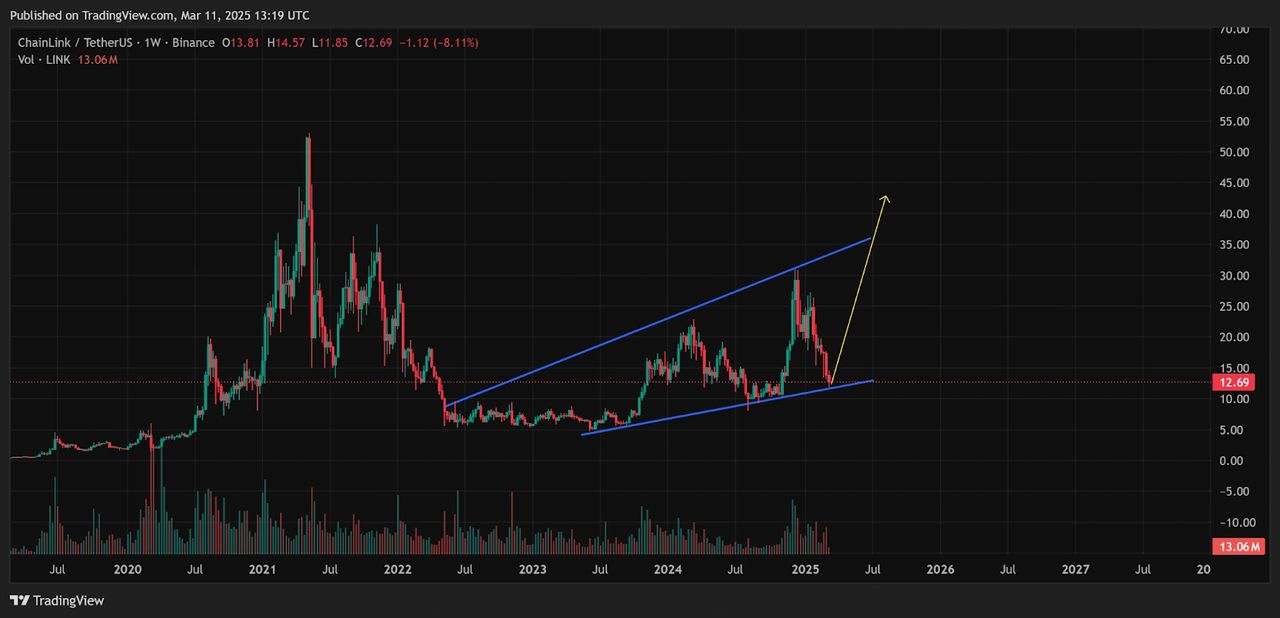
A breakout above this resistance would pave the way for a surge toward $45—a 300% rally from current levels.
However, a breakdown below the lower boundary would invalidate this bullish thesis, pushing LINK toward critical support at $5.57, a historically strong level between 2022 and 2023.
Chainlink Under the Trump Administration
Arkham data reveals that wallets linked to the United States government hold over $1.28 million worth of LINK.
United States President Donald Trump earlier announced that the US Crypto Reserve would include all the digital assets that the government has seized over the past few years.
Trump has focused heavily on “Made in America” cryptocurrencies, and LINK stands to gain a lot under his administration. Chainlink co-founder Sergey Nazarov recently attended Trump’s White House Digital Asset Summit.
Nazarov praised Trump’s crypto-friendly approach and emphasized the need for the US to lead the next evolution of the financial system through blockchain and Web3 infrastructure.
Crypto trader Nicu shared that insiders believe Chainlink’s Proof of Reserves technology is being integrated into the proposed strategic reserve. If true, this would mark a major milestone for the blockchain verification sector, enhancing transparency and security for national holdings. Such a development could send LINK’s price soaring.
Sergey Nazarov, Chainlink’s founder, believes that the oracle network will play a role in the future of finance. This industry will marry the blockchain technology with traditional finance, creating a $350 trillion opportunity. He said:
“We don’t want our industry to be about $3.5 Trillion. We want it to be about $35 Trillion, and eventually $350 Trillion. To do this at this stage of the game, generating crypto tokens will benefit and do some of that, but won’t take us to $10 trillion. What will take us there is if all regulated asset value come together. Chainlink as a technology stack will be important for implementing that flow of value.”
Chainlink is already working on large industries. For example, it is already working with SWIFT Network, a society that moves transacts over $150 trillion annually. The two entities will conduct a vendor system test on May 2nd and a pilot system on July 19. UBS, the biggest wealth manager globally, is part of this Chainlink and SWIFT pilot. After that, they will release the MX standards in November.
SWIFT hopes that using blockchain technology will be an essential part of the financial services in the future.
Link is definitely one project worth holding in your bags!
19. Pi
Pi Network (PI) is making waves in the crypto community with its explosive growth and increasing adoption. The popular cryptocurrency, which has been a hot topic due to its unique mining model and closed mainnet, is now gaining an unprecedented following on the X social media platform. The cryptocurrency is also rivaling top meme coins like Dogecoin (DOGE), quickly approaching the size of the meme coin’s loyal fanbase.
Pi coin is the native cryptocurrency of the Pi Network, a blockchain project designed to make mining accessible through mobile devices. Users can mine Pi coins by tapping a button in the Pi Network app every 24 hours, and the mining rewards follow a declining exponential issuance model to balance growth and scarcity. The total supply of Pi coins is capped at 100 billion.
PI Network Closes In On Dogecoin With 4 Million Followers On X
Pi Network has achieved an incredible milestone by reaching 4 million followers on X, signaling a significant step forward in its rapid rise within the crypto market. This rapid growth and adoption positions the cryptocurrency on the verge of matching or even surpassing the social media presence of Dogecoin which has 4.3 million followers on X.
Pi Coin has made a dramatic entry into the list of top 12 largest cryptos by market cap after recording a significant surge of 23% in the last 24 hours. According to our market data, the asset is making a surprising attempt to overturn the 11% loss recorded on the weekly price chart. Meanwhile, the asset has moved from its daily low of $1.3, recorded in our recent analysis, to turn the $1.7 resistance level into support.
Amidst the backdrop of this bullish run, Pi Network is reported to be making a groundbreaking decision to implement a price-pegging mechanism. Technically, this is achieved by fixing the price of a token to another token or a basket of tokens at a specific rate to reduce volatility and provide stability.
According to the available information, the Pi community has discovered a smart contract code linked to Chainlink. This implies that the team may be planning to stabilize the asset’s value through an automated minting and burning system. Interestingly, this approach is similar to the mechanisms used by stablecoins like USDC and USDT.
While the PiCoreTeam has not yet confirmed the pegging mechanism, market analysts have speculated that this implementation could cause the asset to be widely integrated and adopted into various financial systems. Meanwhile, this algorithmic pegging system would demand that additional tokens be minted whenever the price falls below the target. On the other hand, additional tokens would be burnt whenever the price exceeds the target.
63% of Pi Network users have their coins locked up till 2027 – This may bode well to assist in keeping Pi prices higher during this Bullrun phase. We will likely see a dip in 2027 when the users have the coins unlocked and begin cashing them out.
Pi Network crashed after the mainnet launch, leading to a $6 billion wipeout in the first two days. Historically, most pre-mainnet launch token holders sell them as soon as possible to prevent further losses.
Many newly launched tokens crash
Further, Pi Network price crashed because many recently-launched tokens have crashed. For example, a high-utility token like Wormhole initially peaked at $1.6 after its airdrop in April last year and has crashed to $0.18.
Similarly, ZKsync price soared to $0.2942 after its airdrop and then dropped to $0.1. Eigenlayer, another blue-chip coin, dropped from $5.6 in 2024 to $2.
Most recently, Official Trump and Melania meme coins have plunged by over 80% from their peak.
Pi coin price crashed as cryptocurrencies dived
Further, the Pi Network price crash accelerated because of the ongoing weakness in the crypto industry. Bitcoin price remains in a correction after falling by 10% from its all-time high. Other altcoins like Ethereum, Cardano, Algorand, and Near have also pulled back by double digits from their November highs.
Pi Network has about 100 apps on its network. A strong user growth for some of these apps may be a good catalyst for the price.
Since its inception in 2019, Pi Network has captured the attention of crypto enthusiasts, offering user-friendly and mobile-based mining services. This mining activity clearly contrasts with traditional cryptocurrencies like Bitcoin, which require high-powered hardware for mining.
To commemorate its massive growth, the team behind Pi Network took to X on March 5 to announce its milestone of reaching 4 million followers on X. They congratulated community members and PI enthusiasts who helped support the cryptocurrency in hitting this goal.
In addition to its growing adoption on X, Pi Network has become one of the trendiest cryptocurrencies in the market. While other top digital assets struggle with the broader market volatility and experience price declines, the value of PI is surging at an unexpected rate. CoinGecko has ranked PI Network as the number one trendy cryptocurrency in its top 20 list. The popular cryptocurrency has surpassed top dogs like Dogecoin, Ethereum, Cardano, Solana, XRP, Bitcoin, and other major digital currencies.
CoinMarketCap also ranks Pi Network as the 11th largest cryptocurrency by market capitalization, just two positions from Dogecoin’s 9th. This rapid growth to the 11th position underscores PI’s impressive growth in just a few weeks.
Community Advocates For Binance Listing For PI
Rumors of a potential PI Network listing on Binance, the largest crypto exchange, have been spreading across the crypto market. This speculation grows as the crypto community pushes for this integration on Binance.
Pi Network to Unlock 188 Million Tokens in March
Pi Network is planning to unlock 188 million tokens in March, making them accessible to over 1 million users. This is a substantially larger user pool than most months.
Pi Network is one of the most hyped crypto projects in recent times. Since its mainnet launch on February 20, PI surged nearly 100%, hitting a peak of $2.99 before seeing corrections. At the same time, it’s gaining recognition from the wider community despite earlier criticism.
A week ago, CoinMarketCap refused to update its market cap, but the platform reversed this stance yesterday. PI is now the 11th largest cryptocurrency in the market, ahead of Hedera, Chainlink, Stellar (XLM), and other notable names.
Pi has seen an impressive entry into the market after a slow and steady build. It’s a massive project in ASIA and with such a large population we could really see this coin hold and grow its market position.
A token unlock of this size is bound to have an impact on Pi Network’s price. Recently, the project launched the biggest airdrop in crypto history, which helped juice enthusiasm.
ExplorePi data shows that there are currently more than 11.5 million Pioneer accounts. However, 7.25 million (63%) accounts lock PI for three years, and 1.6 million accounts (14%) lock PI for one year.
Therefore, the selling pressure on Pi Network may not take effect immediately, even with this massive user pool.
I suspect we will see further declines in Pi’s price over the coming weeks and this will present great opportunities to buy in while the price is low. If we see more major exchanges listing Pi there is no doubt that we will see its price surge during this cycle.
Pi is a new digital currency developed by Stanford PhDs, with over 55 million members worldwide. To claim your Pi, follow this link https://minepi.com/RustyRigs77 and use my username (RustyRigs77) as your invitation code.
You can also buy Pi on Coinspot Australia.
https://www.coinspot.com.au/join/REF3PXBV3
20. ZEC
Zec rounds out my top 20 and holds this place as one of the leading privacy coins. I have written about Zec in the past and this is a coin that Andy and I were mining quite heavily back in the day. We have since moved on to place our hashrate into other projects but it is a project that may warrant us to re visit.
Zcash, a pioneering cryptocurrency, stands out in the digital landscape for its uncompromising commitment to privacy and security of transparent transactions. Founded in 2016 by Zooko Wilcox-O’Hearn, Zcash implements zk-SNARK (“Zero-Knowledge Succinct Non-Interactive Argument of Knowledge”) technology to offer users the option of ‘shielded’ transactions, which protect the privacy of the sender, receiver, and transaction amount.
This level of privacy distinguishes Zcash from other cryptocurrencies like Bitcoin and Ethereum, which are pseudonymous but not entirely anonymous. As the digital currency landscape continues to evolve amidst fluctuating market dynamics and regulatory shifts, Zcash’s unique privacy features make it a significant subject of interest for investors and users who prioritize transaction anonymity.
What is the future of Zcash?
Zcash (ZEC) has a promising yet uncertain future, influenced by adoption, regulation, and market trends. As a privacy-focused cryptocurrency, it appeals to users seeking anonymous transactions, but increasing regulatory scrutiny could limit its availability. The coin’s success depends on broader crypto market sentiment, competition from other privacy coins like Monero, and ongoing technological upgrades such as Halo. If ZEC gains institutional interest and expands into decentralized finance (DeFi), it may sustain long-term growth. However, regulatory restrictions and evolving blockchain innovations could pose challenges. Its future hinges on balancing privacy features with compliance and usability in the crypto space.
Zcash (ZEC) could be a promising investment due to its advanced privacy features, including zero-knowledge proofs that enhance transaction confidentiality. Its value proposition lies in offering secure and private transactions, which is appealing to privacy-conscious investors. However, potential investors should consider Zcash’s market performance, regulatory risks, and ongoing development. Analyzing these factors and aligning them with personal investment goals and risk tolerance is crucial before deciding to invest.
The Zcash price is forecast to reach between a minimum of $51.47 a maximum of $59 USD very soon. With a price target above $1000 by 2030 Zcash could be a very sound investment.
Zcash (ZEC) has the potential to recover and surpass its previous highs, but its trajectory depends on multiple factors, including market trends, regulatory developments, and technological advancements. The broader cryptocurrency market’s performance, particularly Bitcoin and major altcoins, will influence ZEC’s price movements.
Additionally, growing adoption of privacy-focused transactions could drive demand, while regulatory scrutiny remains a major risk. If Zcash continues to innovate with upgrades like Halo and expands its use cases in DeFi, it may regain lost value. However, competition from other privacy coins like Monero and shifting investor sentiment will determine whether ZEC can stage a significant long-term recovery.
In a world where pseudonymity is gold, there’s some serious value in anonymity. Zcash allows users to choose between transparent (pseudonymous) and shielded (anonymous) transactions. The network uses famed zero-knowledge proofs, a secure form of cryptography that establishes credibility without revealing identity.
ZEc is a great alternative to Monero XMR and comes at a significantly lower price point. This may bode well for an increased adoption and uptake of the coin through this cycle, propelling the coin back toward its previous ATH.
There is a lot to like about ZEC
- It is a secure blockchain where the network is safeguarded by PoW consensus.
- With exchanges like Paxful coming down heavily on the PoS giants like Ethereum, PoW might still go the distance. This is speculative, though.
- Miners helping with the network security get the rewards, and some part goes to the ecosystem for further development.
- It uses Bitcoin’s original codebase and is open-source.
- Anonymity is achieved using zero-knowledge proofs.
- Zcash has a lot of trusted organizations and individuals invested in it. It is a secure blockchain where the network is safeguarded by a decentralized PoW consensus.
There is a high probability that if the market conditions play out this cycle we could see a ZEC price between $400-500 USD. This would set the scene well for the following cycle 2029/30 where ZEC sits comfortably above $1000 USD and on its way toward $3500 USD for the 2033/34 cycle top.
And one more ALEO, From one Privacy coin to another. I haven’t touched on this coin yet, it’s a very new project, which could provide some great potential over this and the next cycle for some explosive growth. Aleo is a unique project which is both PoW and PoS. So you can mine it and stake it!
Aleo mainnet launched in September 2024. Aleo is a privacy-focused Layer-1 blockchain that uses zero-knowledge proofs (ZKPs) to enhance privacy, security, and scalability. Aleo employs a unique consensus mechanism called AleoBFT.
Team Background
The Aleo team comprises seasoned professionals with experience from renowned companies such as Google, Amazon, and Facebook, as well as prestigious academic institutions like the University of California, Berkeley, Johns Hopkins University, New York University, and Cornell University. The team includes world-class cryptographers, engineers, designers, and operations experts. Founded in 2019, Aleo’s current Chief Technology Officer, Howard Wu, co-authored a foundational paper titled “Zexe: Enabling Decentralized Private Computation,” which explores the application of zero-knowledge technology in Web3. The company’s CEO, Alex Pruden, is a former partner at a16z (Andreessen Horowitz).
Background
As public concern over data storage and security grows, public and private entities urgently need effective online verification mechanisms to safeguard information. However, these organizations also encounter increasing security threats when protecting data. Statistics from 2022 indicate that, on average, one in every 40 organizations experienced a ransomware attack, with the frequency of such attacks continually rising.
In response, the United States, the European Union, and other countries have implemented relevant laws and regulations. While these measures have contributed to data protection to some extent, the risk of data breaches remains persistent. This necessitates continuous investment in data security by organizations, placing significant pressure on them. Both everyday users and governments or enterprises providing digital services are actively seeking a more secure and reliable digital environment.

What is Aleo?
Aleo is a Layer 1 privacy blockchain project based on zero-knowledge proofs, designed to provide developers with a platform for building private and verifiable decentralized applications. Utilizing zero-knowledge proofs, Aleo effectively safeguards user privacy by concealing participant identities, transaction amounts, timestamps, and smart contract interaction details. Users can choose to exit the privacy mode, deciding independently which information to disclose or hide, thus ensuring control over personal data.
Moreover, Aleo leverages zero-knowledge proofs to offload smart contract execution off-chain, supporting a variety of decentralized applications with high transaction throughput (TPS). Compared to other blockchains, Aleo boasts significant advantages in privacy protection and on-chain scalability. It effectively addresses the limitations of current blockchain smart contracts, such as the privacy loss caused by full transparency, scalability challenges for large user bases, and the inability to support real-time online interactions. Aleo can process massive data in real-time, addressing current internet data leakage issues while compensating for blockchain’s shortcomings in data transparency.
Technical Advantages of Aleo
Aleo is a privacy-centric blockchain platform that offers several key technical advantages:
- Performance Advantage: Aleo employs zero-knowledge proof encryption technology to offload smart contract execution off-chain. This enables the support of fully private and highly scalable decentralized applications, capable of processing thousands of transactions per second.
- Scalability: By developing an optimized blockchain architecture, Aleo enhances scalability and increases Ethereum’s flexibility. Miners are only required to verify the correctness of transactions without re-executing each one, thereby improving overall network efficiency.
- Programmability: Aleo provides a full-stack zero-knowledge proof solution, allowing applications to achieve programmability at all levels.
- Ease of Use: The Aleo platform offers end-to-end development tools that support the development, deployment, and continuous operation of privacy-preserving applications, thereby reducing development complexity.
- Privacy Protection: Aleo can prove asset ownership and addresses privacy issues associated with transaction transparency on blockchain platforms like Bitcoin.
- Security: Built on cryptographic designs using zero-knowledge proofs, Aleo establishes secure, compliant, and fair network standards.
- Economic Model: Aleo has established a stable token economy and predictable pricing mechanism, providing a robust foundation for next-generation computing based on zero-knowledge proofs.
- Programming Language: Aleo developed the Leo programming language, which simplifies the development and integration of applications. Developers can write and manage private files more intuitively.
- Cost Advantage: Transaction fees on the Aleo network can be calculated in advance, with each transaction bearing only the cost of zero-knowledge proof verification. This significantly reduces transaction fees and enhances TPS.
Aleo are building a blockchain network that balances privacy, security, and transparency, offering both privacy and limitless scalability.
Funding Institutions
- Series A Funding: Aleo secured $28 million in Series A funding, led by Andreessen Horowitz (a16z), with participation from PlaceHolder VC, Galaxy Digital, Variant Capital, and Coinbase Ventures.
- Series B Funding: The company raised $200 million in Series B funding, co-led by Kora Management LP and SoftBank Vision Fund 2, with additional investments from Tiger Global, Sea Capital, Samsung Next, Slow Ventures, and Andreessen Horowitz (a16z).
- Series B+ Funding: Aleo raised an additional $70 million in Series B+ funding. The involvement of these prominent investment institutions provides robust support for Aleo’s technological development, ecosystem construction, and market expansion.

Application Areas
Aleo’s applications span a wide range of sectors, including decentralized finance (DeFi), non-fungible tokens (NFTs), GameFi, decentralized autonomous organizations (DAOs), and social finance (SocialFi). The platform aims to address issues of information leakage and data privacy, striving to build a truly personalized and privacy-preserving network.
Wallet Applications
LeoWallet
An official wallet project emphasized by Aleo, LeoWallet integrates zero-knowledge proof technology, allowing users to easily create highly confidential proofs directly in their browsers, ensuring complete information confidentiality. In June 2023, the project secured $4.5 million in funding to advance the development of zero-knowledge blockchain infrastructure.
FoxWallet
As Aleo’s first decentralized mobile wallet, FoxWallet supports private transactions and secures them through local private keys. It is the world’s first wallet to support Aleo’s public transfers, join, and split records.
Domain Name Service (Aleo Name Service, ANS)
Users can register memorable domain names for their blockchain addresses, facilitating identity recognition and asset management in the blockchain environment. This feature transforms complex addresses into easy-to-remember names, simplifying and securing user interactions.
Decentralized Finance
ZeFi: Utilizing zero-knowledge proof technology, ZeFi protects user privacy while offering decentralized financial services, including lending, trading, and asset management. The platform aims to provide users with more secure and convenient financial options. On ZeFi, users’ transaction records and identity information are encrypted, ensuring the inviolability of personal privacy.
ZeFi also balances regulatory compliance by allowing regulatory bodies to access necessary transaction information when required, enhancing user trust in financial services, and offering new compliance solutions for the financial industry.
Tools
Obscura: This platform provides direct RPC endpoints, APIs, and SDKs to simplify application development on Aleo and reduce zkDApp setup time.
Staking.xyz: Aleo’s official staking portal, where users can manage and monitor staking positions, receive updates, and detailed reports on validator performance.
Additionally, the Aleo ecosystem includes other projects such as the official identity verification protocol Zpass, which uses zero-knowledge encryption for secure online data sharing, and Bandio, a children’s privacy protection project aimed at providing a safe internet experience without compromising parental and child privacy.
Tokenomics
The core of the Aleo network lies in its community members who are committed to learning, building, and believing in the power of zero-knowledge proofs (ZK), with the goal of creating a more secure and private world.
What is the Aleo Token?
The Aleo token is the native asset of the Aleo network. Holders can use the token to pay service fees to various institutions, companies, or individuals for transaction services.
Why are Tokens Needed?
- Security Assurance for Users and Developers: Tokens enable users and developers to benefit from secure verification and data services.
- Compensation Mechanism for Service Providers: Service providers can receive compensation for their limited time and computational resources.
- Abuse Prevention: The Aleo network is a competitive and mutually beneficial ecosystem. The token design aims to prevent spam and malicious use, such as bot attacks.
Token Utility
Aleo tokens serve multiple purposes within the Aleo network, including:
- Granting Access: Tokens are used to access block space and computational resources on the network. Users must pay tokens to submit and process transactions.
- Creating Incentive Mechanisms: The protocol rewards provers and validators with tokens to ensure protocol security, incentivizing the establishment of a robust decentralized network.
- Enabling Staking: Tokens can be staked to validators for block generation and network security, with stakers receiving proportional network rewards.
- Driving Governance: Post-mainnet launch, Aleo token holders can participate in decentralized governance, voting on protocol upgrades and changes.
How Does Aleo’s Tokenomics Operate?
Similar to Bitcoin, the Aleo network is secured through economic incentives. At the Token Generation Event (TGE), the total supply of Aleo tokens is set at 1.5 billion. Subsequently, tokens are automatically generated by smart contracts to reward miners and stakers. Specifically, the protocol distributes new Aleo tokens algorithmically to participants who adhere to the protocol. Validators earn Aleo tokens by verifying transactions and creating blocks, while provers earn tokens by contributing computational resources to generate proofs, thereby ensuring the security and efficiency of transactions.
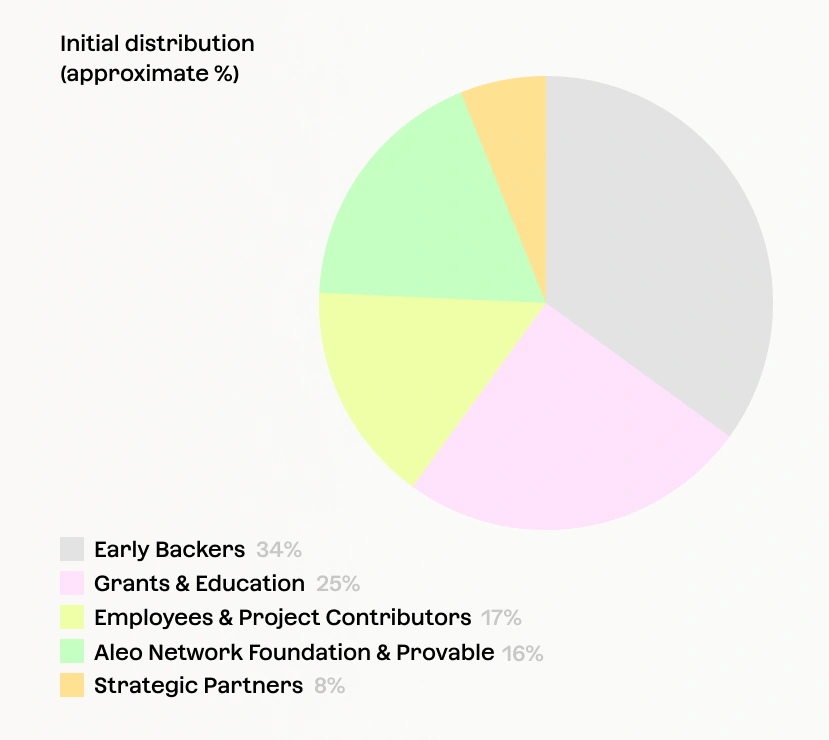
Aleo Token Distribution
The distribution of Aleo tokens is roughly as follows:
- 34% to early supporters
- 25% to fund ecosystem contributors and education
- 17% to employees and project contributors
- 16% allocated to the Aleo Foundation and Provable
- 8% to strategic partners
PoS and PoW Reward Relationship
In the latest incentive adjustments, the Aleo team has modified the reward ratio between Proof of Stake (PoS) and Proof of Work (PoW) protocols. The share of block rewards from mining for validators has been adjusted from 1/2 to 1/3, while validator nodes now receive 2/3 of the block rewards.
During the initial phase of the mainnet, PoW will play a significant role in the Aleo network. However, over time, the block rewards released through mining will gradually decrease, while the weight of block rewards for validator nodes will increase relatively, maintaining a constant issuance of 23 Aleo credits per block.
The following chart illustrates the changes in the amount and proportion of Aleo credits released through PoS and PoW consensus over the next decade:
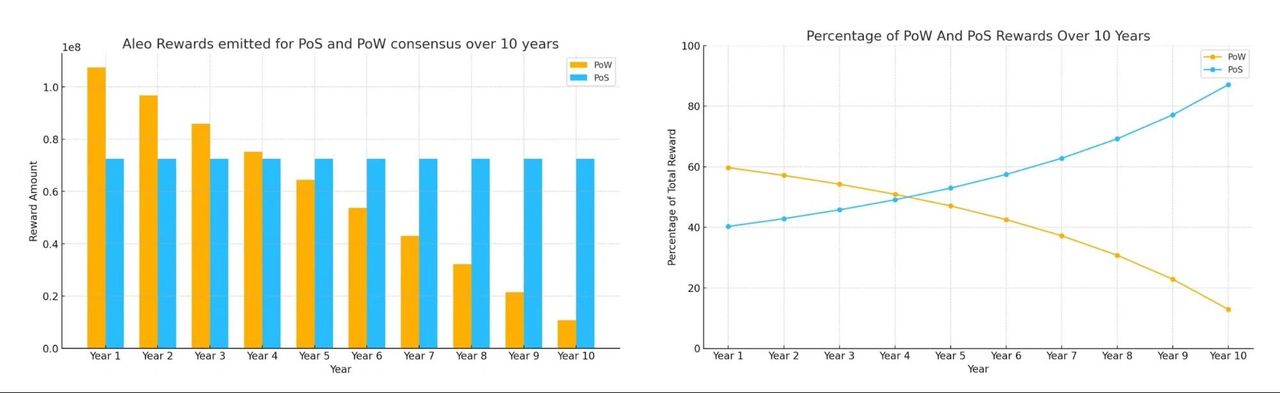
Aleo Launch Ceremony — August 2021
The launch of Aleo is considered a significant milestone in blockchain history. More than 2,200 participants from around the globe collaborated to ensure the security of Aleo’s foundational zkSNARK, laying a solid groundwork for decentralized private computation (DPC) capabilities. This setup bolstered Aleo’s versatility and its internal and external configurations and ensured network security.
Mainnet Launch — 2024
Over the past five years, the developer community has been dedicated to realizing the vision of a zero-knowledge network, with privacy and security as top priorities. The much-anticipated mainnet launch occured in September 2024, marking a significant milestone not only for Aleo but also for the wider Blockchain community.

Aleo: The Privacy-First Blockchain Revolution
Aleo – the next-gen platform blending zero-knowledge magic with developer-friendly tools to build a truly private web.
While Bitcoin and Ethereum expose transaction details, Aleo uses ZK-SNARKs (fancy math that proves you’re honest without spilling secrets). Imagine verifying a password without revealing it – that’s ZK power!
Off-Chain Smarts: Run computations privately off-chain, then validate on-chain. No bottlenecks, no snooping.
Leo Language: Code ZK apps in Leo, a Rust-based language so intuitive even newbies can craft privacy-first dApps.
Hybrid Consensus: AleoBFT mixes Proof-of-Work security with Proof-of-Stake scalability. Validators stake tokens and solve puzzles – double the defense!
ML Without Spying: Train AI models on encrypted data. Banks can assess credit scores without seeing your finances.
Private IDs: Prove you’re human (or a whale) without doxxing yourself.
Silent Finance: Swap tokens, lend assets – all shielded from prying eyes.
Aleo’s ZK proofs can be slow (patience, GPU acceleration is coming!), and learning Leo takes grit. But with a growing toolkit and hungry dev community, this ecosystem is sprinting toward mass adoption.
Aleo’s roadmap? Turbocharged security, Layer-2 scaling, and cross-chain bridges. Whether you’re a coder, miner, or privacy nut – Aleo’s building a web where you control the narrative.
Aleo | Zero-knowledge by design
Aleo was born from a desire to achieve the impossible – to build a user experience on the web that is both truly personal and truly private. Aleo is the first platform to offer fully private applications. Aleo achieves this by leveraging decentralized systems and zero-knowledge cryptography to protect user data on the web.
At its core, Aleo offers users and application developers unbounded compute with absolute privacy. By architecting Aleo as a blockchain that is private-by-default, open-source, and built for the web, we believe Aleo is uniquely positioned to address the shortcomings of blockchain adoption.
With Aleo, users have access to a world of truly personalized web services without giving up control of their private data. Aleo will reshape the role decentralized systems play in our society and introduce new experiences never before seen on the web.
Aleo is truly a next generation crypto and certainly one worth mining and buying as it launches on a growing number of exchanges. Aleo can certainly take some shine off projects like XMR and ZEC but they are more established projects whereas Aleo is new and may take some time to gather the momentum.
The future does look bright for Aleo due to its technological advantages and modern architecture with a hybrid consensus mechanism. I’d certainly be putting this coin in my bag especially at its current prices and its current mining difficulty.
As it’s only listed on a few exchanges currently it is a good time to buy, once it lists on Binance and others such as OKX and Crypto.com, Coinspot, Swyftx etc.. then we will see the coin price climb.
If signing up to Coinbase use this link to receive a bonus
https://coinbase.com/join/ERFQ5AN?src=android-link
You may ask, why have I not included any Ai coins in my list of 20?
Read on, I have covered off Ai coins in a previous Blog, there is a summary of Ai coins further down. If I had to pick one, it would be Fetch but they all have their own unique appeal.
Let’s take a look at some key considerations for crypto projects:
Key Factors to Watch For
Innovation: AI projects that focus on innovative solutions within the AI space will likely attract interest. But beware along with this they will be highly volatile and could see significant losses as market sentiment changes.
Partnerships: Collaboration with established companies can enhance credibility and drive adoption.
Real-World Applications: Tokens with tangible use cases that show how AI can be applied effectively will stand out.
Key Considerations
Community Engagement: Tokens with active and vibrant communities tend to perform better.
Use Case: Look for altcoins with clear utility that solve real problems or improve existing solutions.
Market Trends: Stay updated on cryptocurrency regulations, as they can impact the performance of various tokens.
Some basic categories to consider picking from….
Meme Coins
Dogecoin (DOGE) – The original meme coin continues to have a strong community and endorsements, maintaining its relevance with active social engagement.
VS
Shiba Inu (SHIB) – Gaining momentum with its vast community and ongoing developments, including its decentralized exchange, ShibaSwap.
Innovative Projects
Avalanche (AVAX) – Known for its high throughput and low transaction fees, Avalanche is a decentralized platform that could gain more traction in DeFi and enterprise solutions.
VS
Chainlink (LINK) – As the leader in decentralized oracles, Chainlink is well-positioned to facilitate the linking of smart contracts with real-world data.
DeFi Tokens
Uniswap (UNI) – As a leading decentralized exchange, its governance token continues to attract attention, benefiting from the growth of decentralized finance.
VS
Aave (AAVE) – A top lending protocol that is set to grow as more users seek decentralized financial solutions.
Or possibly Arbitrum…
Layer 2 Solutions
Polygon (MATIC) -With scalability solutions for Ethereum, Polygon is becoming increasingly important, especially as network congestion issues persist. MATIC has become a leading solution for Ethereum scalability, facilitating low-cost transactions and faster processing times. As Ethereum usage continues to grow, demand for scaling solutions like Polygon is expected to increase. MATIC’s ecosystem expansion may lead to substantial price increases as adoption accelerates.
VS
Optimism (OP) – Focused on providing layer 2 scaling solutions for Ethereum, Optimism is gaining traction alongside the growth of decentralized applications.
Privacy Coins
Monero (XMR) – Known for its privacy features, Monero remains a key player as the demand for transaction anonymity grows.
VS
Zcash (ZEC) – Another strong contender in the privacy space, Zcash has seen renewed interest due to regulatory discussions around privacy in crypto.
Or go with one of the new players like Aleo.
Utility Tokens
Binance Coin (BNB) – With multiple use cases on the Binance platform, including trading fee discounts and staking, BNB continues to see strong demand.
VS
Solana (SOL) – As one of the fastest blockchains, Solana is gaining traction in various applications, especially in the DeFi and NFT spaces.

AI coins are rapidly gaining traction and could provide significant profit potential in the altcoin market of 2025. I have covered these off in a blog before but here’s an overview of some noteworthy AI-focused altcoins to consider:
AI Coins
SingularityNET (AGI) – This decentralized platform enables anyone to create, share, and monetize AI services at scale. Its ecosystem is built around facilitating collaboration among AI developers.
Fetch.ai (FET) – provides a decentralized machine learning platform that enables autonomous agents to perform tasks such as optimizing logistics and energy consumption, emphasizing efficiency and reduction of costs.
Numerai (NMR) – A hedge fund utilizing data scientists’ contributions, Numerai allows participants to build machine learning models on financial data, rewarding them with its cryptocurrency based on performance.
DeepBrain Chain (DBC) – This project aims to reduce the cost of AI computing through a decentralized neural network computing platform, enhancing accessibility for AI developers.
Ocean Protocol (OCEAN) – An open-source protocol that facilitates data sharing in a decentralized manner, Ocean Protocol empowers AI and data science communities to access and monetize data.
Cortex (CTXC) – Cortex enables the incorporation of AI into smart contracts, allowing decentralized applications to leverage machine learning algorithms directly on-chain.
With the growing interest in AI technology, these AI coins present a unique opportunity within the broader altcoin market in 2025. As the intersection of AI and blockchain continues to expand, keeping an eye on these projects could lead to fruitful investments. As always, thorough research and due diligence are essential when considering any investment in cryptocurrency, and always tread with caution.
With the altcoin market about to buzz, these tokens listed in this blog present some potential for significant returns in 2025 and possibly 2026 should we see a longer running Bull Market. However, always conduct thorough research and consider your risk tolerance when investing. Altcoin seasons can be volatile, and while opportunities abound, they come with inherent risks. Keep it simple, keep your list of coins in your portfolio small and manageable – Keep to a top 5 or 10, especially as a new investor. More experienced investors may go as high as a top 20 but the more you have the more work it is to watch the signals and pick your exit points.
As spring approaches in the U.S., analysts suggest that the broader cryptocurrency market may be entering a bullish phase. From now until May, many expect a steady increase in altcoin prices, with Chainlink, XRP, and others leading the charge. Speculation surrounding a potential U.S. government-held crypto reserve is adding fuel to the fire as investors bet on its inclusion.
As we look forward to the remainder of 2025’s Bull Run, this next part is where all of the great action happens, several altcoins show strong potential for significant profits. Factors such as technological advancements, market demand, and community support will play a crucial role in determining which altcoins outperform others.
While investing in cryptocurrencies carries inherent risks, thorough research, and staying informed on market trends will empower investors to make educated decisions. As Altcoin Season commences, consider diversifying your portfolio with some of these promising altcoins, especially during these dips, and prepare for potential gains in the exciting landscape of cryptocurrencies as we see the market adjust and more free money flows in over the coming months.
Happy Mining
Rusty Rigs
#crypto altseason
Disclaimer: The content on this site and in this communication should not be considered investment or financial advice. Any investing or crypto mining is speculative. When investing your capital is at risk, please do your own research and invest and make your decisions wisely. Mining profits are not guaranteed and may vary over time depending on the market performance and network hashrates.