February Crypto Market Wrap


Another month in crypto… are you not entertained? Tariff scares, Bybit getting hacked… While the market initially seemed unmoved, it crashed only days after the hack.
February 25 saw the largest outflow of the Bitcoin ETFs since their launch. What to make of this? Are we still in a bull market, has it even begun or did we miss it? Let’s dive in to examine the crypto market February 2025.

The crash was not related to the Bybit hack. It appears that the crypto market simply needs a new narrative. Trump in office hasn’t resulted yet in spectacular new policies such as a strategic Bitcoin reserve. In lack of a catalyst, the prices started rolling over and then collapsing.
BTC saw a 18% drop on the monthly chart, the largest percentage drop since May/June 2022.
This poses the question: are we still in a bull market? Judging by the sentiment, you would think otherwise. The fear and greed index is at capitulation levels.
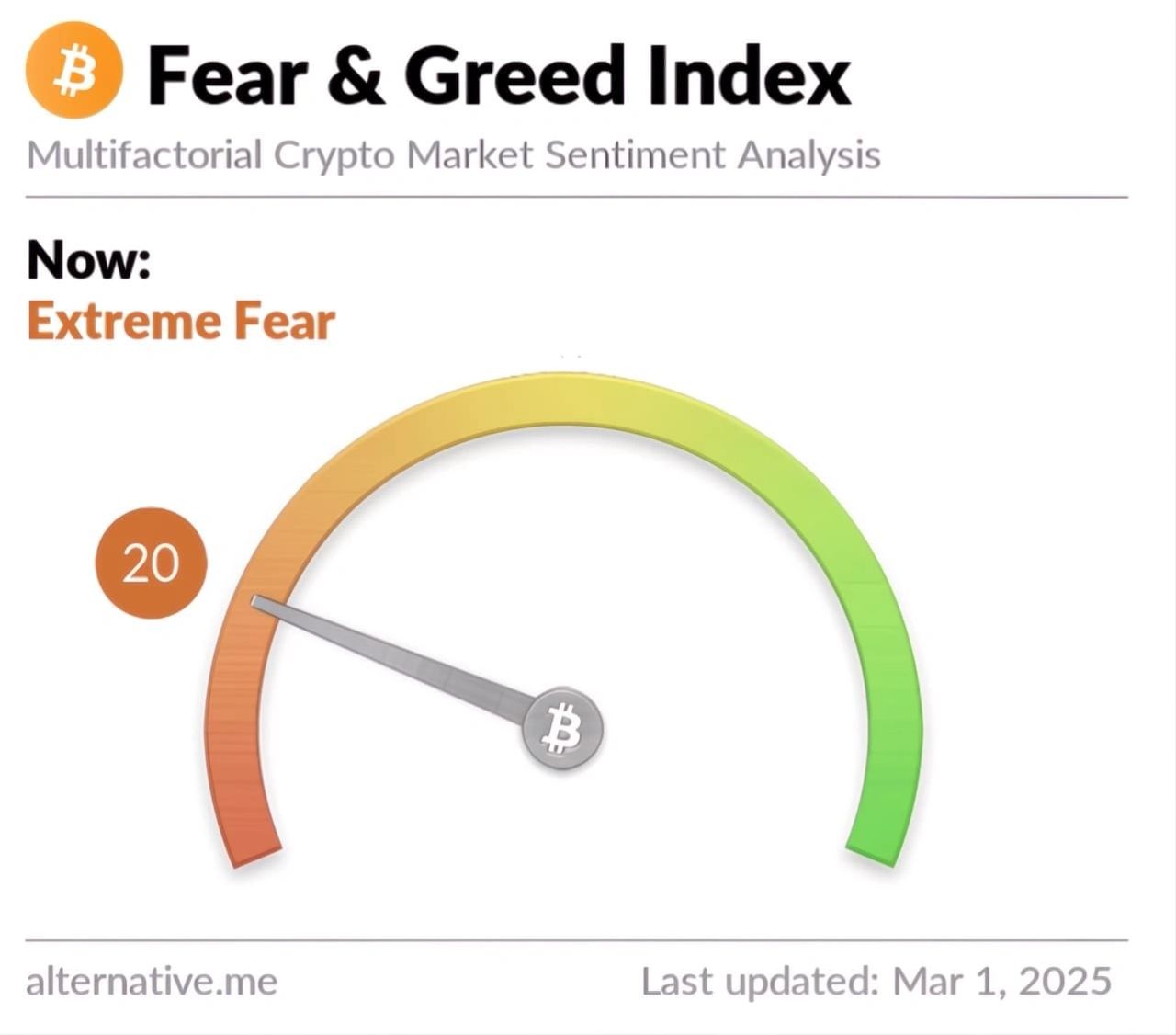
In other words, you’re not the only one to feel a little shaken.
A way to view this dispassionately is to simply assert that there was a big ‘gap’ in BTC’s price chart that simply needed to be tested. After the Trump election, the price gapped up from roughly 69k to 88k in only six days.
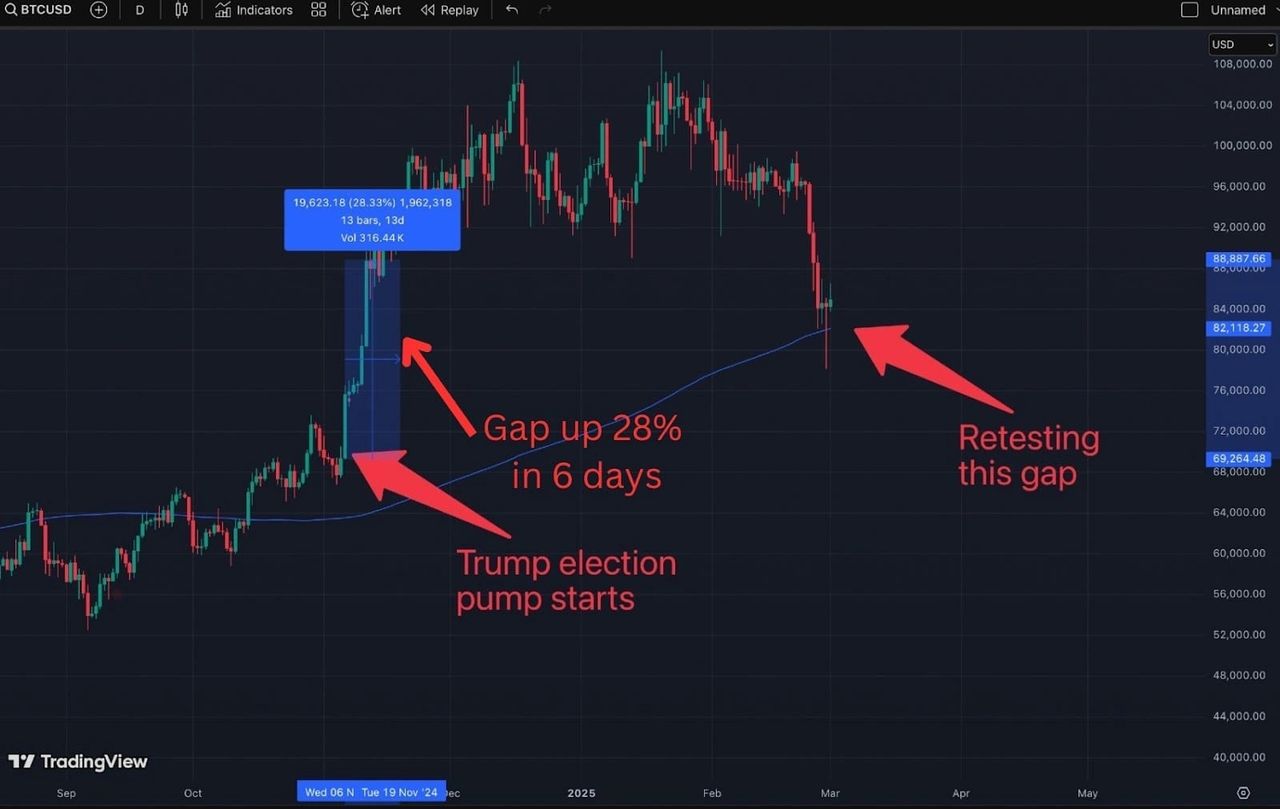
So BTC revisited the price range that it rushed by in early November 2024. This is very common for markets, such a retest.
So how about that bull market, are we still in it? When in doubt, as always, zoom out. Here is the monthly chart for BTC, with the blue line tracking the 10-month moving average.
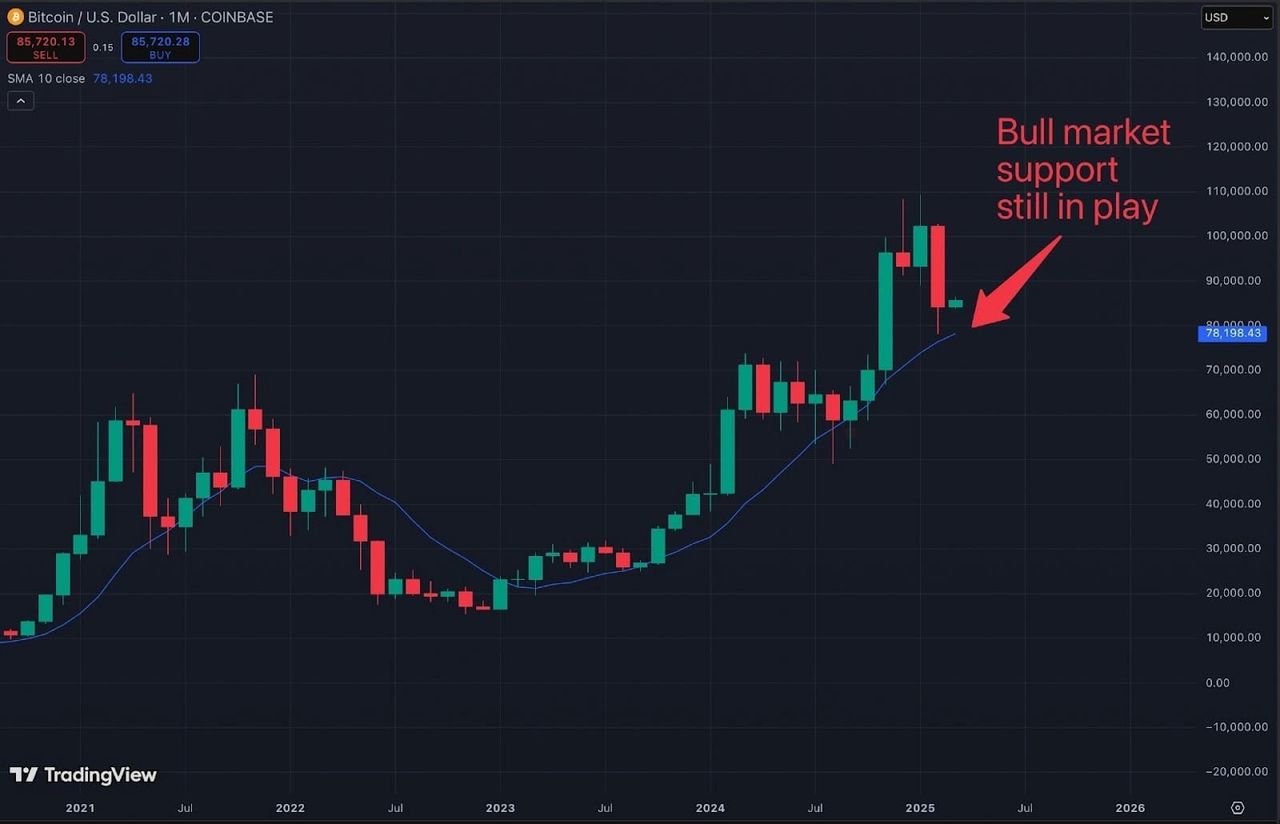
As you can see, this 10-month moving average has in the past 4 years acted as a clean dividing line between bull markets and bear markets. In the spring of 2021, the 50% correction shook the crypto markets – but there were no monthly closes below this line. Indeed, a few months later BTC reached a new all-time high, even if only narrowly.
Of course, we can use different moving averages than the 10-month MA. The 50-week MA is a similar line in the sand and will give you a bit of an earlier confirmed breakdown signal. But the point here is that we’re still a bull market, until proven otherwise. The burden is on the bears to prove us wrong, and they haven’t conclusively managed to convince us. The current peak-to-trough drawdown from 109k to 78k is 28%, a type of drawdown that has occurred often before in previous bull markets, for example in 2017 and 2021.
Another data point is confluent with this hypothesis of an ongoing bull market, namely the fact that none of the traditional on-chain and technical top indicators have flashed top values yet. Not the Pi Cycle Top Indicator, not the Mayer Multiple, not the MVRV-Z score, to name just a few.
Now that we’ve zoomed out, let’s zoom back in.
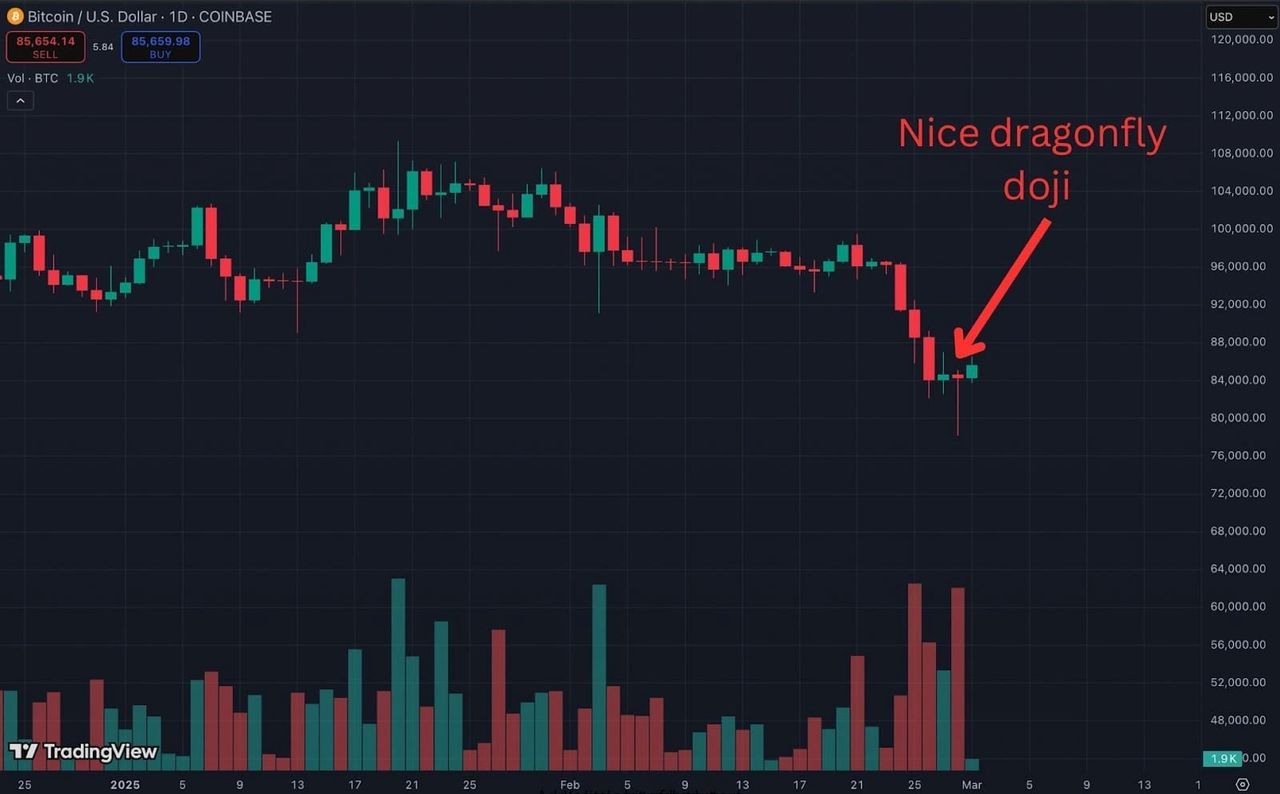
This is the daily chart. Which by the way has Relative Strength Readings of below 30 (not on the above chart), meaning oversold. Often a good buying opportunity.
An indication that we MIGHT have bottomed out, is the so-called dragonfly doji candlestick. It tells us that, around the 78k-83k level, buyers have stepped in to push the price back up to the opening level. This sometimes indicates a reversal from a downtrend to an uptrend.
Liquidity seems on the verge of rising
While we’re all scrambling to come up with explanations and narratives for the price plunge, another impassionate way to look at this is simply a look at global liquidity. In the recent months, financial conditions aka global liquidity has been tighter. It’s just a bit harder for people and institutions to get their hands on cash.
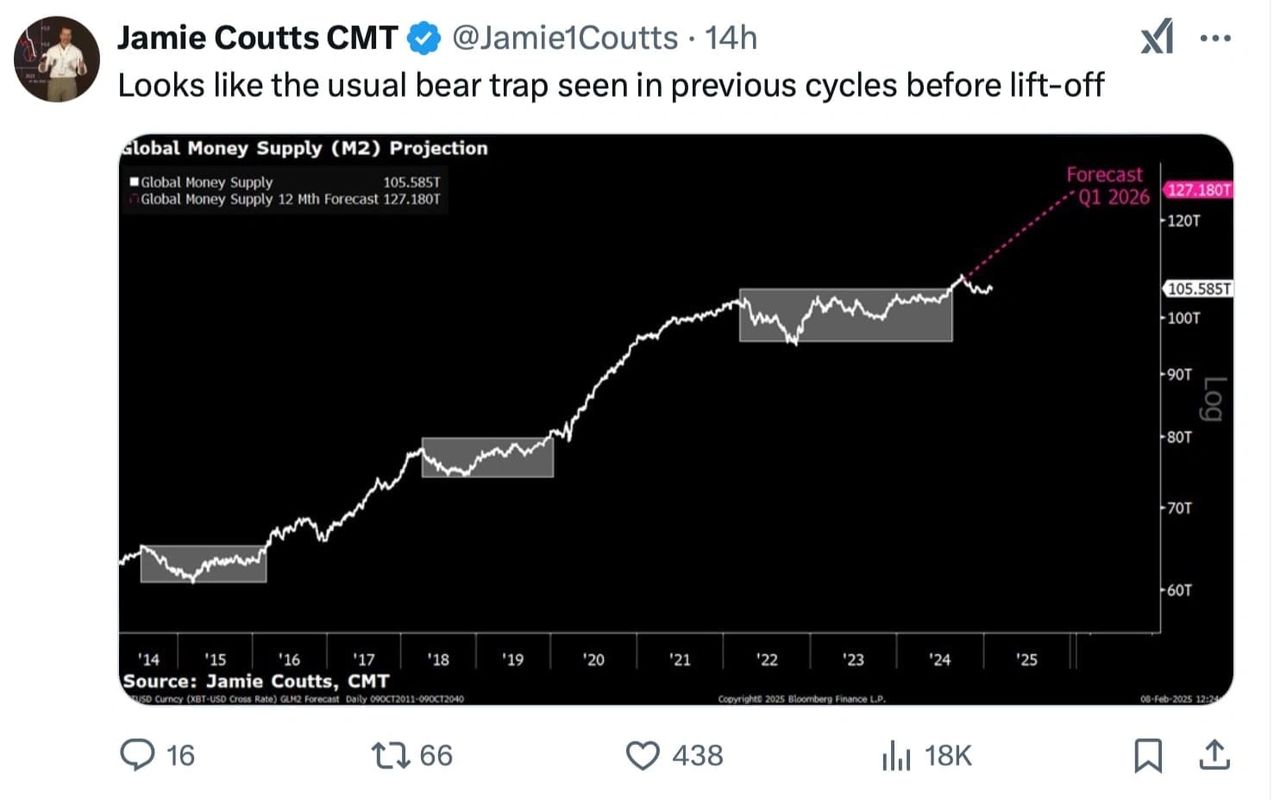
Analysts such as Jamie Coutts foresee a trend of rising liquidity. In fact, he sees the recent dip in global money supply (M2) as a healthy retest before lift-off.
Another tailwind is that the dollar seems to have started its downtrend, almost to the day that Trump took office. A lower dollar is good for risk assets such as crypto.
BTC dominance
Surprisingly, BTC dominance is back in the uptrending channel.
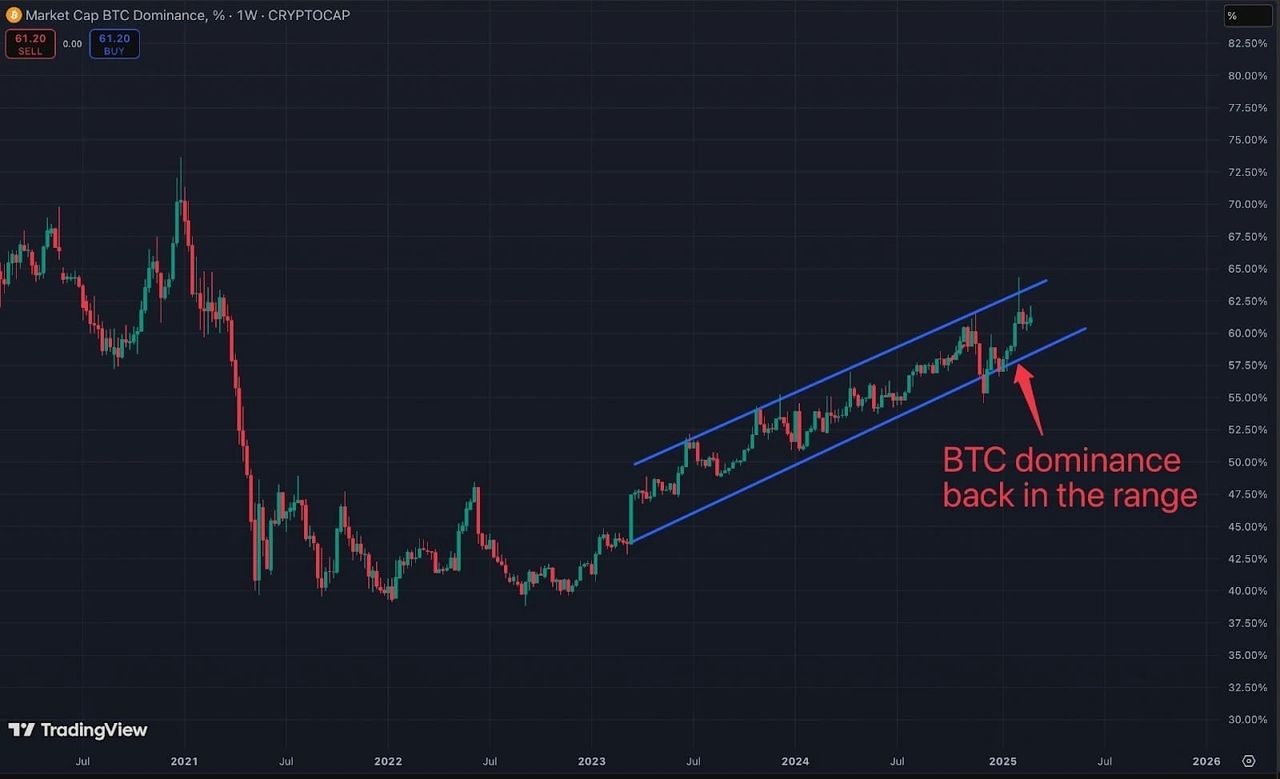
Another way to say this is that the markets are still risk-off. Many people are calling off alt season but I wouldn’t go so far. It’s just that there isn’t enough speculative capital around to get people in the mood for gambling a bit, apart from some brief stretches.

Ethereum
Ethereum is hanging on for dear life, but it is, in fact, hanging on.
If you’re a believer, now is a good time to accumulate. Why? ETH is currently one of the most overlooked assets in the market. Retail investors are disengaged and uninterested, while FUD remains high. At the same time, institutions are accumulating, and DeFi has been legitimized as by a new American administration. Institutions build their high-end products on Ethereum, it’s as simple as that. But could we potentially see ETH dethroned from the number two spot for market cap this Bull Market? If so, by who?

Solana
As the Solana price grapples with a 27% monthly price slump linked to $2.2B in March token unlocks, Cardano’s Plomin governance upgrade faces mixed reactions from ADA holders.
Solana Price Drops 26% Despite ETF Filings
Solana’s SOL has faced a rough period, with its price falling 27% in the past month. Despite recent ETF applications linked to political shifts, market activity remains muted. Analysts point to declining trading volumes and liquidity flow as key factors behind SOL’s struggles.
The Solana price currently sits at $174, down 10% over the past week. Even with whispers of institutional interest, the token’s volatility contrasts sharply with its earlier parabolic rallies. Critics argue that the lack of immediate regulatory clarity continues to dampen investor confidence. “SOL’s downturn highlights the challenges of bridging crypto innovation with traditional finance frameworks,” noted one trader on X.
While Solana’s high-speed blockchain retains long-term believers, short-term turbulence persists. This is in stark contrast to Sol’s previous performance but one that is not entirely abnormal for this phase of the market cycle.
Cardano’s Plomin Upgrade Fuels Governance Milestone
Cardano’s ADA recently crossed a critical milestone with its Plomin hard fork, enabling decentralized governance. ADA holders now directly influence protocol changes, treasury decisions, and upgrades. This shift aligns with Cardano’s research-driven approach to balancing innovation with stability.
The ADA price, now at $0.78, reflects a 20% monthly decline despite the upgrade. Market observers suggest the governance transition may initially unsettle stakeholders accustomed to centralized oversight. Still, the move signals Cardano’s commitment to becoming a community-led network.
While ADA navigates this turbulent phase, Cardano’s focus on governance contrasts with hybrid platforms blending DeFi and Trad Fi, a space where others could redefine standards.
Still there is plenty of potential for ADA in the longer term, there is an established network and following and a certain level of trust among current holders and prospective holders. – the Alt market is yet to truly fire up, as we approach the coming months.
Altcoins to hold as the crypto market prepares to mirror its explosive 2021 growth
As the crypto market regains momentum, investors eye Presales for long-term growth.
With growing interest in blockchain technology and decentralized finance, the crypto market is once again gaining momentum. Investors are actively searching for promising altcoins that offer smart solutions and long-term potential. Among the contenders is Lightchain AI (LCAI), currently in presale at $0.006, having raised $16.1 million.
Now and in the recent six months we have seen an increased chatter around coin presales and while some are simply scams, pump and dumps others are more meaningful and may have the ability to last the test of time and multiple market cycles. What is it that will propel these projects, Defi, Gamefi, Ai, RWA – what will be the catalyst to push these projects to ATH’s and then propel them further?
As artificial intelligence becomes more integrated with blockchain, projects like LCAI are emerging as game-changers in the industry. Alongside AI-driven solutions, other altcoins are making strides with enhanced scalability, smart contract advancements, and interoperability across multiple networks.
Holding the right assets during market upswings can lead to substantial gains, and with renewed optimism in the crypto space. Many say the crypto market appears ready to mirror its explosive 2021 growth, I have also spoken with some traders and analysts that are saying we are tracking more like the previous market. Holding the right bags now will make a significant impact to your profits and overall success this cycle and set you up for the following cycles.
The cryptocurrency market is filled with thousands of projects, but only a few have the potential to deliver long-term value and adoption. The key to selecting strong altcoins lies in their technology, real-world utility, and market demand.
As institutional interest in crypto expands and blockchain adoption rises, investors are seeking assets that provide more than just speculation. The altcoins I genersally speak about in these blogs demonstrate strong development roadmaps, community engagement, and future potential, making them essential picks for those looking to capitalize on the next major market expansion.
With the crypto market showing signs of growth, investors are closely monitoring altcoins with strong fundamentals and long-term potential. Lightchain AI, a project leveraging AI-driven blockchain solutions to enhance decentralized applications could be a bold choice. Another promising contender is the more established Avalanche (AVAX), known for its high-speed transactions and scalability, making it a favorite for DeFi and enterprise adoption.
Algorand (ALGO) also stands as another established token out with its secure and efficient blockchain infrastructure, designed to support financial applications and large-scale smart contracts. There are various cryptocurrencies offering unique innovations that could drive future market success. As blockchain adoption expands, keeping an eye on these assets may present early investment opportunities in projects poised for sustained growth and widespread adoption.
What can Lightchain AI do for the market?
The crypto industry is constantly evolving, and Lightchain AI is emerging as a project that could redefine how blockchain and artificial intelligence interact. By integrating AI-powered computing with decentralized networks, LCAI introduces a new level of efficiency, security, and scalability. Unlike traditional blockchain platforms, it focuses on AI-driven automation, data processing, and decentralized intelligence, making it highly relevant as the demand for AI applications grows.
This could lead to faster transaction speeds, smarter contract execution, and improved decision-making across blockchain ecosystems. As industries continue embracing blockchain for real-world applications, Lightchain AI has the potential to become a key infrastructure player, offering a more intelligent and efficient decentralized future. Its approach positions it as a potential game-changer in the next phase of crypto market evolution. How it plays out and how the pricing structure settles is anyone’s guess but from all accounts we should see a significant surge, one would hope it’s not a pump and dump but more a long term project with scalability and long term value, should you choose to invest then invest wisely and carefully, coin offerings such as these and others always make me wary. I definitly would not be putting the house or sheep station on it, but a small investment may just pay off handsomely – or not!
The question remains though….. what will drive the market surge, what will propel Alt Season?
Alt Season
This time, the season will be likely driven by stablecoin holders, rather than a rotation out of Bitcoin, according to Ki Young Ju, CEO of analytics service CryptoQuant.
Altcoin trading volume is now approximately 2.7 times higher than Bitcoin’s
Young Ju said in a Feb. 20 post on the X platform. He added that “BTC Dominance no longer defines alt season — trading volume does.”
Historically, altcoin seasons occur when traders rotate profits out of Bitcoin and into other cryptocurrencies. This time, according to Young Ju, there is “[n]o direct BTC-to-alt rotation, but stablecoin holders are favoring alts.”
However, the CEO cautioned that this is “a very selective alt season” where “only a few coins are pumping” due to a lack of “fresh liquidity” entering the crypto market.
As of Feb. 21, Bitcoin dominance stands at 58%, up from lows of 51.5% in December, according to data from CoinStats. This figure typically reverses during the altseason.

Shifting market dynamics
Stablecoin market capitalizations increased sharply after Donald Trump’s presidential election win in the United States. The total stablecoin market capitalization is roughly $232 billion as of Feb. 21, according to CoinGecko.
Citi, an investment bank, expects continued adoption of stablecoins to propel digital asset performance in 2025, particularly for altcoins.
However, rug pulls and insider schemes involving Solana-based memecoins are driving investor outflows and a decline in capital inflows on the popular blockchain network, a potential impediment to an altcoin rally.
Meanwhile, Bitcoin’s ongoing institutional adoption is decoupling the digital currency from the broader crypto market, Young Ju said.
US Bitcoin exchange-traded funds (ETFs) broke $100 billion in Bitcoin holdings in November. Meanwhile, public companies have collectively bought more than $60 billion worth of Bitcoin, largely as an inflation hedge, according to BitcoinTreasuries.NET.
“Bitcoin has built its own paper-based Layer 2 ecosystem through ETFs, MSTR, funds, and more. In this paper-based L2 Bitcoin, bridging to other altcoins is impossible,” he said in a December X post.
As a result, “[o]nly a few [altcoins] are starting to show independent trends as they attract new liquidity,” Young Ju said.

Stripe, PayPal are ‘primary catalysts’ for stablecoin growth — Polygon Labs
Stablecoins have ballooned into a $230-billion industry, which is equivalent to more than 1% of the US money supply.
The stablecoin industry’s rapid growth in recent years is likely owed to major payment providers integrating the novel technology and making it easier for businesses to get paid in fiat-equivalent tokens, according to Polygon Labs CEO Marc Boiron.
In an interview with Cointelegraph, Boiron said, “Companies like Stripe and PayPal integrating stablecoins is likely the primary catalyst for their growth.”
PayPal’s foray into digital assets began in 2022 when it started letting users transfer and receive Bitcoin BTC, Ether ETH and other tokens. One year later, the company launched its US dollar-pegged PayPal USD PYUSD stablecoin, which quickly surpassed $1 billion in market capitalization

When PYUSD launched, PayPal CEO Dan Schulman said, “The shift toward digital currencies requires a stable instrument that is both digitally native and easily connected to fiat currency like the US dollar.”
Stripe has also integrated stablecoins through its Pay with Crypto feature, which lets businesses accept USD Coin payments on Ethereum, Solana and Polygon. The company also partnered with global payroll provider Remote to allow US-based businesses to pay global contractors in USDC.
In October, Stripe announced the acquisition of stablecoin startup Bridge Network for $1.1 billion.
In addition to the digital payment stalwarts, traditional businesses and institutions are also adopting stablecoins thanks to new regulatory frameworks in Europe and recent policy shifts in the US, said Boiron.
“Institutions are seeing the doors continue to open,” said Boiron. “We’re also seeing strong interest from non-crypto native businesses who recognize the revenue potential of stablecoins.”
What all these companies have in common is they see the “proven profitability demonstrated by established [stablecoin] players” and recognize the “opportunity to provide better payment rails for their users, especially for remittances, while avoiding traditional fee structures.”
A $230-billion industry
Stablecoins have grown into a $230-billion industry supporting use cases across both developed and emerging economies. As a standalone figure, the value of stablecoins in circulation is equivalent to more than 1% of the US money supply, according to Polygon’s $0.02timmy.
Tether’s USDT is the largest stablecoin in circulation, accounting for more than 61% of the overall market, according to CoinMarketCap.
Tether is also one of the world’s most profitable businesses, generating $13 billion in net earnings in 2024 on the back of its massive US Treasury holdings.
Polygon’s proof-of-stake chain saw its stablecoin supplies jump 14% in the fourth quarter to surpass $2 billion, according to Boiron.
“Polygon PoS continues to be the leading [Ethereum Virtual Machine] chain with almost 30% of all app action transactions, meaning transactions beyond basic token operations like approvals, transfers and wrapping,” he said.
Recent innovations in stablecoins include the launch of 1Money, a layer-1 payments network that supports multicurrency transactions.
Yield-bearing stablecoins are also gaining traction, with the US Securities and Exchange Commission recently greenlighting Figure Markets’ YLDS, a dollar-pegged stablecoin that offers users a 3.85% annual percentage rate.
Meanwhile, Tether co-founder Reeve Collins recently announced plans to launch Pi Protocol, a decentralized stablecoin that offers yield.
“The most promising development may be yield-bearing stablecoins that combine the stability of traditional collateralization with DeFi yield,” said Boiron, who drew attention to Ondo Finance’s USDY.
Ondo’s so-called “yieldcoin” product is essentially a tokenized instrument that is secured by US Treasurys, giving non-US residents access to a stablecoin-like product earning a US-denominated yield. Currently, USDY allows users to earn up to 4.35% annual percentage yield on stablecoins such as USDC.

4 reasons Pi Network price crashed after mainnet launch
Pi is massive in Asia, the network crashed after the mainnet launch, leading to a $6 billion wipeout in the first two days.
Pi Network was trading at $0.76 USD Last Saturday, down from the mainnet launch price of $2. Here are the four main reasons why the Pi coin price crashed.
Pi Network prices crashes amid scam accusations
A key reason why the Pi coin price crashed is that Ben Zhou, Bybit’s chief executive officer, attacked it of being a scam. He cited a Chinese report that accused Pi of being a scam targeted towards the elderly.
Pi Network has rejected these accusations and maintained that it is a genuine crypto project that has been in development in the last six years.
Bybit’s CEO statement was notable for two reasons. First, the company has become the second-biggest crypto exchange in terms of volume after Binance. Second, it came on the same day that a $1.4 billion hack happened on its exchange.
– Pi Network will unlock 188 million tokens in March for over 1 million users, expanding its reach but easing immediate selling pressure.
– A Binance community vote favored listing Pi, but delays triggered backlash, with fans review-bombing the exchange’s app reviews.
– Despite platform acceptance, Pi Network’s vocal community draws criticism, which could impact future exchange relationships.
Pi Network Prepares for Big Unlock
Pi Network is one of the most hyped crypto projects in recent times. Since its mainnet launch on February 20, PI surged nearly 100%, hitting a peak of $2.99 before seeing corrections. At the same time, it’s gaining recognition from the wider community despite earlier criticism.
A week ago, CoinMarketCap refused to update its market cap, but the platform reversed this stance yesterday. PI is now the 11th largest cryptocurrency in the market, ahead of Hedera, Chainlink, Stellar (XLM), and other notable names.
CoinMarketCap’s community sentiment shows that 91% of its users are bullish on Pi, as the firm is planning to unlock 188 million tokens to over 1.1 million users this month.
A token unlock of this size is bound to have an impact on Pi Network’s price. Recently, the project launched the biggest airdrop in crypto history, which helped juice enthusiasm.
ExplorePi data shows that there are currently more than 11.5 million Pioneer accounts. However, 7.25 million (63%) accounts lock PI for three years, and 1.6 million accounts (14%) lock PI for one year.
Therefore, the selling pressure on Pi Network may not take effect immediately, even with this massive user pool.
Nonetheless, Pi Network is also ruffling more than a few feathers. Recently, Binance hosted a community vote on whether or not to list PI tokens, and its users were overwhelmingly in favor.
Despite the votes, Binance is yet to list PI, and several users are not taking this lightly. Pi fans have review-bombed its Google reviews.
“Before listing cryptocurrencies, Binance will check and consider many factors including liquidity and trading volume in the market,” Binance claimed. Although the exchange didn’t directly reference Pi Network, it commented on several Pi-centric 1 star ratings on Play Store.
Many (but not all) of these reviews and responses took place on Asia-based servers, where the project is the most popular. Recently, the Vietnamese government issued a warning about Pi Network, and Bybit CEO Ben Zhou reminded his users that China issued similar warnings years prior.
Regardless, Pi Network seems to have a huge community of enthusiastic supporters. Although some of its fans are getting a reputation for their hostility and defensiveness on social media, the project remains resilient to the current market conditions and this may be one project worth keeping an eye on, or picking up if the price dumps after token unlocks. I have been experimenting with mining Pi on my phone for a short while and it’s easy to do, reach out to find out more.
Litecoin
In February, LTC was one of the few altcoins that exhibited price dominance against BTC. Litecoin remained at breakeven value for the month, while Bitcoin faced an 18% drop. Litecoin’s resilience led to positive social commentary surrounding the crypto asset, which was largely dominated by the spot LTC ETF filings.
After a period of outperformance against major crypto assets, Litecoin’s
LITECOIN price dropped as low as $94, a 26% fall from the weekly open.
While the trade wars between the US, Canada, China, and Mexico continue to pressure the crypto market, multiple analysts have pointed out a potential opportunity in Litecoin.
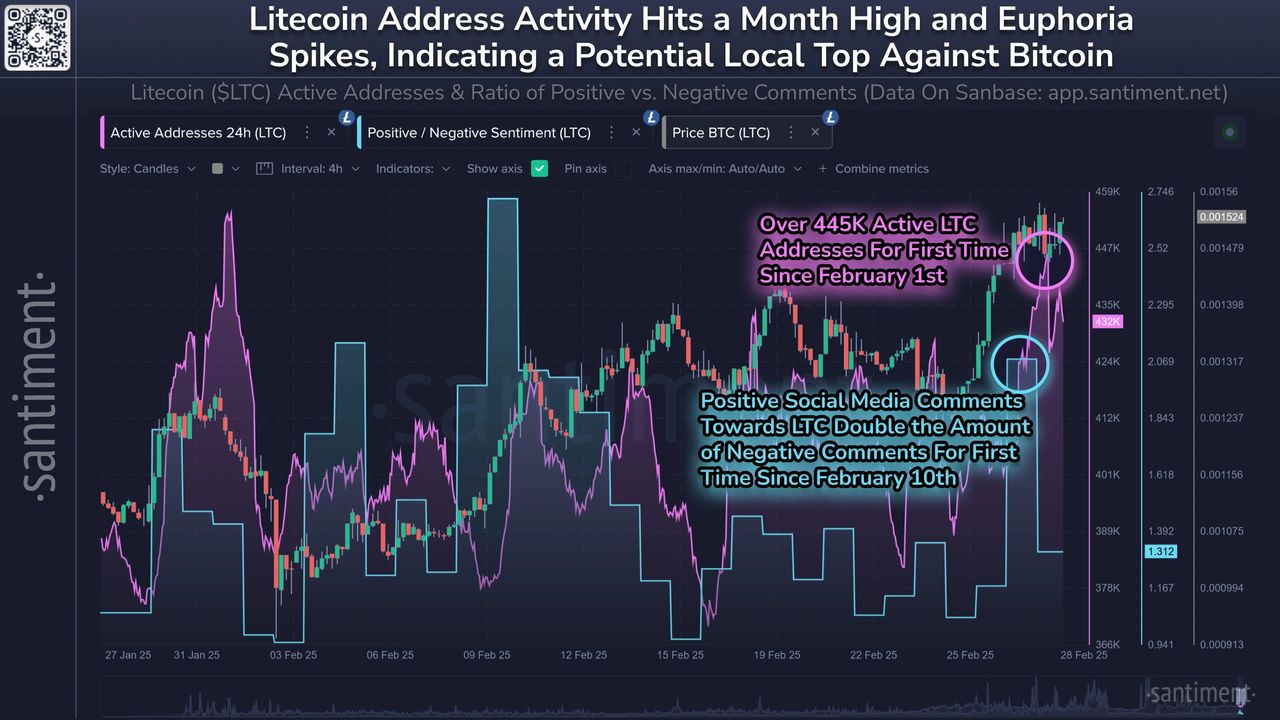
Santiment data pointed out these developments and identified an increase in LTC active addresses to 445,000 over the month.
Irrespective of the current market structure, Valeriya, a crypto and Forex trader, stated that Litecoin displays “signs of re-accumulation.” The trader added,
“Testing the indicated level (POI) may provide favorable conditions for opening a long position. Growth potential: 60%”
Key Litecoin levels to hold under $100
From a technical perspective, Litecoin trades in a higher consolidation range, where the overhead resistance range of $130 to $140 remains unbreached.
The daily chart shows that the price has remained above the 200-day exponential moving average (200D-EMA) since Nov. 6, 2024. A break below the 200D-EMA might indicate the early signs of a high time frame (HTF) bearish shift.
Under those circumstances, the immediate support for Litecoin remains between $92 to $100 and $80-$88. As illustrated in the chart, LTC retested support range 1 ($92 to $100) on March 4 before immediately recovering above the 200D-EMA.
The relative strength index (RSI) also dropped to 38, its lowest value since Aug. 8, 2024, deviating below a 7-month low.
Data from IntoTheBlock added more on chain confluence to the support ranges defined in the chart. Between $79 and $90, a total of 6.86 million LTC tokens were held by 1.73 million addresses, while 1.11 million addresses held 17.84 million LTC tokens in the $90 to $108 range.
Thus, in terms of trading volume, $108 and $90 is the immediate support range, while more holders are between $79 and $90.
With Litecoin sitting above its 2019 high at this point of the cycle it looks highly favorable for it to reach beyond its $266 USD 2021 cycle peak and on toward $650-750 USD or higher this cycle with some calling for LTC to surpass $1200 USD this cycle. It has been one of the most bullish of the Alts these past few years and with potential ETF’s looming we could easily see price appreciation toward those higher numbers. This is definitely one coin to mine via Scrypt mining and also one to pick up on those local dips.
Dogecoin
From one Scrypt coin to another, Doge is another coin very much worth accumulating. While it’s impossible to predict the exact price Dogecoin will reach during this market cycle, some analysts predict DOGE could see a significant price surge, potentially reaching $20 or even higher, based on historical trends and the potential for a strong bull run.
Javon Marks predicts DOGE could reach over $20 in this cycle, citing its previous bull run performance and the potential for a 306x increase. Ali, another analyst, suggests DOGE could climb to $30 if it continues to follow its historical price trends. There is a very real possibility that Doge could be trading near the $3 by sometime in May.
I am fairly certain that we will see Doge trading firmly above $1 this cycle if all things play out right. Strong positive sentiment and increased adoption could drive DOGE’s price higher.
Elon Musk’s Influence: Elon Musk’s tweets and support for DOGE have historically had a significant impact on its price.
Technical analysis suggests DOGE could be heading towards a significant breakout, with some analysts targeting a price of $15 or higher.
Doge could certainly hold some massive potential if this market cycle lives up to the hype.
Kaspa (KAS) – Speed Meets Scalability
Kaspa (KAS) is attracting interest for addressing one of blockchain’s main problems: scalability. Kaspa handles thousands of transactions per second using Directed Acyclic Graph (DAG) technology, providing great speed free from the bottlenecks encountered in conventional blockchains.
With a $2.2 billion market capitalization, currently ranked 54th on CoinGecko, it is notable for cheap transaction costs and effective network. Kaspa’s capacity to manage massive transaction volumes with almost instantaneous finality sets it to satisfy the growing need for scalable blockchain solutions.
With the market poised for a bull run, Kaspa might explode and be a fierce competitor to reach $1 before Dogecoin, especially as businesses progressively embrace blockchain technology and analysts are positive about its future.
This is another coin that we have been mining for some time and I have written about on numerous occasions. This project looks extremely solid and is definitely a long-term stayer. Can Kas reach the top 20 market cap this cycle and if so, then how far off the top 10 will it be and could it go as high as a top 5 slot in the following market cycle?
We know the tide is turning and Ether is losing some of its luster, which coin will knock ETH from its number two slot? Kaspa certainly has the potential but at this point in time I would be placing Sol as my leading contender for the top two spot in the near term.
Ethereum: Is Its Time Up As The Number Two Crypto?
Ethereum (ETH) has long been the king of decentralised applications (dApps) and smart contracts, serving as the backbone for DeFi, NFTs, and decentralised autonomous organisations (DAOs). However, its status as the number two cryptocurrency is being challenged. Sluggish price action, declining user activity and the rise of more efficient competitors are sparking debates about whether Ethereum’s best days are behind it.
The 2021 market cycle demonstrated the limitations of ETH in terms of speed and cost to transact. During periods of high demand, Ethereum’s fees spiked, making it impractical for everyday use. Layer 2s — expected to solve this problem — were not yet available in 2021. In the meantime, fast and cheap alternatives like Solana arrived, demonstrating a strong point of difference with their high transaction speeds and low costs.
During the following bear years, the Layer 2s did arrive, heralding the age of fast and cheap access to Ether dApps. Arbitrum, Optimism, and other Layer 2 solutions reduced congestion and fees, making Ethereum more accessible. What was unforeseen, however, was the fragmentation they introduced. Users now face the challenge of navigating multiple Layer 2 ecosystems, each with its own set of rules, fees and interfaces. This complexity has made it difficult to know which ETH Layer 2 to use, diluting the user experience and contributing to Ethereum’s struggle to retain its dominance.
ETH By The Numbers
To assess whether Ethereum is losing its grip as the number two cryptocurrency, it’s crucial to compare it against its main competitors using key Layer 1 metrics. Ethereum’s numbers are competitive but fragmented when combined with its Layer 2 solutions like Arbitrum and Optimism. In contrast, blockchains like Solana offer a seamless user experience by consolidating all transactions on a single layer.
Daily Active Addresses
Daily active addresses (DAA) are a vital measure of user engagement and network activity. Ethereum’s DAA on its mainnet has remained stagnant, showing minimal growth. However, when combined with its leading Layer 2s like Arbitrum and Optimism, Ethereum’s DAA becomes stronger, albeit fractured across different networks.
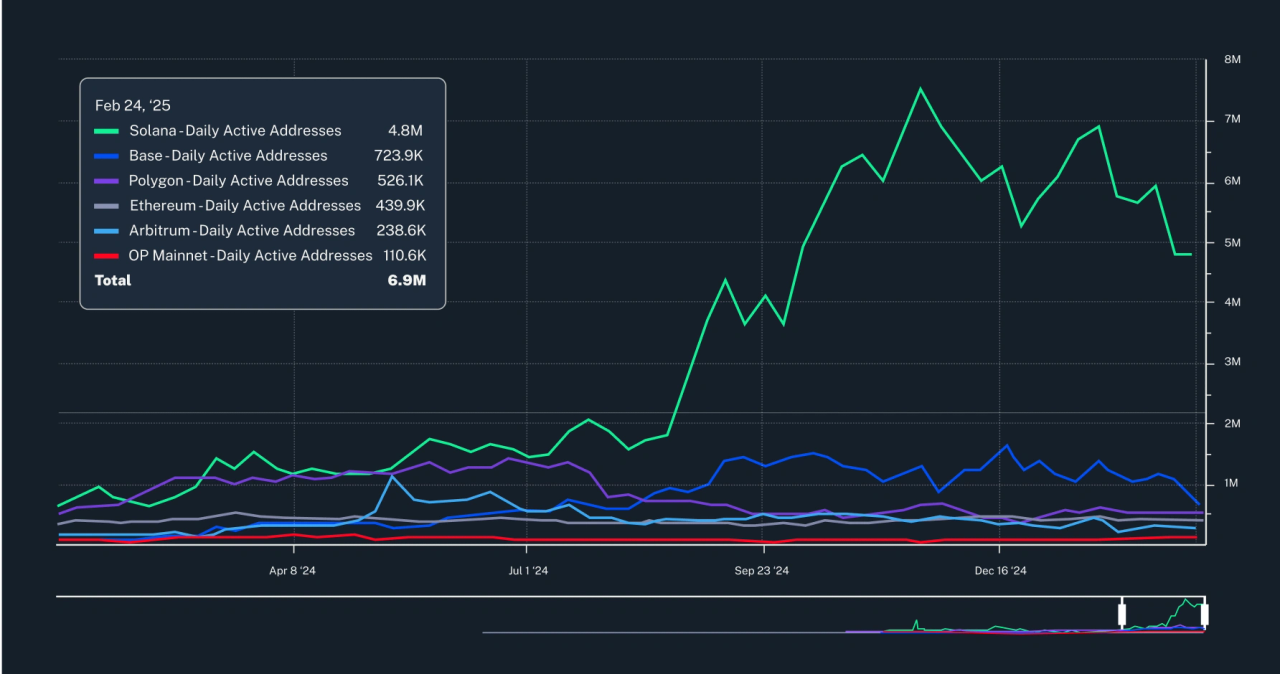
The combined DAA of Ethereum and its largest Layer 2s is 2.1 million. A significant number when combined, which beats all other competition with the exception of this cycle’s leading Layer 1, Solana, which boasts more than double the DAAs at 4.8 million.
Total Value Locked (TVL)
Total value locked is a critical metric for evaluating the popularity and utility of a blockchain within the DeFi ecosystem. Ethereum still leads the pack, with a TVL of $115 billion ($72.6B USD) — excluding its Layer 2s. When the TVL of its Layer 2 solutions is included, Ethereum’s total exceeds $128 billion ($81B USD).
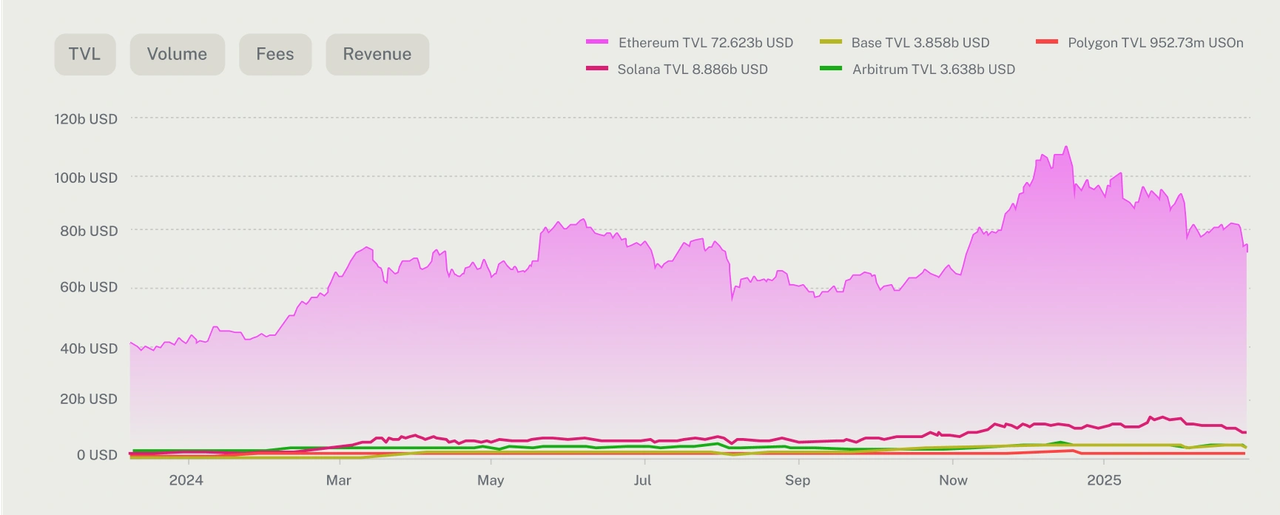
In comparison, Solana has seen rapid growth in TVL, reflecting its thriving DeFi ecosystem and growing developer confidence. Even with this emergence, Solana still only has a TVL of $14 billion ($8.9B USD), which is significantly behind ETH. To further illustrate how far ahead ETH is in this category, Sui — hyped as the emerging L1 of this cycle — has only $1.9 billion ($1.2B USD) in TVL.
Daily Transactions
Daily transactions measures network usage. Ethereum’s mainnet transactions have plateaued, but when combined with its Layer 2s — especially Base, which accounts for the majority of transactions in the ecosystem — the total becomes more competitive, reaching 31.4 million daily transactions.
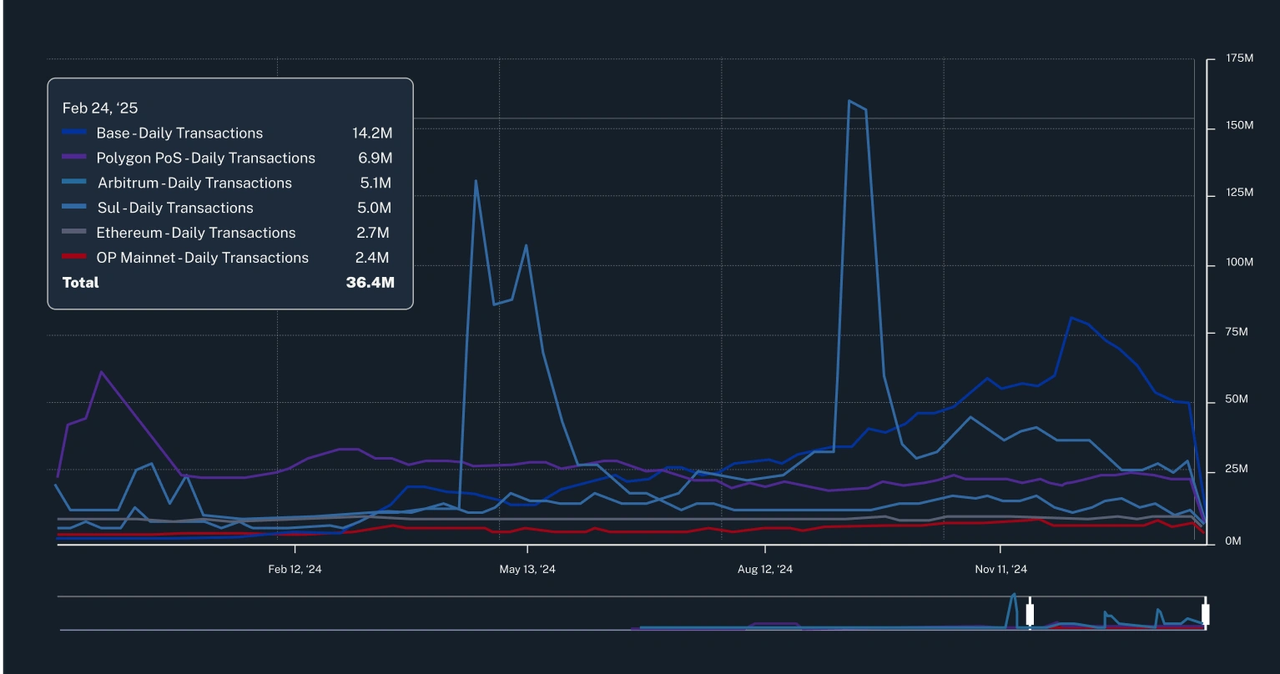
Among other leading Layer 1s, Sui stands out with a respectable 5 million daily transactions, showing activity levels comparable to many of the Layer 2s. However, what isn’t shown on this graph is the comparison with Solana. At the time of writing, Solana processes 110 million daily transactions at the time of writing, but just a month ago, it peaked at an impressive 500 million daily transactions.
These numbers demonstrate that modern blockchains are making progress toward balancing transation scalability with security and decentralisation
What Could Turn ETH Around?
Ethereum’s path to regaining its dominance isn’t guaranteed, but several possibilities could help reverse its current challenges. Two potential areas of focus are shifting the leadership strategy of Vitalik Buterin and the Ethereum Foundation (EF), and addressing Layer 2 fragmentation to enable seamless interoperability.
The Ethereum Foundation’s Leadership
Vitalik Buterin has been the visionary behind Ethereum and has remained a key technological and strategic leader. However, the Ethereum Foundation, an organisation concerned with advancing the network, has faced leadership issues over the past 12-24 months.
The Foundation’s communication and direction have been questioned by many in the community, leading to Buterin himself saying the EF must improve its two-way communication to push Ethereum forward.
Additionally, the EF underwant a major leadership shuffle, with Executive Director Aya Miyaguchi stepping aside and letting Hsiao-Wei Wang and Tomasz Stańcza take the reins as co-directors.
By actively promoting Ethereum’s strengths and countering competitors’ narratives, the leaders could help restore confidence and inspire renewed interest.
Solving Fragmentation and Seamless Interoperability
Ethereum’s reliance on multiple Layer 2s has fragmented its ecosystem, complicating user experience. If Ethereum can enable seamless interoperability across all layers, it would create a unified experience where users can move assets and interact with dApps without friction. This could reignite developer interest, enhance liquidity and strengthen its overall ecosystem.
Ethereum’s position as the number two cryptocurrency is under significant threat. While it remains a behemoth in terms of TVL and developer adoption, the lack of growth in daily active addresses and transactions concerns many in the community. Compounding this issue is the rapid rise of high-performance Layer 1s like Solana and Sui, which are attracting users and developers with faster, cheaper and more scalable solutions.
The narrative is shifting, and unless Ethereum can accelerate its development and regain user momentum, its status as the second-largest cryptocurrency may be at risk.
Ethereum is far from dead, but the crypto landscape is evolving rapidly. It must adapt to maintain its position, or it risks losing its standing to faster, more innovative competitors. As it stands, Ethereum’s time as the undisputed number two is no longer a certainty and it would appear to be a matter of when that occurs and who that rival may be to claim that 2nd spot.
My top picks to make a charge at the top two spot would be SOL, XRP, SUI, ADA and XLM in the near term. Doge should hold its spot within the Top 10 but I do not see it challenging for a top two spot. Looking further afield I would add Kaspa into the mix along with Avax and LTC. These coins all have potential for a solid Top 5 and top 10 spot for market cap. Looking at the top 20 market cap coins we could see Kaspa enter that field this cycle as it climbs its way upward, Optimism is another project I feel has some serious potential for a top 20 spot and we should also see ETC re-enter the top 20 spot this cycle. These coins are all inside the Top 100 at this stage of the game and certainly have the capability to climb much higher. The pressure is on for Ether and there is still so much possible growth available ahead. It will be an interesting ride to the top and most likely multiple tops of this Bullrun.
5 Cryptocurrencies Trump Wants US To Hold In Reserve
XRP, SOL, ADA, Bitcoin and Ether are the five cryptocurrencies named by President Donald Trump to be kept in reserve.
US President Donald Trump has named five cryptocurrencies he wants to be part of a new strategic reserve – in other words, crypto holdings owned by the US government.
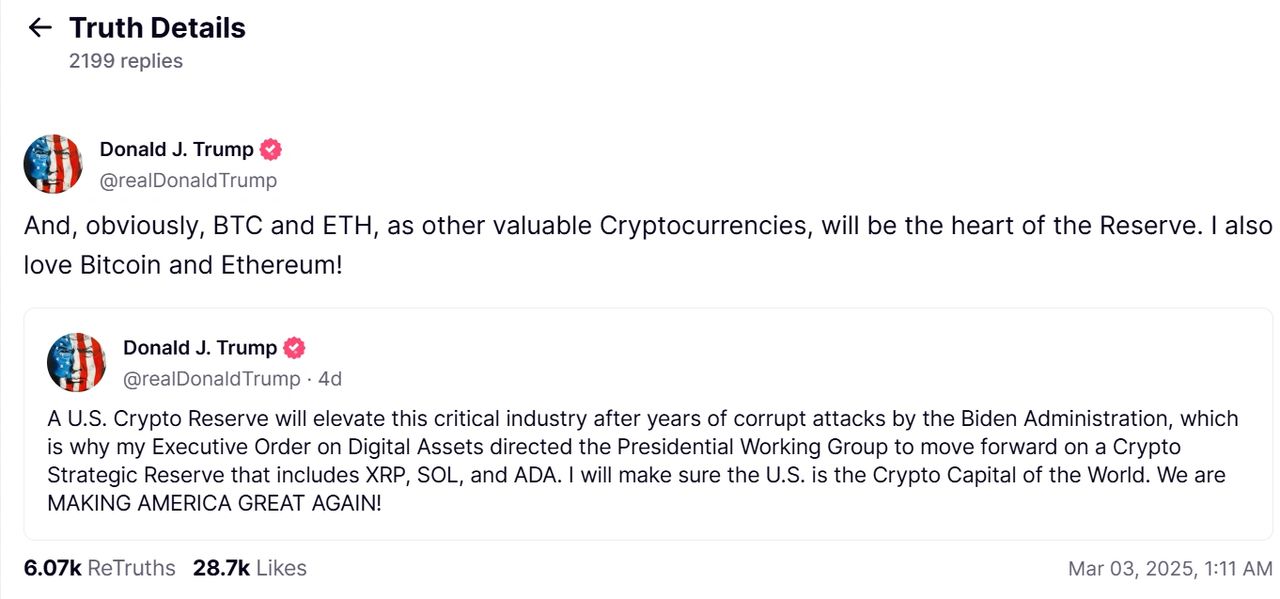
In a post on Truth Social last Sunday, Trump announced that his January executive order on digital assets would create a stockpile of XRP, SOL and ADA currencies, surprising traders by choosing three lesser-known tokens and sending their prices soaring.
Later on Sunday, Trump added that bitcoin and ether, the two biggest cryptocurrencies, would be included in the reserve.
1. XRP
Created by the US crypto company Ripple, XRP is the world’s third-biggest cryptocurrency, with $140 billion of the tokens in circulation, and each token worth around $2.40, according to CoinGecko data.
Ripple has touted XRP as a way to help transfer funds around the world faster and more cheaply than other cryptocurrencies including bitcoin. Like other tokens, its price has been volatile.
US President Donald Trump has named five cryptocurrencies he wants to be part of a new strategic reserve – in other words, crypto holdings owned by the US government.
In a post on Truth Social on Sunday, Trump announced that his January executive order on digital assets would create a stockpile of XRP, SOL and ADA currencies, surprising traders by choosing three lesser-known tokens and sending their prices soaring.
Later on Sunday, Trump added that bitcoin and ether, the two biggest cryptocurrencies, would be included in the reserve.
Here is what we know about the tokens, in the order Trump named them:
1. XRP
Created by the US crypto company Ripple, XRP is the world’s third-biggest cryptocurrency, with $140 billion of the tokens in circulation, and each token worth around $2.40, according to CoinGecko data.
Ripple has touted XRP as a way to help transfer funds around the world faster and more cheaply than other cryptocurrencies including bitcoin. Like other tokens, its price has been volatile.
Ripple is a major player when it comes to crypto lobbying. It donated $45 million to a lobbying group that tried to influence the US elections in favour of the crypto industry, according to OpenSecrets.
In January, its CEO Brad Garlinghouse posted a photo of himself alongside Trump, saying they had enjoyed a “Great dinner”.
For years, the company was locked in a legal battle with the US Securities and Exchange Commission over whether its sales of XRP in 2012 counted as an unregistered securities offering. Ripple mostly won that case, though the SEC did have a partial victory.
Asked for comment on Monday, a Ripple spokesperson referred Reuters to a tweet Garlinghouse published on X on Sunday in which he said he appreciated Trump’s “vision of a govt digital asset reserve representative of the industry.”
Ripple’s President Monica Long told Reuters in June that the PAC that Ripple had donated to was bipartisan and focused on supporting candidates who back the regulations desired by the crypto industry.
2. SOL
SOL is the name of the token that runs on a blockchain called Solana. The Sol blockchain is often used to launch meme coins – including Trump’s own cryptocurrency, which the president unveiled in January.
With around $73 billion worth of tokens in circulation, CoinGecko data puts it as the sixth-biggest cryptocurrency.
It has been volatile and lost most of its value in 2022, hurt by its association with former FTX CEO Sam Bankman-Fried. Although Solana was not directly related to the now-collapsed crypto exchange, Bankman-Fried frequently praised the token.
A relatively newer player in crypto, Solana saw the price of its token soar in 2021 when it was talked up as a rival to ether and because of its use in the then-booming market in non-fungible tokens (NFTs).
Solana’s website says it is managed by “Solana Foundation”, which describes itself as a non-profit foundation based in Zug in Switzerland. Lily Liu and Daniel Albert are listed as the foundation’s executive directors. Reuters was not able to immediately reach those connected with Solana.
3. ADA
ADA runs on the Cardano blockchain. It was founded in 2015 by Charles Hoskinson, a well-known US tech entrepreneur and co-founder of the Ethereum blockchain project.
There is $31.4 billion worth of ADA tokens in circulation, according to CoinGecko, making it the eighth-biggest cryptocurrency.
The token’s price was the biggest gainer after Trump’s announcement, briefly soaring more than 70% above its level on Friday.
Cardano’s website lists five entities, including a Switzerland-based non-profit, called the Cardano Foundation, and a for-profit arm, called Emurgo. Cardano did not immediately respond to a request for comment.
4. Bitcoin
The first and biggest cryptocurrency, bitcoin started circulating in 2009, created by a mysterious figure identified only as Satoshi Nakamoto.
Just like other cryptocurrencies, bitcoin is primarily a way to move money between people without using intermediaries such as banks.
One individual bitcoin costs around $86,000 and there are around $1.7 trillion worth of the tokens in circulation, CoinGecko data shows, meaning it accounts for more than half of the $3 trillion in nominal value of all digital currencies.
Bitcoin surged last year, helped by the US SEC in January 2024 allowing it to be included in exchange-traded funds and by Trump’s election in November, which raised expectations for a wave of pro-crypto regulation.
5. Ethereum
Ether is the cryptocurrency of the Ethereum blockchain, which seeks to be a major player in decentralized finance (DeFi) – the name given to the use of blockchain technology to offer financial services without intermediaries.
Founded in 2013-2014 by Vitalik Buterin and others to compete with bitcoin, its token, ether, trades at a fraction of bitcoin’s price but is still the second-biggest cryptocurrency.
World Liberty Financial, a crypto company Trump and his sons announced last year, has issued digital tokens on the Ethereum blockchain that it has so far sold for over $500 million. World Liberty said in February it was unveiling a strategic token reserve designed to bolster bitcoin, Ethereum and other cryptocurrencies “that are at the forefront of reshaping global finance.” Could a strategic reserve assist an Ether recovery and a new ATH?

As you can see February was a very mixed month and this is indicative of the unrest in the wider market. Sit tight and keep on accumulating, now is a great time to invest in filling those bags, adding more machines to your mining operations while prices are low and setting yourself up for the market momentum shift that is incoming.
There is much to look forward to in the coming months and we may see this cycle run longer than previous cycles for various reasons. We are still waiting for that catalyst to push the market to the next level, trust me, it’s coming and the longer this build up phase goes for the better!

There are many great projects in the market and within the top 300 coins but here are my top picks for potential performance this market bull run are as follows (But please don’t take my word for it, research it and please don’t consider this financial advice).
1. Bitcoin – definitely worth having this in your bag, I don’t really need to explain this one.
2. Solana – my pick for the eventual number two spot for market cap. So much to like about Sol and some solid charts and information. Definitely worth examining and adding to your mix if not already. ETF potential.
3. XRP – finally breaking free of the SEC chains and has some serious upside potential and could hold the top two spot briefly before SOL overtakes it. Also an ETF potential. Can XRP dethrone ETH?
4. Kaspa – Some serious potential with a project like this, I have written about it multiple times and this is a coin that we mine. This has potential to be a top 20 coin very soon and a high probability to be a top 10 coin this cycle. I see this as an eventual Top 5 market cap coin.
5. Optimism – There is a lot to like about the chart on this coin. The project is solid and built on the ETH blockchain. There is a great amount of upside with this coin this cycle.
6. Stellar – This one has run already in the early phase like SOL but has so much more potential. There are many projects built around this project and this is one that can rival XRP. I expect some great things from this project this cycle.
7. Cardano – Another project similar to XRP and a major rival to XRP, has some potential for larger profits if it repeats its previous cycle pattern.
8. Doge – This one goes without saying, expectation is everything and Doge is on everyone’s lips. Trump even has a government department called DOGE. We will see a new ATH for Doge the question is simply how high. Long term holders and miners can expect some very big pay days from this coin.
9. Litecoin – From one Scrypt coin to another – This coin has been a solid performer even through the bear market and should we see an ETF approval then it is highly likely that we will see a new ATH and price action between $500-750 would not be out of the question.
10. Kadena – The price is cheap right now and the project has so much potential, miners for it are cheap as well. this project has some massive potential but still has a way to go. I don’t expect to see an ATH this cycle but I do expect to see it climb back above $10 and that will bag some great returns from where it sits right now.
11. HBAR – This one is another of my favorites and has some solid potential to push to a significantly higher ATH this cycle. Certainly, worth holding and certainly worth accumulating for the long term.
12. Nervos Network – This is one that Andy and I have been mining for a long time and has been brilliant for us. The team behind it are great and the project is sound. Momentum has been building slowly and without fanfare. Mining it has been profitable for a long time and it certainly has the potential to climb to a new ATH this cycle and an even higher ATH next cycle as the project develops. It’s worth a look and adding to your mix.
I will be covering these coins and a few others such as Sui, Pol, Avax, ARB, Matic, ZEC, Aleo and ETC in an upcoming series of posts as we prepare for the bull market. These would be my current top 20 coins (It’s hard to narrow to a top 20, there are possibly a few others that could sneak in there).

Positioning yourself now to gain a suitable position is vital. Understanding the potential for these projects and the possible exit points is important and learning why these projects stand out from others. Stay tuned and enjoy the ride, this cycle is different from previous it has a new flavour and feel. examine the technicals and certainly let me know if you disagree with any of my picks or if you have valid arguments for any others.
The crypto market has expanded to more than 2.4 million cryptocurrencies, a fivefold increase from 2021. Because it’s easy to create new cryptocurrencies, many of them have no real-world use and are only intended to make a quick profit. While there is a possibility to make some serious cash quickly with some of these – most end up holding the bag. Invest in more established and valid projects and you are less likely to be burned. Look for porjects with utility and value and learn the technicals.
Enjoy the journey and reach out anytime.
Happy Mining
Rusty Rigs
Disclaimer: The content on this site and in this communication should not be considered investment or financial advice. Any investing or crypto mining is speculative. When investing your capital is at risk, please do your own research and invest and make your decisions wisely. Mining profits are not guaranteed and may vary over time depending on the market performance and network hashrates.