Alephium – Proof of Less Work

Alephium’s official ticker symbol is ALPH. It contributes to the blockchain’s decentralization and overall security by incentivizing miners to process blocks on the Alephium blockchain. Mining is a core mechanism of the Alephium blockchain: it is the mechanism by which transaction records are added and verified across the network. The token also secures the Alephium network against DDoS and spam attacks via transaction fees payable in ALPH.
Alephium is a Layer 1 blockchain, live since November 2021, which avoids common industry compromises, offering simultaneously scalability & expressivity, strong security & robust decentralization.
Alephium is the first live Layer 1 sharded blockchain scaling and improving on Bitcoin core technologies, Proof of Work & UTXO. It delivers a highly performaning, secure DeFi & Dapps platform with enhanced energy efficiency. It differentiates itself with a strong tech proposition: from its unique sharding algorithm called Blockflow, its energy efficiency thanks to Proof-of-Less-Work, its unique Stateful UTXO model & more that will be detailed below!
But it’s not only the tech. It has a very strong focus on User Experience through its suite of wallets, a strong community, and a striving ecosystem of dApps (including DEX, NFT marketplace, games & others), a bridge to Ethereum with more than 6000 holders of the wrapped asset & millions of TVL. This is what I have been waiting to see, how it was setting itself up and just how successful this project might truly be.
I have held off covering this coin until now to avoid any mass hysteria and people rushing out to buy the latest miners, I wanted to see how it all panned out and really do some research on the project before committing to a blog and being responsible for spreading the hype. Some of the early miners were selling for quite a pretty penny and sure, while the current AL1 and AL1 pro are not cheap they are in line with many of the bigger miners that we have spent more on over the years and would be comparable to the recent KS5 pros that we bought months back. Payback time is currently favorable but bear in mind that the network hashrate will grow and the rewards will drop, but ALPH has a long way to go and some sizeable growth ahead. If you are mining Alph then bravo to you – great choice and well done for having the foresight, especially if you were mining it early on GPU rigs. If you are not mining ALPH then it may just be a good time to start… This project really looks quite promising. Let’s dive in and take a look at the technical specs that make Alephium tick….
💎 Why is Alephium special ?
On top of an awesome team, an outstanding community and a lot of energy, here is a summary of the technical specs:
It scales through sharding. Alephium is built on a novel and complete sharding algorithm called BlockFlow. It improves on the UTXO model of BTC to make it scalable and uses DAG data structure to reach consensus between different shards. This will allow up to 10’000 Transactions Per Second (currently more than 400 TPS vs Bitcoins 7 TPS). This really is quite mind-blowing.
It is programmable & secure. Alephium proposes a stateful UTXO model offering layer-1 scalability and the same level of programmability as the account model implemented on ETH, whilst being more secure.
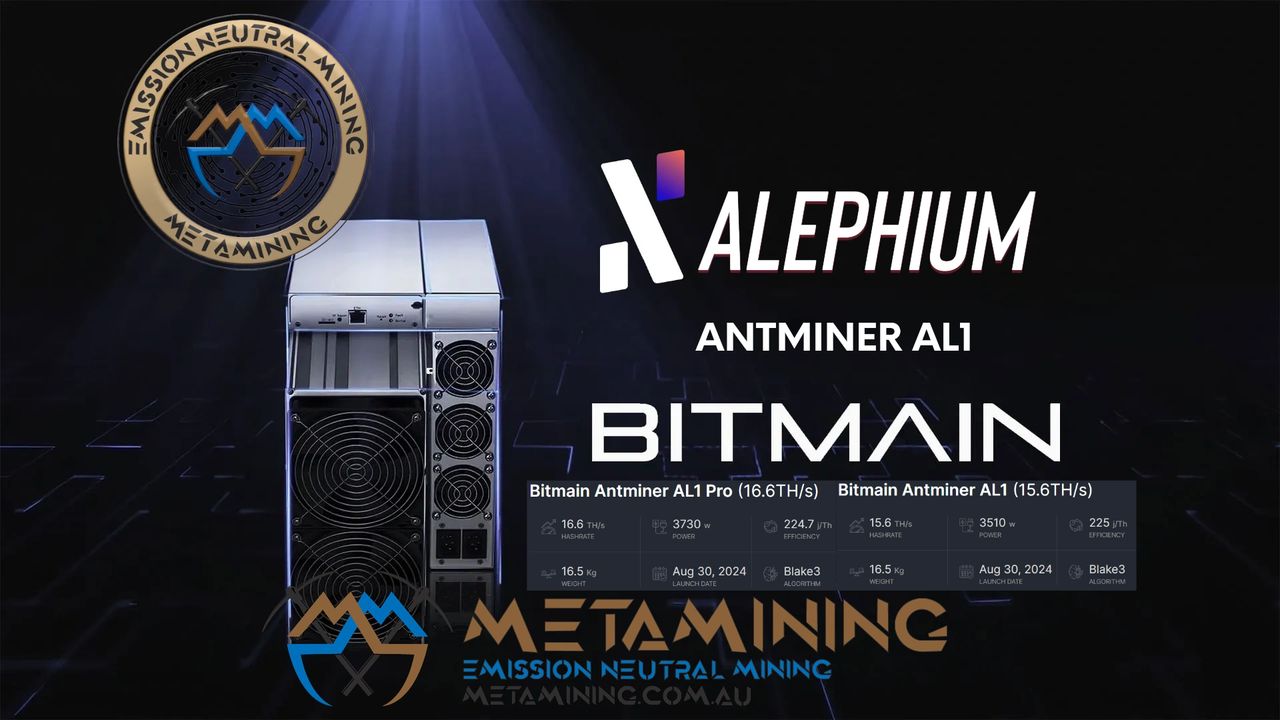
It is less energy consuming thanks to POLW. Proof of Less Work combines physical work and Coin economics to dynamically adjust the work required to mine new blocks. Given the same network conditions, Alephium only uses ⅛ of the energy compared to Bitcoin. This is evident in the miners being produced and just how efficient they are at lower power usage. Prior to the recent ASIC miners launched by Goldshell and then Iceriver most recently, Alephium was mined on GPU’s just like ETH back in the day. The mining was very energy efficient and with lower power consumption you could effectively mine Alephium (although Bitmain have just launched a monster unit at 3510w which hashes at a massive 15.6T hashrate and a pro version at 3700w and 16.6T Hasrate mining an insane amount of Alph and is currently the most profitable miner on the market mining over 400+ Alephium coins per day).
It improves on chain structure with its own custom VM (Alphred). It resolves many of the critical issues of the current dApps platforms with huge improvements on security, development experience and introductions of new paradigms such as trustless P2P smart contracts transactions.
It has its own programming language for dApps. Ralph is similar to the Rust syntax, hence its name. It allows to build efficient and secure smart contracts easier than Solidity for example. It is specifically designed to facilitate the creation of Decentralized Finance applications!
Putting all these innovations together, Alephium delivers a highly demanded solution in the industry: a scalable blockchain improving on mature ideas from Bitcoin to deliver reliable, powerful and secure DeFi and dApps capabilities.
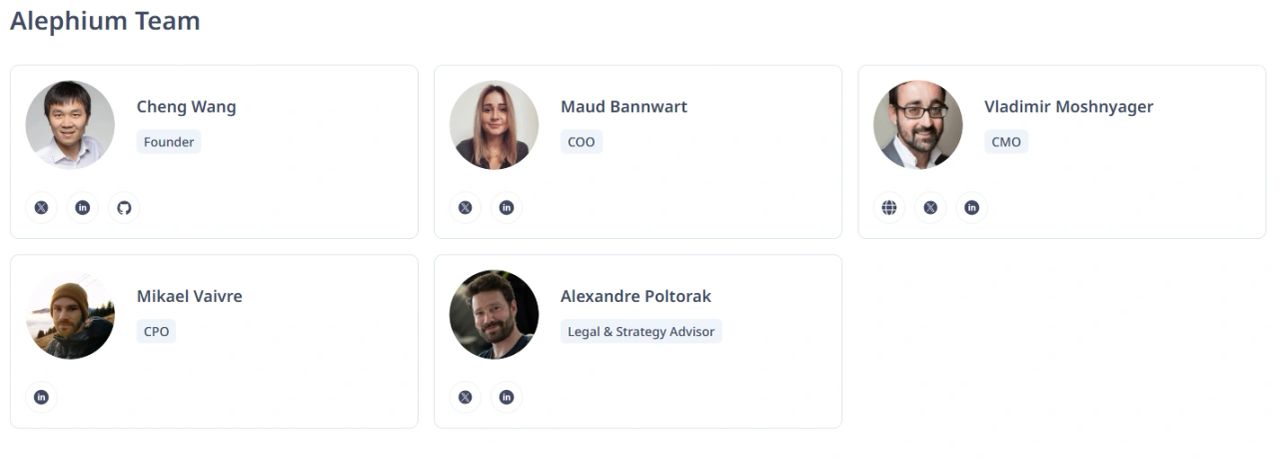
The Alephium Team
The core team count is 14 members. 9 are tech team members and the remaining 5 are part of the operations team. Find them on X
@Cheng Wang#1571 🛠 is the founder, core dev, double PhD dropout in Math & CS, grand wizard of Alephium, working from Lausanne, Switzerland
@s0ukie#8277 ⚙️ is the Chief of Staff, without whom nothing moves, previously @Lykke and @Bestmile. Working from Zürich, Switzerland
Meet the rest of the team on their website or on Linkedin : https://www.linkedin.com/company/alephium/people/
Talk with Alephium
Discord : https://discord.gg/JErgRBfRSB
Telegram : https://t.me/alephiumgroup
Reddit : https://www.reddit.com/r/Alephium/
Connect with Alephium
Twitter : https://twitter.com/alephium
LinkedIn : https://www.linkedin.com/company/alephium
Facebook : https://www.facebook.com/alephium
Read, setup, explore, contribute
Website : https://alephium.org/
Whitepapers : https://github.com/alephium/white-paper
Medium : https://medium.com/@alephium
Github: https://github.com/alephium
Let’s dive a little deeper here…..
Security & Expressivity: Stateful UTXO
Alephium is programmable & secure. Alephium introduces the stateful UTXO model offering layer-1 scalability and the same level of programmability as the account model implemented on ETH, whilst being more secure.
The classical UTXO (Unspent Transaction Output) model is famously used to keep track of accounting in the Bitcoin blockchain. It is also found in Bitcoin Cash, Zcash, Litecoin and many more…
In UTXO, there are no accounts nor balances at the protocol layer, just transactions. Coins are stored as a ledger of unspent transactions output (UTXO) & new transactions consume existing UTXOs to produce new UTXOs. This model is simple to understand conceptually, it scales well and is very transparent. It has a few downsides: it doesn’t have a state and is not expressive enough for developers, meaning it’s hard to build complex programs on top of it.
The account model is more intuitive and closer to a classic database. It records the increase/decrease in balances of addresses when transactions happen. This structure is more accessible and easier to master for developers, enabling a more “expressive” system: developers can build dApps more easily. The account model also has limitations: parallel execution is hard, MEV is a constant drag, and it often lacks enough security checks to be secure at the smart contract level.
Alephium combines the security of the UTXO model with the expressiveness of the account model. It achieves this by actually using both… but for different things! UTXOs are used for assets/tokens and the account model for smart contracts and states.
The sUTXO is a massive improvement for developers as they can interact with an upgraded account model specifically dedicated to token handling. Lastly, the sUTXO model gives a solid foundation to build smart contracts by giving an assurance of secure asset management.
Scalability and Sharding: BlockFlow algorithm
Alephium scales through sharding: its state is divided into groups, and the transactions are processed in parallel by several blockchains to increase throughput. Its sharding algorithm is called Blockflow, and allows for huge UX improvements with single-step cross-group transactions.
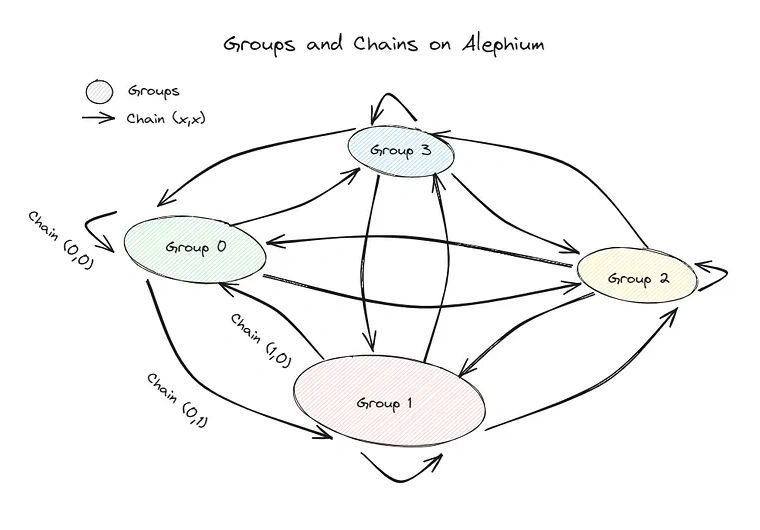
Sharding enhances the scalability of blockchain networks by splitting up information across multiple areas or “shards” to increase the throughput capacity. This allows Alephium to handle a lot of transactions per second (400 as of today and more than 10k upon further development). For reference, Bitcoin can handle 7 transactions per second.
In account-based chains, accounts are partitioned into chains. Because of that, cross-chain transactions require complex mechanisms like bridges or beacon chains and are generally not single-step or uniformly secured, leading to complexity for users and for developers to provide a secure experience.
By contrast, in Alephium, single-step cross-group transactions sets Blockflow apart from traditional sharding algorithms as it offers a more efficient and better developer and user experience due to single-step cross-group transactions.
Energy efficiency: Alephium’s Proof of Less Work (PoLW) consensus mechanism
Alephium is less energy-consuming thanks to Proof of Less Work. It combines physical work and Coin economics to adjust the work required to mine new blocks dynamically. Given the same network conditions, Alephium only uses ⅛ of the energy compared to Bitcoin.
This works by allowing miners to shift, after a certain point, part of their external cost to internal network cost through burning coins.
This keeps the essential mechanics of increasing mining costs while not increasing energy consumption. Therefore, it allows Alephium to reduce its energy consumption without compromising security.
Alephium tokenomics
The token supply on Alephium is limited with a hardcap of 1 billion. At Mainnet Launch (11.8.21), an initial supply of 140M tokens (14% of the hardcap) was mined with the genesis block. The remaining supply of ALPH tokens will be mined over the years. Of these 140M tokens:
80M tokens (8%) 🤝 Pre-sales and future strategic private sales. Vesting periods varying from 2 to 4 years.
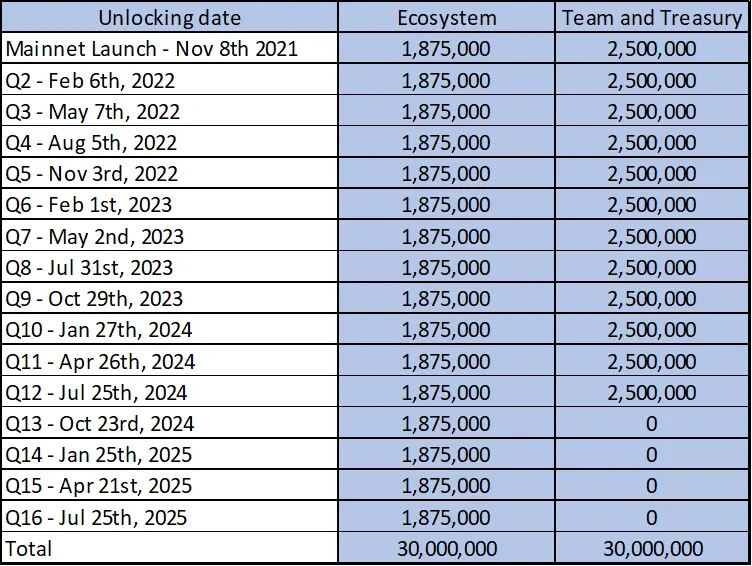
30M tokens (3%) 💡 Community and ecosystem development. Locked on-chain for 4 years and vested quarterly.
30M tokens (3%) 🧑💻 Treasury & Team. Locked on-chain for 3 years and vested quarterly.
860M tokens (86%) 🌊 Mining Rewards. These tokens will be used for mining rewards over years. They ensure the processing of transactions and the execution of smart contracts on the Alephium blockchain.
In addition, half of the transaction fees are burned with each block and Proof of Less Work enables internal mining cost through burning when the hashrate and energy consumption are significantly high.
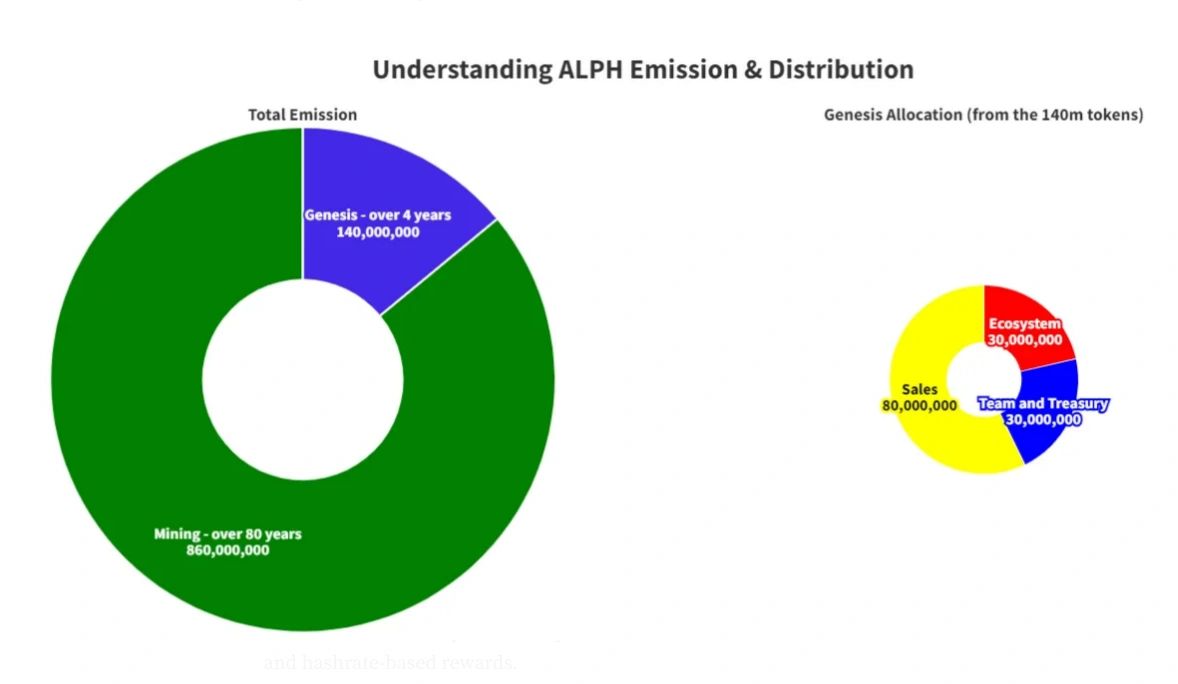
Mining Emissions
As Alephium uses Proof of (Less) Work, 860 million ALPH will be mined and distributed to the miners who secure the network as block rewards. There is no halving on Alephium, the block reward is adjusted dynamically depending on the network hashrate and timestamp.
The core emission schedule works like this: the block reward is bound by two curves based on hashrate and timestamp. At a given time and for a given hashrate, the reward per block equals the minimum between the time-based and hashrate-based rewards.
Block Reward = min (time-based reward, hashrate-based reward).
Deflationary forces
While inflationary, thanks to mining, Alephium also has deflationary forces:
- 100% of the transaction fees are burned. (Before the Leman Network Upgrade in March 2023, only 50% of the transaction fees were burned).
- Alephium’s Proof of Less Work will require coin burning when it’ll be triggered to internalize part of the mining cost through the upfront burning of ALPH.
Genesis Allocation & Vesting Schedule
The genesis ALPH are allocated as follows:
- 80M (8%) for past and upcoming sales, subject to on-chain lock upon sales with varying vesting periods.
- 30M (3%) for ecosystem development, vesting over 4 years in quarterly unlocks.
- 30M (3%) for treasury and team, vesting over 3 years in quarterly unlocks.
Please note that according to CoinmarketCap’s official methodology, Ecosystem and Team wallets are to be excluded from the circulating supply (whether the tokens are locked or not). Therefore, these ALPH will only be counted as circulating after they leave the original wallet and not after they unlock.
Sales allocation vesting
Three sales events were held for ALPH: seed sale, pre-sale, and private sale. A total of 62,951,077 ALPH were sold and locked for periods varying between 2 to 4 years. The unlock schedule is detailed below.
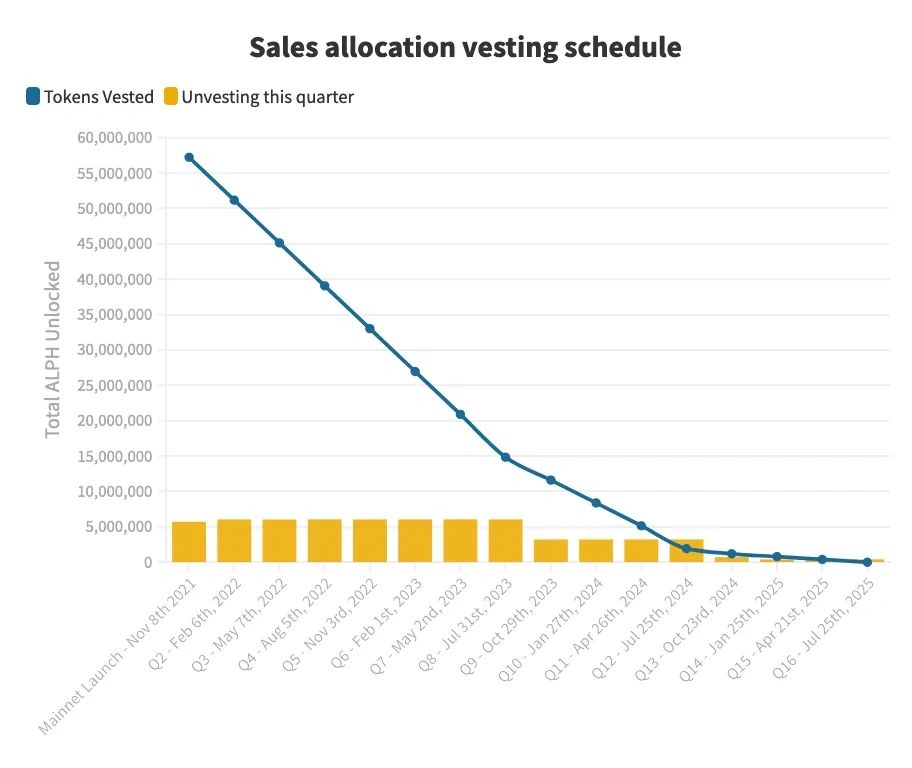
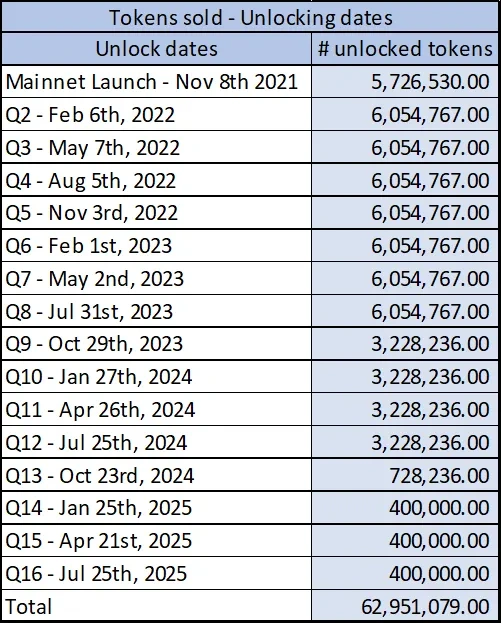
The remaining 17,048,943 ALPH will be used to secure funds to ensure the long-term development and sustainability of the project. This will be done over the medium to long term, in a variety of ways, from direct sales, liquidity provisioning and OTC deals, optimizing for minimal impact on the markets while improving the liquidity, distribution & circulation of ALPH.
Ecosystem and Treasury allocation vesting
The ALPH allocated to the Ecosystem and for the Treasury follows this unlock schedule:
Circulating Supply: Circulating Supply is the best approximation of the number of assets circulating in the market and the general public’s hands. Are not part of the Circulating Supply ALPH that is locked (via smart contracts or legal contracts), allocated to the team or private sale participants, or in Ecosystem/Bounty/Marketing initiatives.
Total Supply: This is the number of ALPH in existence today. Basically, the sum of the initial supply (minted at genesis block = 140M ALPH) plus the ALPH mined until today, minus the ALPH burned (by transaction fees burned for example).
Maximum Supply: The theoretical maximum of ALPH that can exist, it is set at 1 billion. However, it will never be reached due to the various deflationary mechanisms of Alephium.

A unique VM & powerful language & tools: Alphred, Ralph & the Asset Permission System
Alephium provides a unique tool for devs, its own VM: the combination of Alphred (the VM), Ralph (the programming language) & the APS (Asset Permission System) leads to increased security through built-in controls and checks, exceptional performance, and unique features (such as flash loan resistance) thanks to the UTXO model.
In addition to increasing resilience against MEV with its MEV-aware design, Alephium’s VM addresses the most common attack vectors and security pitfalls of the industry, like reentrancy attacks, unlimited authorization, double dip issues, flash loans, and more!
The Ralph smart contract programming language focuses on three goals: security, simplicity, and efficiency. It was built to be extremely expressive and easy to use, even for beginners Ralph has been tailored to be secure by design as it leverages the built-in features of the VM.
Alephium’s Asset Permission System (APS) offers a safer and more flexible solution to eliminate Ethereum’s token approval risks. Controlling the flow of assets, APS provides enhanced security and greater control over transactions.
As blockchain technology evolves, innovations like APS pave the way for safer and more robust decentralized applications. Developers and users alike stand to benefit from this improved approach to managing and securing digital assets on Alephium.
Alephium’s Growing Ecosystem
Following its first network upgrade in spring, a ramp-up in communication in the summer, the launch of a Bridge to Ethereum in the fall and new listings at the end of the year, Alephium has bloomed into a vibrant ecosystem & attracted a lot of attention and new users.
Alephium places a significant focus on UX, and has released a full suite of wallets: a desktop wallet (Mac, Windows, Linux), a browser extension (chrome & firefox), as well as android & iOS mobile wallets. This has helped tremendously to onboard people to its ecosystem! Alephium Launches Browser Extension Wallet | by Alephium | Medium
Thanks to the bridge, a lot of TVL has migrated to Alephium’s ecosystem, and conversely, more than 6’000 Ethereum addresses now own wrapped ALPH on Ethereum. Uniswap is now one of the biggest trading venues for the token.
It became much easier for new developers to discover how powerful it is to build decentralized applications there. With the help of Alephium documentation, dApps’ proof of concepts, and workshops, many dApps were developed in the past few months.
Ayin is the first decentralized exchange (DEX) on Alephium, Deadrare has been the first NFT marketplace & gaming apps like ALPH.bet allow users to experiment with on-chain bets & lotteries of ALPH & other tokens! You can find all of these alph.land, the repository of all things Alephium. And many more are coming with the hackathon.
Lastly, Blockflow Alliance DAO is the first decentralized autonomous organization on Alephium. It is dedicated to boosting adoption & usage, expanding the community, nurturing development & promoting the Alephium ecosystem.
Alephium partners
- UTXO Alliance : https://utxo-alliance.org/
- Bitcoin Association Switzerland : https://medium.com/@alephium/alephium-becomes-a-member-of-bitcoin-association-switzerland-2293fec16fc9
- Cetacean Capital: https://cetacean.capital
- Crypto Valley Association : https://cryptovalley.swiss/
- Dappnode: https://dappnode.io
- Ergo : https://ergoplatform.org/
- Flux Labs : https://runonflux.io/fluxlabs.html
- Hodling SA : https://www.hodling.ch/
Glossary | Alephium Documentation
The best of many worlds
Alephium is the first operational sharded blockchain bringing scalability, ETH-inspired secure smart contracts, and energy efficiency to Bitcoin’s proven core technologies (UTXO and Proof-Of-Work) while ensuring better performance. Alephium also focuses on usability and accessibility making it the perfect blockchain to support decentralized applications and open protocols.
Alephium is built on the BlockFlow and PoLW algorithms. BlockFLow delivers efficient and practical stateful UTXO sharding. PoLW uses a clever combination of physical work and token economics to dynamically adjust the work required to mine new blocks, ensuring a reduced energy footprint compared to classic Nakamoto PoW mining. As in many other blockchain networks, the token mechanism of Alephium is crucial for its operation.
Mining is a critical component of maintaining and developing a public ledger. It is the process of validating transactions and adding them to the Alephium blockchain. In addition, mining is the only way to issue new Alephium tokens. A consensus protocol has been implemented to ensure only Alephium miners can mine and validate transactions. In Alephium, this is called “Proof-of-Less-Work” (PoLW).
For this process to be decentralized, having as many miners participating as possible is important. Hence, to incentivize the mining, the blockchain rewards the miner who successfully issues a new block and facilitates the transactions.
Alephium will be mineable over the next 80 years so there is still time to get started – this project actually looks very promising. As Alephium uses Proof of (Less) Work, staking isn’t supported natively on Alephium. However, in the future, staking or liquidity pools could be offered by third-party decentralized applications or protocols built on top of Alephium.
I would imagine miner prices coming down as network hashrates climb in the coming months, it can pay to get in relatively early and claim the larger rewards on offer such as the 400+ coins per day on offer with the new Bitmain Al1 miner. Either way it just may prove to be a worthwhile time as miner prices have recently come down slightly, and we are aproaching the run up stage toward the bull run peak over the next 6-9 months and then the question remains will there be two peaks or one this next run? Will we have one in April/May and then another in September/October?. If we do see a surge, then the price of Alephium may be so, that the profitability of these miners stays high, even as the hashrate increases and coin production drops, and if this is the case then machines prices will likely move higher.
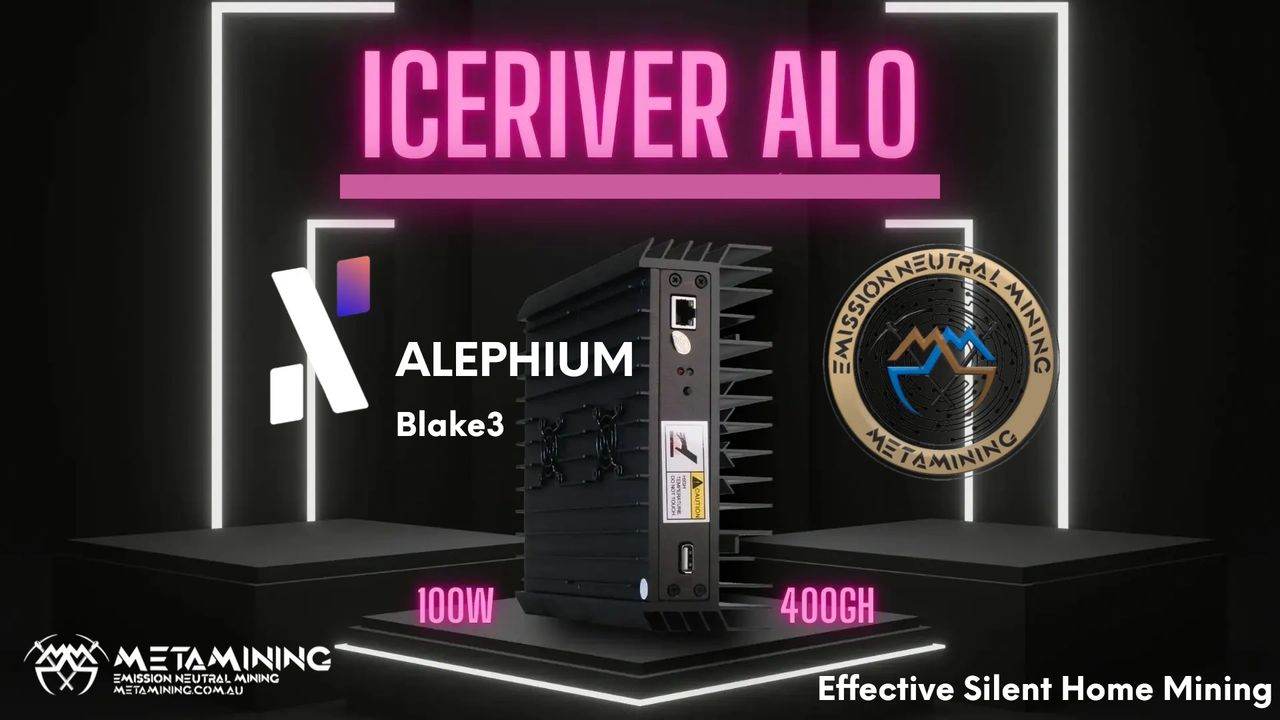
Do your homework further and ensure your mining ventures are balanced and stable, never place all your eggs in one basket, some diversification is the key. Alephium certainly looks a very promising project over the long term with its superior design to many other blockchains, if the team develop it wisely and with the right level of dApps and a robust ecosystem then this coin could easily become a future top 20 coin and compete with the likes of SOL, ETH and XLM. Enjoy the journey and certainly keep this in your watchlist or start mining it to some degree, even on a small AL0 home miner as it may reward you handsomely in time.
Happy Mining
Rusty Rigs

Disclaimer: The content on this site and in this communication should not be considered investment or financial advice. Any investing or crypto mining is speculative. When investing your capital is at risk, please do your own research and invest and make your decisions wisely. Mining profits are not guaranteed and may vary over time depending on the market performance and network hashrates.