
Crypto Altseason & The Rise and Rise of Bitcoin


Multiple charts scream ‘It’s altcoin season’ as Bitcoin dominance hits 8-week lows
Bitcoin dominance charts moving downward may be a signal that the much-anticipated “crypto altseason” is finally here!
According to crypto traders, many altcoins are currently displaying some bullish patterns that suggest “it’s altcoin season” as Bitcoin dominance begins to drop.
Altcoins eye “phenomenal” rally to $2.78 trillion
In the latest altseason crypto analysis, trader Jelle highlights a breakout from a highly bullish continuation cup-and-handle setup forming on the TOTAL3/USD weekly price chart.
TOTAL3 refers to the combined market capitalization of all cryptocurrencies excluding Bitcoin
BTC$118,226 USD and Ether ETH$3,574 USD.
A break above the neckline of the pattern at $1.1 trillion could push TOTAL3 up by about 100% to $1.98 trillion.
“Altcoins have broken out from the multi-year cup and handle!” the trader said in a Thursday post on X, adding:
“One last hurdle to overcome, but once this clears $1.1 trillion, everything goes nuts.”

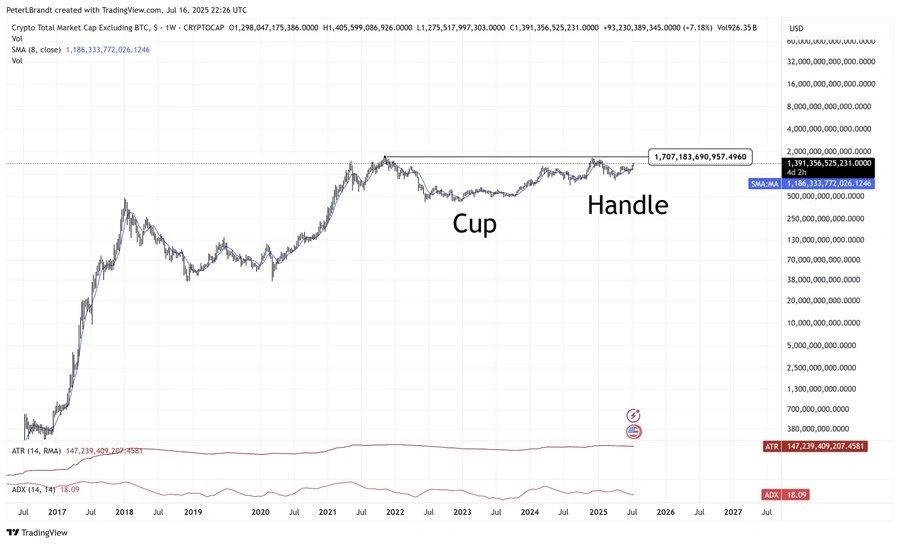
Veteran trader Peter Brandt observed a similar setup on TOTAL2, or the combined market capitalization of all cryptocurrencies excluding Bitcoin, on the weekly candle chart.
The measured target of this pattern is $2.78 trillion, or a 97% rally in the total altcoin market cap.
Responding to the breakout, Brandt said:
“It’s altcoin season.”
Jelle and Brandt’s bullish outlooks come as altcoins posted their strongest performance against Bitcoin since late November 2024, breaking out of a multimonth downtrend as observed by analyst Stockmoney Lizards.

This chart above shows the tide is turning for Alts…
Fueling the altcoin rally is Ether’s 24% performance over the last seven days, suggesting capital rotation from Bitcoin as other cryptocurrencies play catch-up.
“ETH is trading at $3,400. That’s how fast things can go,” said MN Capital founder Michael van de Poppe, adding:
“These six months are going to be phenomenal for Altcoins.”
Crypto Market Is in The Early Stages of Altcoin Season
- Swissblock’s Impulse and Structure indicators suggest the altcoin market has bottomed and is now entering a breakout phase.
- Bitcoin dominance fell from 66% to 64% despite BTC hitting new highs, signaling growing capital rotation into altcoins.
- The Altcoin Season Index hit 35—its highest since February—fueling optimism, though some analysts urge caution due to token saturation.
A recent report from wealth manager Swissblock and insights from other analysts conclude that the crypto market is entering the early stages of an altcoin season.
Although Bitcoin dominance remains high, experts believe the market situation will shift quickly.
Early Signs of Altcoin Season Emerge
Altcoin Vector, Swissblock’s institutional-grade altcoin market report, recently stated that the altcoin season has begun. Their team asserts that the market shows clear signs of capital rotation from Bitcoin into other altcoins.
This isn’t merely speculation. It’s supported by two key indicators used by Swissblock: Impulse and Structure, both of which help track market trends.
Impulse, which measures the percentage of altcoins showing exponential strength, is signaling a shift. Since June, only 8% of altcoins have shown negative momentum. Historically, market bottoms form when this number falls between 15–25%.
Therefore, Swissblock believes the altcoin market has likely bottomed out.
Structure evaluates whether the market is in a breakout position. The analysis highlights that the altcoin market cap (TOTAL2) has broken out with a 22% increase. Past data shows such breakouts often lead to market cap gains between 67% and 96%.
“We’re in the early stage of altseason. And our framework says it’s not a matter of if or when — it’s a matter of how intense.” – Altcoin Vector concluded.

Recently Bitcoin dominance dropped from 66% to 64%, even though Bitcoin reached a new all-time high. This indicates that altcoins are gaining market share faster than Bitcoin, is this enough to say momentum has shifted, is it a precursor for the change in the tide toward Alts?
Altcoin Season Index Hits Highest Level Since February
The Altcoin Season Index stands at 35, its highest since February. According to this index, an official altcoin season begins when 75% of the top 50 coins outperform Bitcoin over the last 90 days.
Although it hasn’t reached the 75 threshold yet, the recent spike to 35 is significant. It’s a strong improvement over the past four months and has fueled growing optimism. There is still some ways to go but momentum is shifting and it can shift quickly.
Several analysts have grown more confident in this prediction. TechDev, a well-known analyst, believes the altcoin market has been suppressed for four years and is now ready to break out. Meanwhile, Michaël van de Poppe emphasizes that this is the best time to buy altcoins and take profits over the next 12 to 24 months.
Still, Nicolai Sondergaard, a Research Analyst at Nansen, warns that even if an altcoin season happens, it may not resemble previous ones.
“I think it’s hard to say whether the much-awaited altseason will actually bless us at this time. BTC dominance remains high at 64.59%. Although it has been flattening somewhat, likely due to capital flowing into ETH, SOL, and HYPE as some of the major players, that doesn’t necessarily imply that funds will trickle down into alts as they have in previous cycles. One of the key challenges facing the altcoin market today is the saturation of tokens,” Nicolai Sondergaard
Early this week the altcoin market cap (TOTAL3) reached $933 billion, a more than 14% increase since the beginning of July.

Is Bitcoin season ending?
Bitcoin dominance, or Bitcoin’s market share relative to the overall crypto market, is one of the indicators commonly used to indicate whether Altseason has begun. It reflects overall investor sentiment and risk appetite in the market.
This indicator had been on a downward trend since June 27, reaching an eight-week low of 62.61% on Thursday.

Several analysts said Bitcoin’s market dominance had reached its peak as altcoins continued pushing higher.
Popular crypto analyst Mikybull Crypto said, “Bitcoin dominance is dumping” as it breaks below the critical support provided by the 50-day simple moving average (SMA) at 64.78% and the 100-day SMA at 64.38%.
“Massive for altcoins.”
Bitcoin dominance is “breaking down slightly but has a long way to go to confirm a larger turnaround is due,” said Daan Crypto Trades, suggesting that it might be too early to call an Altseason.
For example, Blockchain Center’s altcoin index has more than tripled since June 22. But it is still only 39% of the top 50 altcoins that have outperformed BTC during the last three-month period, far from the 75% needed for an official altcoin season.
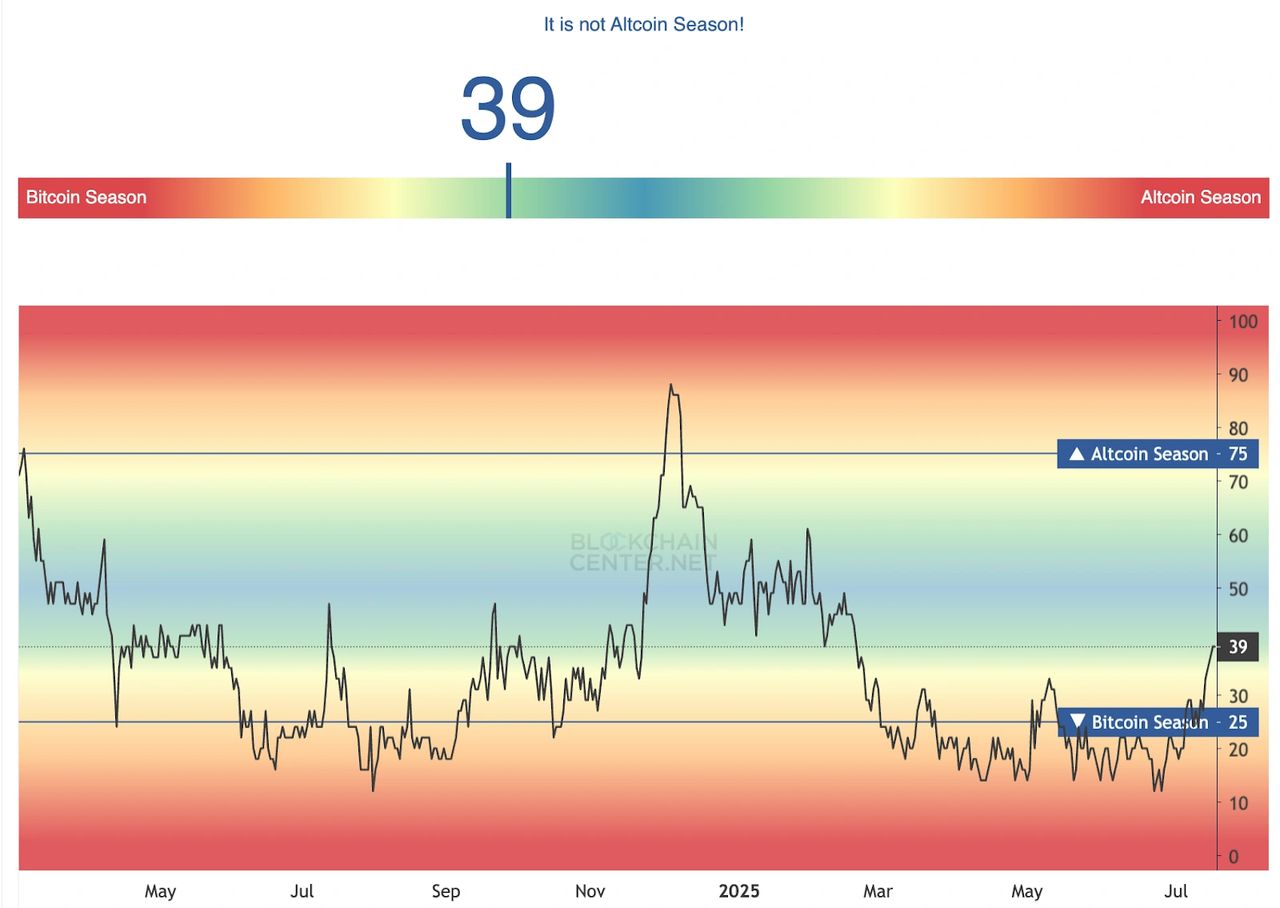
It appears that the tide is turning but we will need to see more of a move and more Altcoin dominance to firmly declare Altseason is in full swing.
Bitcoin has slowed following a profit-taking dip, but investor conviction is rising as U.S. lawmakers advance new crypto legislation.
Bitcoin has reclaimed the $120,000 mark following a brief pullback earlier this week as renewed institutional flows continued to be buoyed by clearer U.S. crypto policy.
Its return comes after profit-taking briefly capped the alpha crypto asset’s momentum, stalling a seven-day rally that had pushed it to new highs.
Last week’s rally found a local bottom near $114,000, QCP Capital said in its Wednesday Asia Colour note, adding that Bitcoin has since hovered in a tight range as traders assess whether that would hold or give way to a deeper retracement. Currently it is ranging sideways tightly holding the $118K USD band.
U.S. equities, which have been closely tracking Bitcoin’s rise this year, have stalled since early July, a drift the firm said could signal exhaustion. The S&P 500 has risen by just 0.6% over the past five days, according to Google Finance data.
“Equities have so far shrugged off a cocktail of headwinds, from elevated base tariff levels to fresh threats targeting nations purchasing Russian oil,” QCP wrote.
Still, institutional confidence in Bitcoin appears to be gaining momentum, despite persistent macroeconomic risks.
“The push for regulatory clarity is a major confidence booster for both retail and institutional investors,” James Toledano, chief operating officer at Unity Wallet.
Toledano is referring to key developments in crypto policy over the past few weeks, centered on the U.S. House’s passage of the GENIUS Act on Thursday.
“While the outcomes are still pending, the signal is clear: U.S. lawmakers are engaging seriously with crypto. And ultimately, clarity invites capital,” Toledano said.
Others see broader liquidity trends supporting the rally.
Bitcoin “continues to grind higher” as fresh liquidity comes in, Vincent Liu, chief investment officer at Kronos Research.
The rally is “driven by corporate treasury traction, steady stablecoin flows, and a maturing crypto ecosystem,” he added, noting that while this is the case, the current rally is open to risks including “a dollar rebound and stubborn inflation.”
Macro data on the horizon could also challenge the rally’s resilience, Liu noted, pointing to jobless claims set for release on July 24 as a key test.
A stronger-than-expected print, he cautioned, could “revive rate hike fears and pressure crypto.”
Supply and demand
Other observers remain steadfast in their assessment of Bitcoin’s trajectory, citing its fundamentals and institutional demand. Ryan Yoon, senior analyst at Tiger Research, said he sees the uptrend continuing despite lingering headwinds.
“While short-term profit-taking will continue amid the recent price surge, supply and demand dynamics are poised to strengthen further,” he said.
Yoon also said corporate adoption of crypto, particularly for Bitcoin as a treasury asset, has continued to gain momentum since the second quarter.
The trend shows firms pivoting their treasury to Bitcoin, Ethereum, Solana, and other crypto assets, even as some face financial struggles.
“This momentum shows no signs of abating,” Yoon observed.
Despite this, Yoon points to “elevated short-term inflation expectations, diminished prospects for interest rate cuts, and the intensifying tensions between Trump and Powell” as negative signals for the market.
While tariffs are a “risk the market has already priced in,” broader factors like war and geopolitical escalations are “always looming,” he said.
“Nevertheless, even if an altcoin season gains speed, Bitcoin’s dominance is unlikely to decline given the accelerating inflow of institutional capital,” he said.
XRP and Ethereum Are Pumping: Is Solana Next? Here’s What the Charts Say
XRP soared to new all-time highs this week, with Ethereum showing impressive weekly gains. Technical indicators suggest Solana may not be far behind.
It certainly feels like altcoin season is in the air. With Bitcoin trading sideways today, crypto traders appear to have their eyes set elsewhere: Ethereum has surged past the $3,300 mark, currently trading at $3,339.13 after a strong 20% weekly gain. XRP is up, eclipsing its 2018 all-time high. Could Solana, the Ethereum rival sitting just outside of the top 5 coins by market cap, be next?
The macro picture continues to look promising for risk assets. The cryptocurrency market marches forward on its recent rally, with total market cap reaching $4 trillion this past week. Bitcoin, though failing to break past $120,000 since earlier in the week, still holding a commanding $2.3 trillion in market cap on its own.
Traditional markets show mixed signals with the S&P 500 losing 0.40% and closing at 6,243.76, easing from a fresh record high reached earlier in the session. The Nasdaq was an overperformer, adding 0.18% and posting a record close of 20,677.80.
So where does that leave Solana?
Solana approaches a golden cross

It might come as no surprise, given recent moves by both XRP and Ethereum, that the charts are looking bullish for SOL, the native token of the Solana blockchain.
Solana has posted a 9.7% gain over the past week, currently trading at $175.15 after testing the psychological $180 level. The recent surge comes on the heels of multiple bullish catalysts, including the launch of Virtune’s Staked Solana ETP on Deutsche Börse Xetra, offering regulated exposure to SOL with staking rewards. The spillover effect from Ethereum’s massive ETF inflows has created additional demand for high-beta altcoins like Solana, with trading volume exploding to confirm genuine market interest.
The technical picture for Solana presents a compelling bullish case across multiple indicators. Solana finally defeated its bearish triangle, breaking a price resistance level in play since early 2025.
The Relative Strength Index, or RSI, measures the speed and magnitude of price changes to identify overbought or oversold conditions. At 68 points on the RSI, SOL shows strong bullish momentum without yet reaching the overbought threshold of 70. This is generally interpreted by traders as bullish as it indicates buyers are in control while still having room to push prices higher before hitting exhaustion levels. Traders typically see RSI readings between 50-70 as the “sweet spot” for sustained upward movement.
The Average Directional Index, or ADX, for SOL is at 21, which is a good thing for SOL bulls in this case. ADX measures trend strength regardless of direction, with readings above 25 confirming a strong trend. At 21, this suggests the bearish correction that took the price of SOL down 47% from May highs is weakening. For traders, this means SOL could be on the verge of a confirmed bullish breakout.
As for the token’s Exponential Moving Averages, or EMAs, the chart shows a 50-day EMA (orange line) currently below the 200-day EMA (red line), typically a bearish signal. EMAs are price averages over a given period of time. However, the price has decisively broken above both averages, currently trading around $175 while the EMAs sit near the $160 price zone.
As the two EMAs approach, we may be about to enter into a golden cross scenario, further confirming Solana’s transition from bearish to bullish. Regular readers may remember that Ethereum, which leads Solana by several billion in market cap, recently formed this same pattern on its own charts, fueling bullish momentum.
The Squeeze Momentum Indicator for Solana shows “off” status, indicating volatility has already been released from a previous compression phase. This was necessary for prices to break past the heavy resistances and may suggest SOL has moved out of consolidation and is now in an active trending phase, which typically supports continued directional movement rather than choppy sideways action.
The visible range volume profile shows significant trading activity in the $150-160 zone, creating a strong support base. This high-volume node acts as a “magnet” that should provide support on any pullbacks, as many traders have positions in this area they’re likely to defend.
Key Levels
- Immediate support: $160-162 (previous resistance turned support)
- Strong support: $150-155 (high-volume node and EMA confluence)
- Immediate resistance: $189.03 (horizontal resistance visible on chart)
- Strong resistance: $200-205 (psychological round number and measured move target)

XRP: Knocking on history’s door
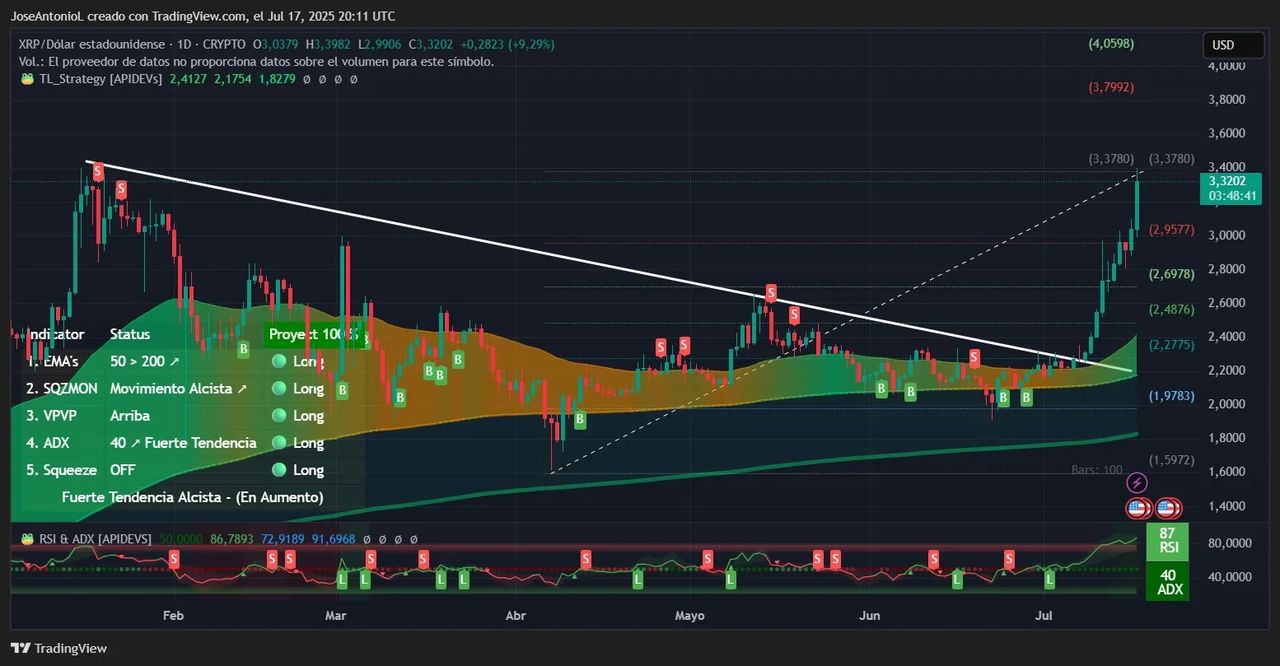
When it comes to XRP, there’s no other way to put this: the coin is delivering stunning returns for its true believers. XRP surged as high as $3.47 USD, breaking past its 2018 all-time high of $3.40.
It now seems like a near-certainty that XRP will hit at least $3.50 sooner rather than later, with users on Myriad — placing the odds at a commanding 95%.
The current price represents a massive rally fueled by regulatory optimism surrounding crypto-friendly bills in the U.S. Congress and the launch of ProShares’ XRP Futures ETF. With the token now practically in price discovery mode after breaking its long-standing triangle pattern, the technical setup suggests potential for significant further gains if the all-time high is decisively broken.
XRP’s technical indicators are firing on all cylinders, painting an extremely bullish picture:
The RSI reading of 87 indicates extreme overbought conditions, as readings above 70 typically signal overextension. However, in strong trending markets, especially when breaking multi-year highs, RSI can remain overbought for extended periods. This is what traders call “embedded RSI,” where the indicator stays above 70 while price continues higher.
While it warns of potential short-term pullbacks, it also confirms exceptional buying pressure that often accompanies historic breakouts.
With its ADX at 40, XRP shows an exceptionally strong trend. Readings above 25 indicate strong trends, but levels above 40 signal what is referred to as “power trends”—moves so strong they often continue beyond logical targets. Momentum traders should stay with the trend rather than fight it—but those who missed the bus should probably wait for a better moment unless they can handle the risk or a normal correction after all-time high levels.
Unlike Solana, XRP displays a perfect bullish EMA setup with the 50-day EMA well above the 200-day EMA. The price at $3.47 trades significantly above both averages, with strong separation between them. This configuration typically indicates a mature uptrend with institutional support, as longer-term investors have been accumulating throughout the move.
Technically speaking, the coin is so bullish that even a 25% drop would remain healthy and inside the broader bullish trend.
Key Levels
- Immediate support: $3.00 (psychological level and engulfing candle canceling today’s gains)
- Strong support: $2.69 (previous resistance zone)
- Price test zone: $3.40
- Next target at approximately $3.79 based on the 127.2% Fibonacci extension
- Ultimate target near $4.00-$4.05 based on the pattern’s measured move and next round number

XRP News: Fedwire Adopts ISO 20022 Boosting XRP and Crypto Adoption
Fedwire, the U.S. Federal Reserve’s real-time gross settlement system, has officially adopted the ISO 20022 messaging standard, marking a significant shift in global payment processing. This transition, set to take effect on July 14, 2025, aims to enhance the speed, security, and interoperability of financial transactions worldwide.
ISO 20022 is a global standard for financial messaging that facilitates seamless cross-border payments. It supports rich data exchange, enhanced security, and better compliance, making it a crucial upgrade for
financial institutionsFISI–. With Fedwire now compliant with ISO 20022, blockchain projects that meet this standard are poised to become top choices for banks and payment systems seeking fast and programmable settlement options.
Several major cryptocurrencies are already compliant or aligned with ISO 20022 standards. These include XRP,
Stellar (XLM), Cardano (ADA), Algorand (ALGO), Quant (QNT), and Hedera (HBAR). Each of these cryptocurrencies has unique use cases that align with the benefits offered by ISO 20022. For instance, XRP is known for its global payments and banking partnerships, while Stellar focuses on stablecoin infrastructure and fintech adoption. Cardano, on the other hand, is recognized for its decentralized apps and scalability focus.
XRP, in particular, is seen as a natural fit for Fedwire due to its reputation for enabling real-time, low-cost cross-border transactions. Ripple’s On-Demand Liquidity (ODL) product is already used by major financial players, and the adoption of ISO 20022 further enhances XRP’s relevance. Recent on-chain data indicates a surge in XRP wallet creation and higher transaction volume, suggesting that institutions are preparing for blockchain-based cross-border payments. If U.S. institutions explore Fedwire XRP payment integrations in the future, it could significantly boost XRP’s price and adoption.
Cardano (ADA) is another blockchain that is fully compliant with ISO 20022. Its decentralization, scalability upgrades such as Hydra and Mithril, and the new ADA/USD1 trading pair on Bitrue are boosting liquidity and confidence in the network. Analysts expect ADA to rally toward $0.90–$1.20, with higher lows and volume growth suggesting a bullish breakout.
Stellar (XLM) is seen as a fintech-friendly platform for ISO-compliant solutions, focusing on stablecoin issuance and low-fee payments. Algorand (ALGO) is praised for its energy efficiency and institutional-grade performance, with discussions ongoing with multiple central banks for CBDC development. Quant (QNT) connects legacy systems with blockchain, positioning itself as a key player in financial network interoperability. Hedera (HBAR), backed by top firms, focuses on enterprise-grade speed and security, making it suited for high-volume ISO-compliant transactions.
With ISO 20022 now live on Fedwire, this transition could mark a turning point for the XRP price and similar crypto assets. Analysts expect more traditional finance players to adopt blockchain rails, leading to increased institutional interest in ISO 20022 crypto list tokens and a growing use of Fedwire-compatible crypto payments. The adoption of ISO 20022 by Fedwire is more than a technical update—it’s a gateway to blockchain-powered finance. Projects like XRP, Cardano, and Stellar are at the forefront, ready to support a new era of instant, secure, and compliant global payments. If XRP finds its way into future Fedwire payment flows, its price and usage could skyrocket.

99% chance’ Bitcoin dominance has peaked if Ethereum surge continues
The odds are low that Bitcoin dominance will continue pushing higher if Ether holds its current bullish uptrend, says crypto analyst Matthew Hyland.
Crypto analyst Matthew Hyland says that Bitcoin’s market dominance has reached its peak if the price of Ether continues its upward trend.
“If ETH breaks bullish and remains bullish against BTC there is a 99% chance BTC Dominance has topped,” Hyland said in an X post on Tuesday.
“Impossible” for BTC dominance to spike if ETH pattern holds
“It is basically impossible for Dominance to push higher if ETH continues higher against BTC,” Hyland added.
Bitcoin
BTC $118,037 USD dominance — a measure of Bitcoin’s share of the market — is at 63.82% at the time of publication, up 9.89% since Jan. 1, according to TradingView.
Over the past seven days, it is down 1.85%, which crypto trader Ash Crypto said is because “money flowing into ETH & altcoins.”
Bitcoin’s rising market dominance typically suggests that investors favor Bitcoin over altcoins, while a decline may signal growing confidence in the broader altcoin market.
Meanwhile, Ethereum…
ETH $3,552 USD is up 19.87% over the past seven days, trading at $3,117, according to CoinMarketCap data. Crypto trader Cas Abbe said the asset is at a stage of one of the most obvious bull flag formations, “and it’s getting closer to a breakout.”
Bitcoin may consolidate short term
Ether’s relative strength against Bitcoin has spiked almost 10% over the past 30 days.
Capriole Investments founder Charles Edwards advised that he expects Bitcoin’s market to cool off following its recent high of $122,884 on Monday but believes the uptrend will pick back up toward the end of the year.
“I see some consolidation here after the big move, but ultimately higher into year end,” Edwards said.
While TradingView’s Bitcoin Moving Average Indicator signals the asset is a “Strong Sell,” many crypto analysts predict much higher for the asset before the year-end.
21Shares crypto research strategist Matt Mena feels that Bitcoin isn’t likely to enter a downtrend anytime soon, with strong fundamentals supporting its trajectory.

Ethereum’s ‘Trustware’ era could push ETH to $15.8K — Consensys
While I may not be a massive fan of ETH personally and I feel that its performance to date since the merge to PoS has been lacklustre, there is hope yet and while having a brief conversation with Dan our senior Tech and IT guru at Metamining he pointed out quite a few valid points where ETH still has value yet to add.
He told me not to write it off just yet, and he makes a lot of sense. With all the new fabric of regulations and with all that is still yet to come within the merging of the crypto space and traditional finance ETH does have a great deal to offer.
As Ethereum marks a decade, Consensys touts its security architecture and “trustware” thesis as key to its long-term role in global finance.
Ethereum nears its 10th anniversary, blockchain company Consensys is proposing a new way to think about the network’s role in the global economy: as critical infrastructure for what it calls a “trustware” era.
According to Consensys, Ethereum is evolving beyond a smart contract platform into a foundational layer for verifiable, programmable trust in financial systems and beyond.
While the concept remains speculative, Consensys points to Ethereum’s growing share of tokenized assets, stablecoins and decentralized finance as early signals of that shift, further predicting that demand for Ether
ETH$3,566 USD could rise sharply in the coming years.
Jason Linehan, chief strategy officer at Consensys, spoke about the network’s “cost-to-corrupt” model, a framework he says could help drive ETH to new highs.

Trustware: Ethereum’s next identity
While not often discussed or measured, trust is behind nearly every economic interaction. According to Consensys, the global economy spends over $9.3 trillion annually on trust infrastructure in insurance, legal systems, auditors, compliance, notaries and go-betweens.
The digital era has enabled a new form of trust — borderless, transparent and enforced by code, allowing strangers to transact with mathematical certainty. Consensys calls this “trustware.”
“Trustware is a new way to talk about the incredible value that Ethereum is already bringing to the economy,” Linehan said. “Value that has been built block by block over the past 10 years through the effort of organizations like the Ethereum Foundation, Consensys, and the global Ethereum developer community.”
As traditional financial institutions recognize the efficiency and value of this type of trust infrastructure, Consensys argues that demand for Ethereum will rise accordingly, driving long-term growth in the value of ETH.
How Trustware reshapes Ethereum’s value proposition
The cost-to-corrupt model is a valuation framework that links the market value of ETH to the security required to protect the economic activity on Ethereum. It operates on a simple premise: The more value Ethereum secures, in the form of stablecoins and other DeFi assets, the more expensive it must be to attack the network.
Using a “cost-to-corrupt” model, Consensys predicts the price of ETH to hit $4,900 by the end of 2025 and $15,800 by 2028. Linehan said the model assumes $1 trillion value in stablecoins, $500 billion in tokenized real-world assets (RWAs), and $300 billion in total value locked (TVL) by 2028, figures he considers conservative.
“There are credible projections of $2 trillion in stablecoins and up to $16 trillion in RWAs by 2028 or 2030,” he said, noting Ethereum’s current dominance in both asset classes.
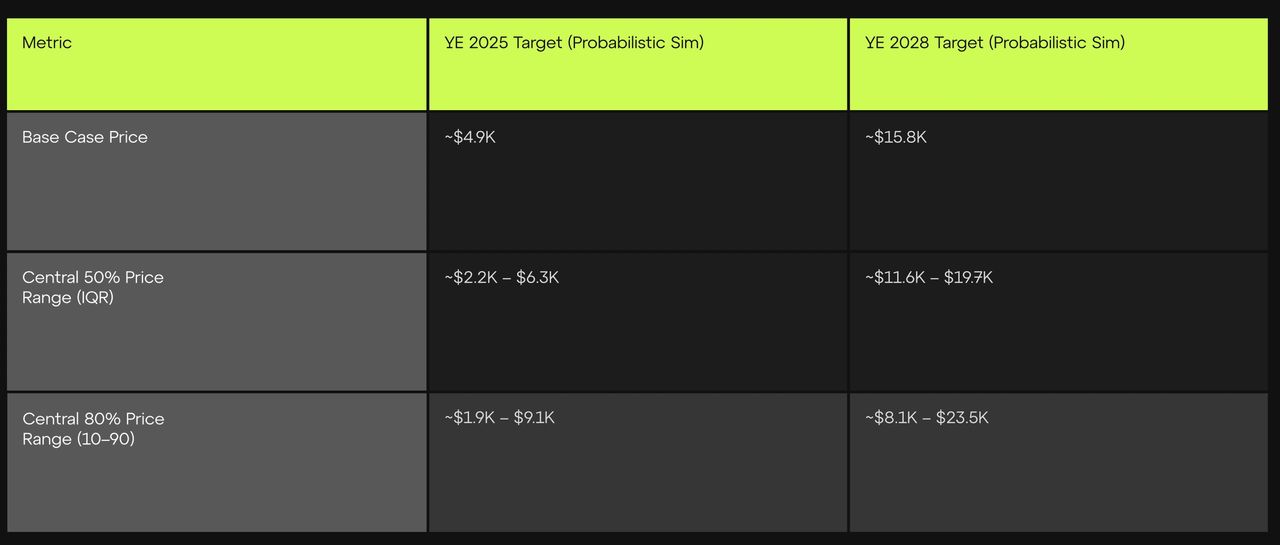
Price call ETH cost-to-corrupt floor & market premium. Source: Consensys
The report also suggests that investors in ETH are still early stages. Currently, the total market capitalization of cryptocurrencies represents 0.3% of global wealth, while stablecoin volume is 0.1% of foreign exchange.
As of May 31, Ethereum had secured $220 billion in High-Quality Liquid Assets (HQLA) onchain, according to Consensys, significantly outpacing Solana’s $20.3 billion and Avalanche’s $3.7 billion, despite these networks growth over the past years.
“The future will not look like the past… it’s going to be an economy like we’ve never seen, and it will blow the doors off of what we have today. Ethereum makes it possible,” said Linehan.
Atheneum’s architecture of safety and scale
As Ethereum nears its 10th anniversary, it boasts 21 network upgrades and a legacy of foundational innovations, and a change from Proof of Work to a Proof of Stake model, including smart contracts, NFTs, tokens, DeFi, DAOs, oracles, rollups, stablecoins, proof-of-stake and RWAs — all pioneered on its platform.
Its new architecture is powered by 1,056,000 validators across 84 countries. Consensys says that while other blockchains may attract specific sectors, like gaming and memecoins, where trustware is less critical, Ethereum is still a prime choice for institutional investors managing billions in global capital.
“Agentic finance will mean tokenized RWAs and all other asset classes will be accessed and transacted in thousands of times a second, 24/7/365, by the most sophisticated algorithms we can imagine,” he said.
What If the Magnificent 7 Allocated Just 1% of Their Cash to Bitcoin?
The largest companies in the world – The Magnificent 7 – Apple, Microsoft, Alphabet, Amazon, Meta, Nvidia and Tesla have balance sheets built to weather uncertainty. Their treasuries are designed for stability, liquidity and scale. Traditionally, this has meant holding large reserves of U.S. dollars, government bonds or short-duration instruments.
But today’s economic climate is challenging that orthodoxy. Persistent inflation, negative real yields, geopolitical volatility and growing distrust in long-term monetary policy have turned “safe” assets into a silent liability. The question facing corporate finance leaders is no longer whether to act — it’s when.
And when that action comes from companies like Apple, Microsoft or Amazon, the implications extend far beyond a single quarterly disclosure. Bitcoin’s design makes it uniquely sensitive to high-quality capital inflows. A single move from one of the Magnificent 7 could reprice the entire market.
Quantifying the Baseline: A 1% Allocation Scenario
The Magnificent 7 — Apple, Microsoft, Alphabet, Amazon, Meta, Nvidia and Tesla — collectively hold approximately $483 billion in cash and equivalents. If each were to allocate just 1% of their treasury to bitcoin, it would represent $4.83 billion in capital flowing into the asset.
At an assumed Bitcoin price of $120,000, this capital would purchase: 40,258 BTC.
This figure is not abstract. It represents over 89 days of global bitcoin issuance at current mining rates (450 BTC per day). It also accounts for more than 1% of the estimated liquid float available on the market.

These are material numbers — not just because of the dollar amounts involved, but because Bitcoin cannot expand its supply to meet demand. It has no board of governors, no central bank, and no facility to “accommodate” treasury flows. The only variable that can adjust in response to demand is price.
Modeling More Aggressive Allocations
What happens if the reallocation rises to 2%? Or 5%?
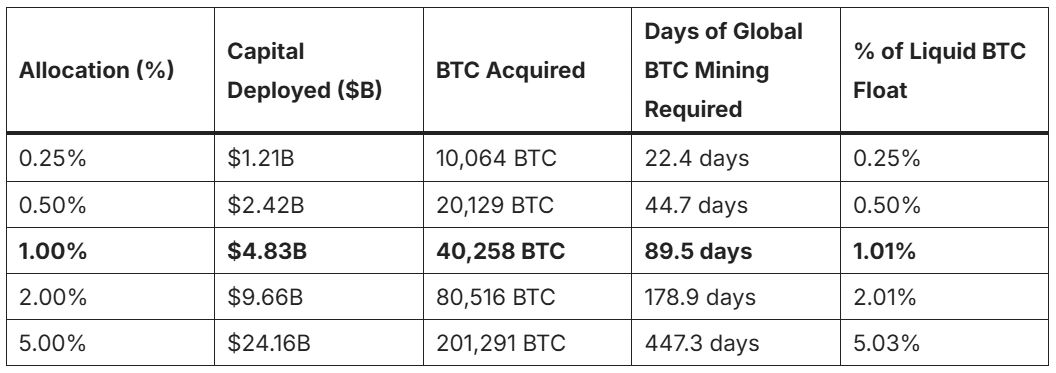
A 5% allocation would attempt to absorb more than 200,000 BTC — an amount greater than what is mined globally in an entire year. It would also consume over 5% of the liquid float. These conditions would strain market liquidity to the point that price would need to move substantially upward simply to clear the order book.
Bitcoin’s architecture rewards early conviction with more coins per dollar. It penalizes delay with rapidly escalating entry costs.
It is important to recognize that corporate treasury strategy is as much about narrative as it is about numbers. The market does not wait for SEC filings or year-end reports. It responds to intent.
A few well-placed remarks during earnings season — a statement from Alphabet about “assessing non-sovereign assets,” or from Amazon referencing “monetary hedging instruments” — would be sufficient to catalyze capital movement. Traders would front-run the announcement. ETFs would accelerate their inflows. Long-term holders would begin withdrawing from exchanges.
The result is a reflexive loop: The mere suggestion of institutional demand contracts available supply, lifts price and forces others to act more quickly to avoid diminished exposure. This self-reinforcing mechanism is especially powerful when the signal comes from companies that manage hundreds of billions in assets.
Bitcoin is not a stock; there is no issuance curve to smooth capital flow. There is only supply, demand, and an open, permissionless global market that reacts in real time.

Peer Dynamics and Strategic Positioning
Tesla’s early entry into bitcoin (11,509 BTC as of today) gives it a significant strategic edge. If another member of the Magnificent 7 were to follow suit — particularly one with an even larger cash position — it would immediately raise questions among the remaining firms.
At that point, the decision not to act would require active justification to shareholders.
Meta, Amazon and Nvidia would no longer be assessing bitcoin in a vacuum. They would be assessing it relative to their peers — peers who are using bitcoin not just as a treasury reserve, but as a signal of long-term thinking and strategic adaptability.
In this way, Bitcoin adoption among the Magnificent 7 would not resemble gradual diffusion. It would behave more like a tipping point.
For companies with strong balance sheets and limited marginal returns on cash, the opportunity cost of doing nothing is rising.
- Cash earns negative real returns
- Bonds carry reinvestment risk and duration mismatches
- Share buybacks have a diminishing impact in a market with declining multiples
- International expansion exposes capital to FX volatility and geopolitical risk
Bitcoin offers none of these liabilities.
It is a non-dilutive, non-sovereign, globally liquid asset that can be held without counterparty exposure. It trades 24/7, settles globally, and is immune to the monetary policies of any single government.
In this light, a 1% bitcoin allocation functions less like a bet — and more like insurance.

What Conviction Looks Like at the Top
Bitcoin does not need the entire S&P 500 to adopt it in order to reprice dramatically.
It only needs a small number of credible actors — those with the capital, visibility, and influence to reshape the narrative and flow.
The Magnificent 7 are uniquely positioned to play this role. With a combined $483 billion in idle cash, even a minor reallocation would have outsized impact on Bitcoin’s market structure.
And once that signal is sent — through words, filings or visible capital flows — the window for low-cost entry closes quickly. Because in bitcoin, the supply never increases.
Only the price does.

Trump set to open $14trn US retirement market to crypto investments
US President Donald Trump is preparing to open the $US9 trillion ($14 trillion AUD) US retirement market to cryptocurrency investments, gold, and private equity in a move that would spur a radical shift in the way Americans’ savings are managed.
Trump is expected to sign an executive order as soon as this week that would open up 401k plans to alternative investments beyond traditional stocks and bonds, according to certain people who have been briefed on the president’s plans.
This type of investment may just be the catalyst required this cycle to inject capital to the crypto space that can propel multiple cryptocurrencies into astronomical ATH’s. The most likely and most influential crypto’s set to benefit are BTC, ETH, LTC, SOL, XRP and others that have been gaining traction such as HBAR and XLM. There is no doubt that as we see this kind of cash hit the space that there will likely be a flow on effect into other crypto projects and the wider space including Major Meme’s, DeFi, Gaming Tokens, Ai etc..
With the current crypto market sitting at $3.93 Trillion, a 3.0% change in the last 24 hours. The crypto market just hit a massive milestone this week: Total market capitalization has crossed $4 trillion for the first time ever. Total cryptocurrency trading volume in the last day is at $232 Billion USD. There is no doubt that we could see that market cap shift well above $5 Trillion USD in short time and even if it claims just 12% of that $9 Trillion 401k investment market that will add another $1 Trillion in market cap to the crypto market without even factoring in any other money supply.
I have no doubt that we will see many other nations follow and our own Superannuation schemes begin adopting a much more pro crypto stance. We are still early and there is still significantly more cash that will flow into crypto.
With more and more people favoring investment in crypto within retirement funds and even major investment channels now firmly backing investment in Bitcoin and selected other crypto’s, you can see the tide is turning. Bitcoin dominance is currently at 60.7% with Ethereum dominance at 10.5%. We are still within Bitcoin season but things are shifting and it will not be long until we see Altseason fully kick in, there will be chatter in the coffee shops, talk around the water cooler and everyone will become a crypto expert…. more and more people will be talking about it just as they do here in Australia around Melbourne Cup time – who will be the winning horse?
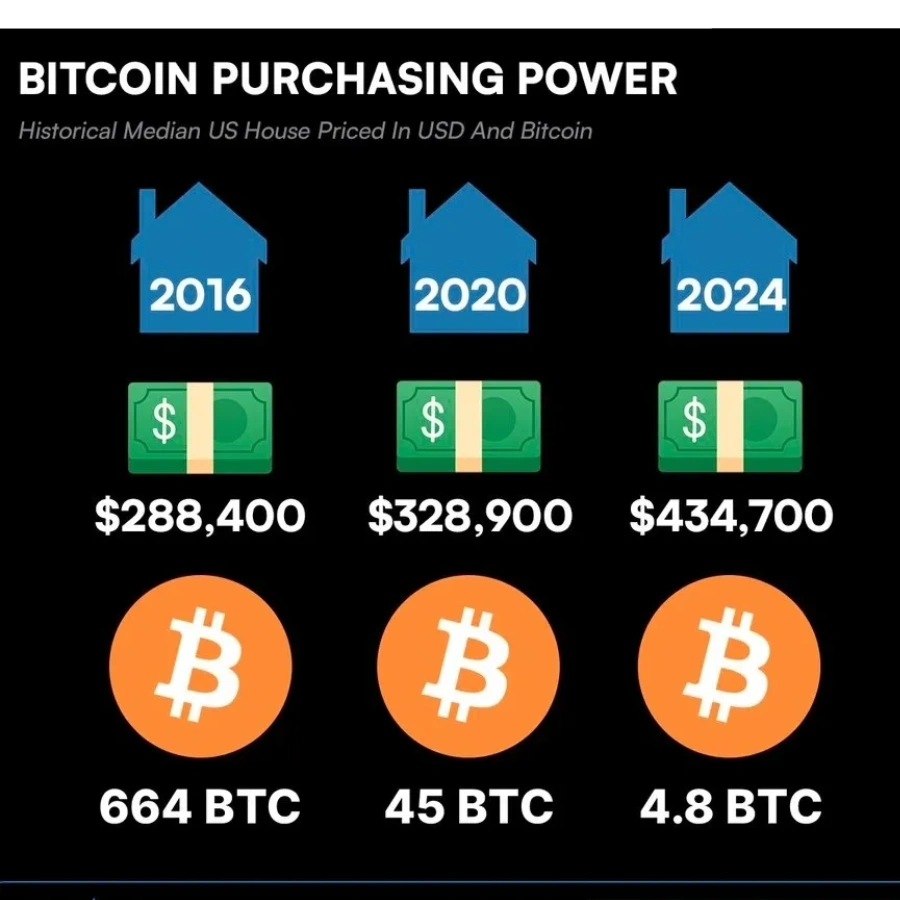
With Bitcoins purchasing power continuing to grow and the rise of BTC and crypto as an asset class, one thing is for sure – we will see Bitcoin continue grow in popularity and value and we will see crypto on a broader scale more and more influence the wider market and in turn be influenced by the wider market in a maturity that we have not yet seen in the space.
But there will still be Trump and Elon and memecoins, pump and dumps and opportunists. Scammers will try their best to steal what they can and we will hear more and more reports on this. Guard yourself well, ensure you have a cold wallet and you have all things in order. Get set for the rocket ship that is about to take off!
Happy Mining
Rusty Rigs

Disclaimer: The content on this site and in this communication should not be considered investment or financial advice. Any investing or crypto mining is speculative. When investing your capital is at risk, please do your own research and invest and make your decisions wisely. Mining profits are not guaranteed and may vary over time depending on the market performance and network hashrates. The views and opinions expressed by the author are for informational purposes only and do not constitute financial, investment, or other advice.