
Eth and ETChash mining in 2024

Well back in the day this is where it all started for many of us that are mining in the crypto mining space today. Most miners are attracted to mining BTC but traditionally as the recent machine advancements push tech further, push hashrates up and demand more power there comes a point that certain cryptocurrencies get harder to mine on smaller rigs at a lower scale.
This is where things were pretty much at when Bitmain launched the S9 BTC miner. Released in November 2017 this baby pumped out BTC with a hashrate of 14T/h and was just under 1400w at the wall. While that is still a manageable rig for home on a power scale it was certainly not manageable on the ears at 85db, then try adding more and the db noise level goes up to ridiculous!
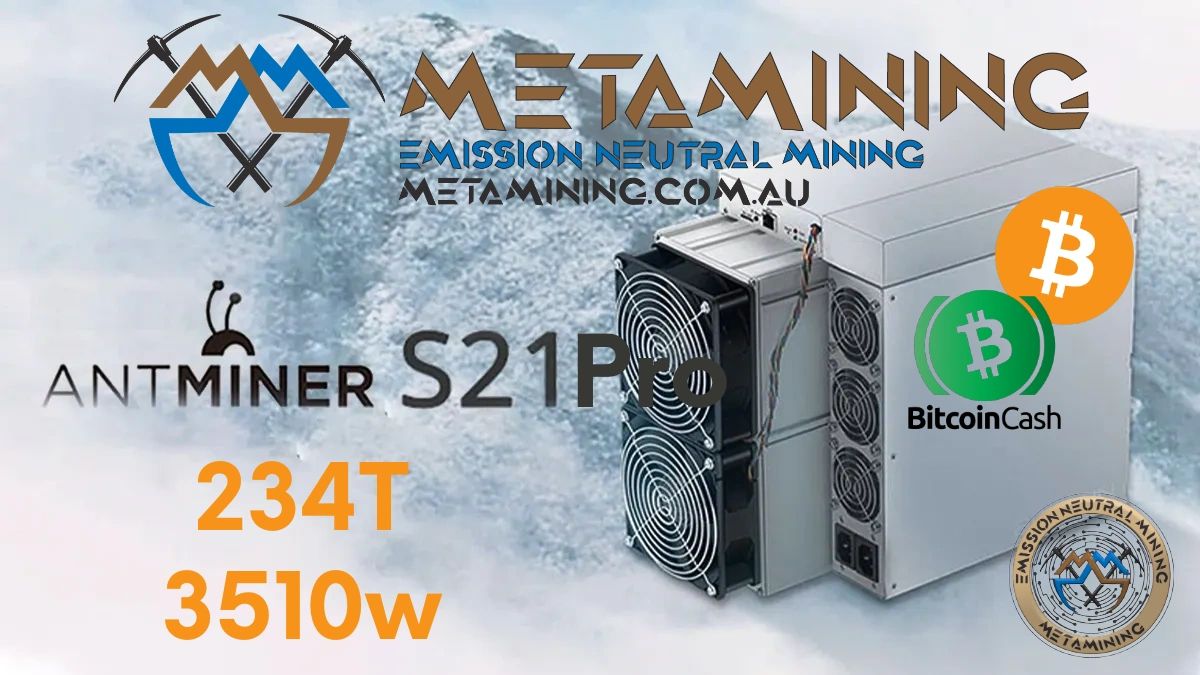
Compare that with todays units at over 3510w pumping out BTC with a hashrate of 234T/h, most larger miners today are between 65-85db so they are not suitable for home mining because of the noise, you need 3 phase, you need heat extraction and you need to maintain a cool constant temperature inside to best facilitate trouble free mining plus a host of other things such as air quality and other factors that will assist in protecting your machines and effectively running data and power. Hence the reason people host miners with us. It is just easier to leave it to us and for them to not have to worry about all that stuff.
This is also the reason that back in 2017 so many more people started jumping onto ETH mining. It was easy to mine on your GPU and you didn’t need to run big noisy rigs (unless you decided to make a massive GPU miner)
Something like this
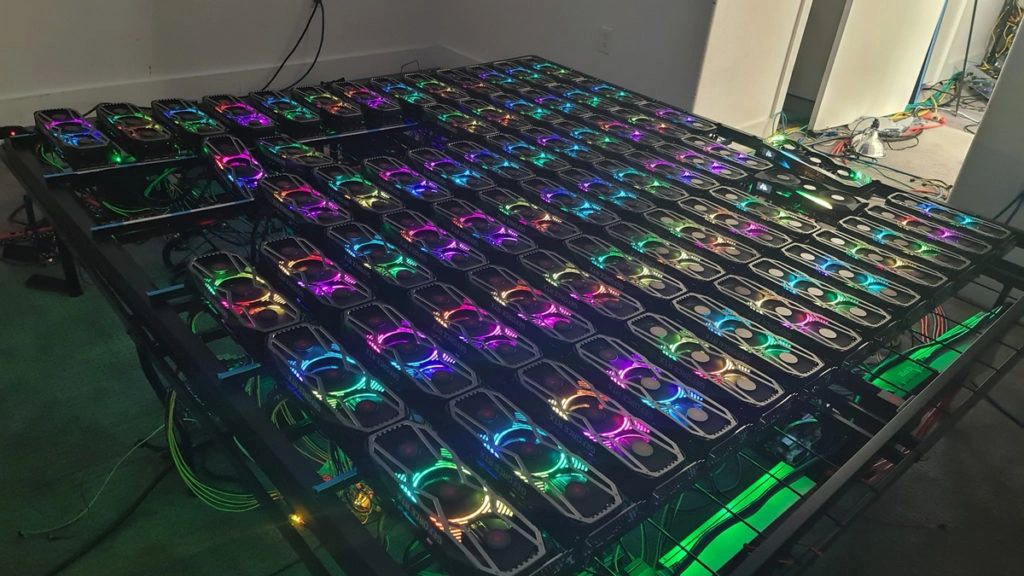
Or maybe this….
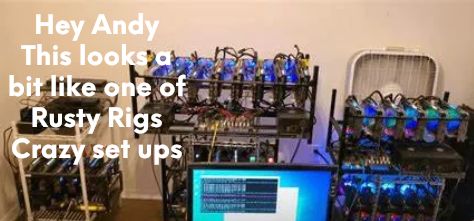
Andy was way neater with nice, enclosed units, I was like the open wheeler race car, all about mining efficiency and cooling, who cares about the noise or how neat it looks, it’s making me free magical internet money!
So ETH mining was becoming more popular and with that ETH mining ASIC’s emerged. I introduced Andy to ASIC mining and as I wrote about in previous blogs he went out and bought two kick arse CK5 2400w miners – the best at the time for mining CKB – Nervos Network. That was the beginning of the end for his home mining ventures as his family were not liking the fact that he was running a few jet engines in the house.
I was the same and had grown to having machines not just in my mining room but EVERYWHERE, my family were at wits end. Andy and I had months of machines being offline, or we were swapping what machines we would run each few days or each few weeks so that they all got a run for all the different currencies. The machines that ran 24/7 though were my GPU rigs, in all the weird and wonderful configurations and Frankenstein builds that I had going on!


Ethereum
Mining ETH was brilliant, I was mining ETH and holding it and I was also mining ETH on other rigs and getting paid out in BTC. It was great and then they finally merged to 2.0 and killed PoW mining. They had been threatening it for years and it was a running joke that it would never happen…… but they finally did it and in September 2022 ETH mining via PoW ended as it transitioned to PoS. I won’t go all into detail about ETH and PoS and PoW and all of that stuff because I’ve already covered it off back in 2022 in the lead up to and post the ETH merge. But when ETH merged to PoS in 2022 it left a massive vacuum in the crypto mining space and especially in the GPU mining world.
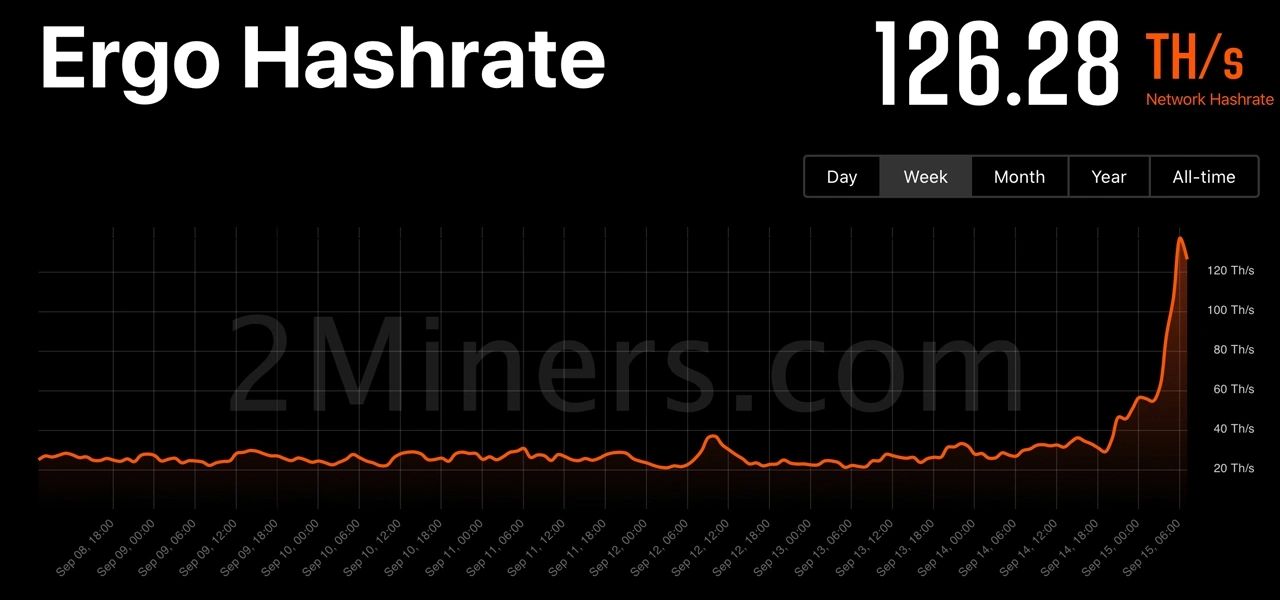
Everything changed, some miners were angry, others were confused and others that were GPU heads frantically started seeking other coins to mine and even ASIC’s. It was a pretty crazy time and I remember watching the network hashrates all over the place.
ERGO spiked
Ethereum Classic hashrate spiked also along with many other GPU mineable coins.
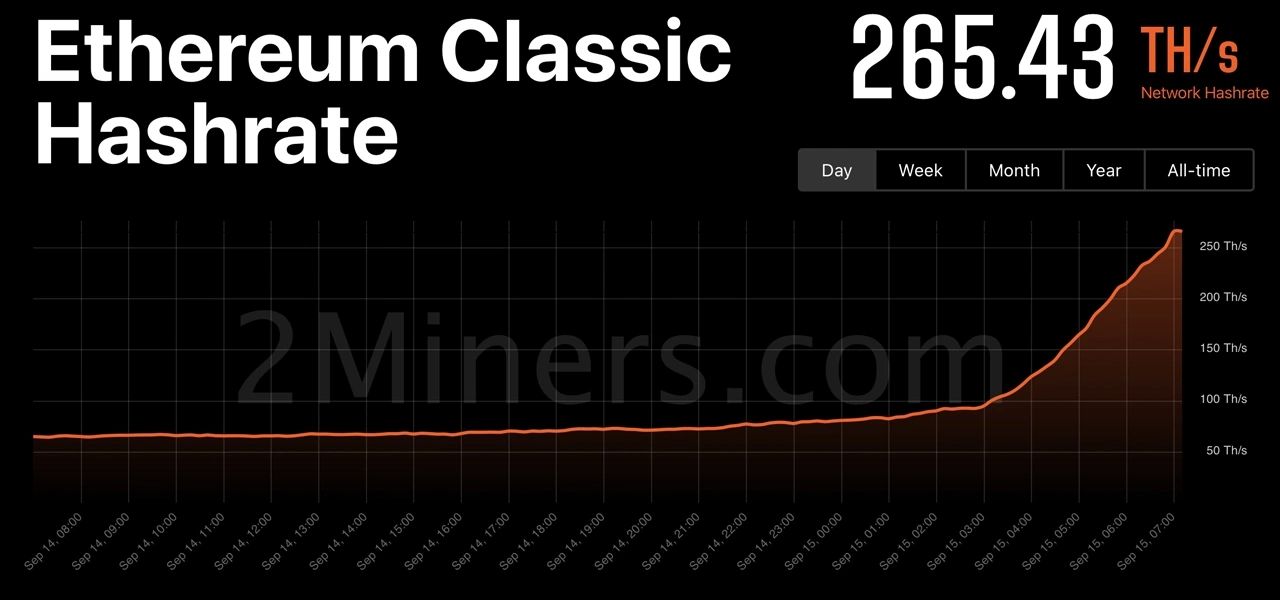
In the lead up to the merge and for a while after there were miners jumping onto all sorts of coins searching for mining “profitability” after ETH. For the next 6 months or so the network hashrates were all over the place. It was crazy to see the charts pump parabolic for hashrate then a week or a month later drop away and you would see another chart like Flux or Neoxa or some other random coin going gangbusters for hashrate. I mine ETH until the very minute it swapped over, I remember the day and logging in to my computer remotely and swapping all the mining details for the rigs. I basically swapped to ETC, RAVEN and ERGO, it seemed pointless to me to search for others and keep swapping around. Plus, I had my ASIC’s going and we had our larger machines at our farm and a business to run. The enquiry around that time was huge especially for ASIC miners and smaller home miners as all the GPU miners were shifting their perspective.
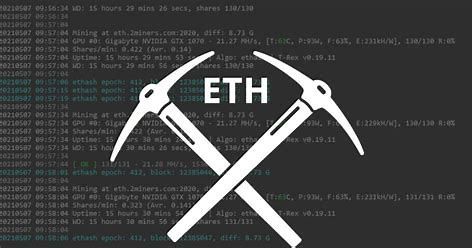
So where is ETHash mining now?
But you said you can’t mine ETH anymore Russ? Isn’t that a stupid question? Well actually what if I told you, you can mine ETH now!
There are still ways to mine ETH, you can mine ETHash coins on GPU’s or ASIC’s – the best and most efficient is the Jasminer X16P at 5.8G/h for only 1900w it blows away GPU mining. But it’s 75db so you will want to host it with us or have a purpose built room to house it in unless you want to drive the family insane – trust me I know and so do my family!
There are also smaller miners that are great for ETHash mining at home While the X16P might make you around $25 AUD per day (but remember like I always say – it’s not about the daily profits in fiat value it’s about the coins) there are smaller miners that are perfect for home mining that are still very worthwhile. The Jasminer X16Q and the X4 miners are both great miners for ETHash mining and will make around $5.50 per day mining ETHash for between 1200w and 600w depending on the machine and the hashrate. But bear in mind the X4 at 2.5G/h is a 75 db machine as opposed to the smaller X16Q being 1.95G/h virtually silent and only 600w (which is perfect for home mining). I personally wouldn’t go above 950w for a home miner (apart from 2000w GPU rigs – but I have most of mine running between <600-1200w as 6 card rigs – it all depends on what you mine).
You can mine any of the ETHash coins (ETHO, EGEM, Quark, ETP) and with the Jasminer and iPollo miners for home mining and they will range in price from around $900 to around $5500. The larger miners for hosting by Bitmain E9 Pro, Jasminer X16P and Forrest Miner EPU XC are all more powerful and noisier with wattages between 1900w and 3300w. You can mine any of these coins or ETChash with these miners and either keep the native coin or swap it for ETH or even BTC if you choose. Therefore, you can still in theory mine ETHEREUM…albeit indirectly…. But is it worth it or are you better to keep the native coin or are you simply better off to mine ETC, or will you find the next gem of a coin on the ETH algo?
*Similarly with any mining rig you can mine a native coin such as Kaspa or CKB and then swap it to something like BTC or ETH and therefore you are indirectly “mining” BTC or ETH. But is it the smartest way to go or could you make more holding the native coin and waiting for it to pump, or is it possibly better to swap the native coins for BTC or ETH at a certain ratio (maybe 50/50 or 40/60 to hedge your bets)? Coins to mine | minerstat
What about ETChash mining?
As covered above all of those miners are great for mining ETC as well and with some of those miners you can dual mine ETC and Zil and this is where I feel ETChash mining has an edge. ETC is the original Ethereum and still has a loyal following. Where ETC trends in this market cycle and Bullrun price I am not sure, but let’s take a look….
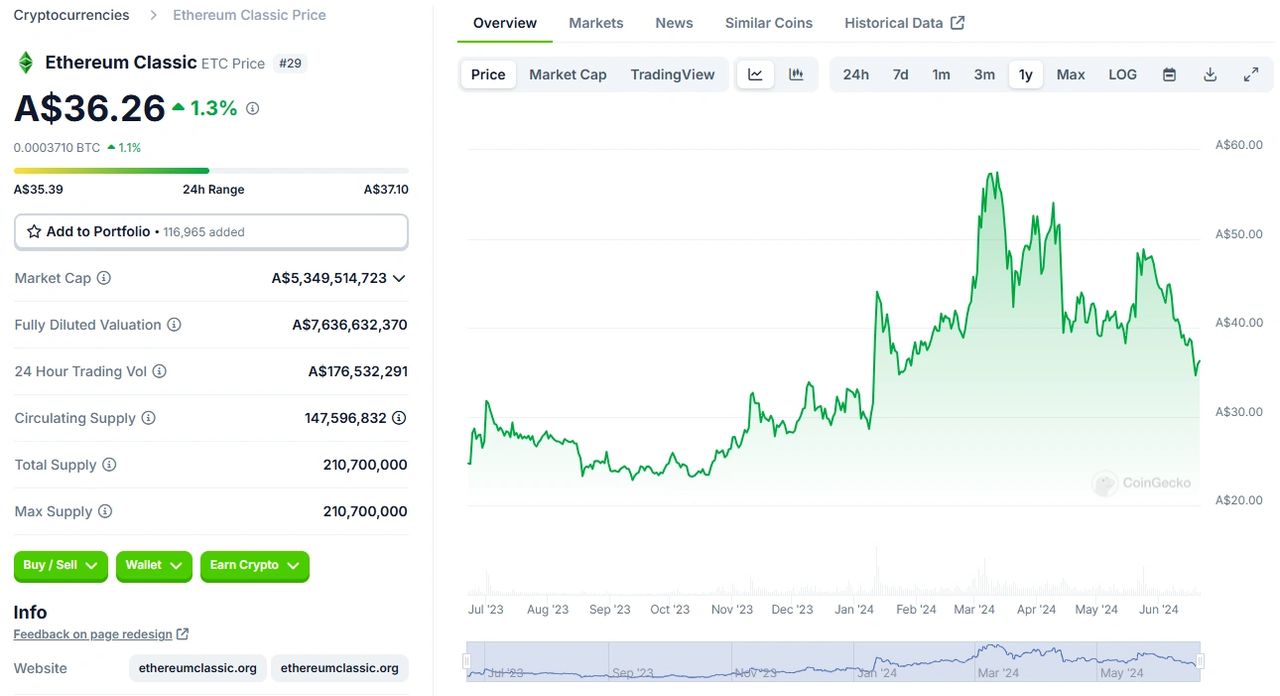
ETC – ethereum Classic’s chart actually looks very good over the past 12 months.
It’s currently ranked in the top 30 and has been a pretty solid coin over the years. If we look even further out with its all time chart then we can see the total picture and even then it doesn’t look to bad at all. It has some solid consistency and has always maintained a fair value rather than dropping away to cents or under $1.
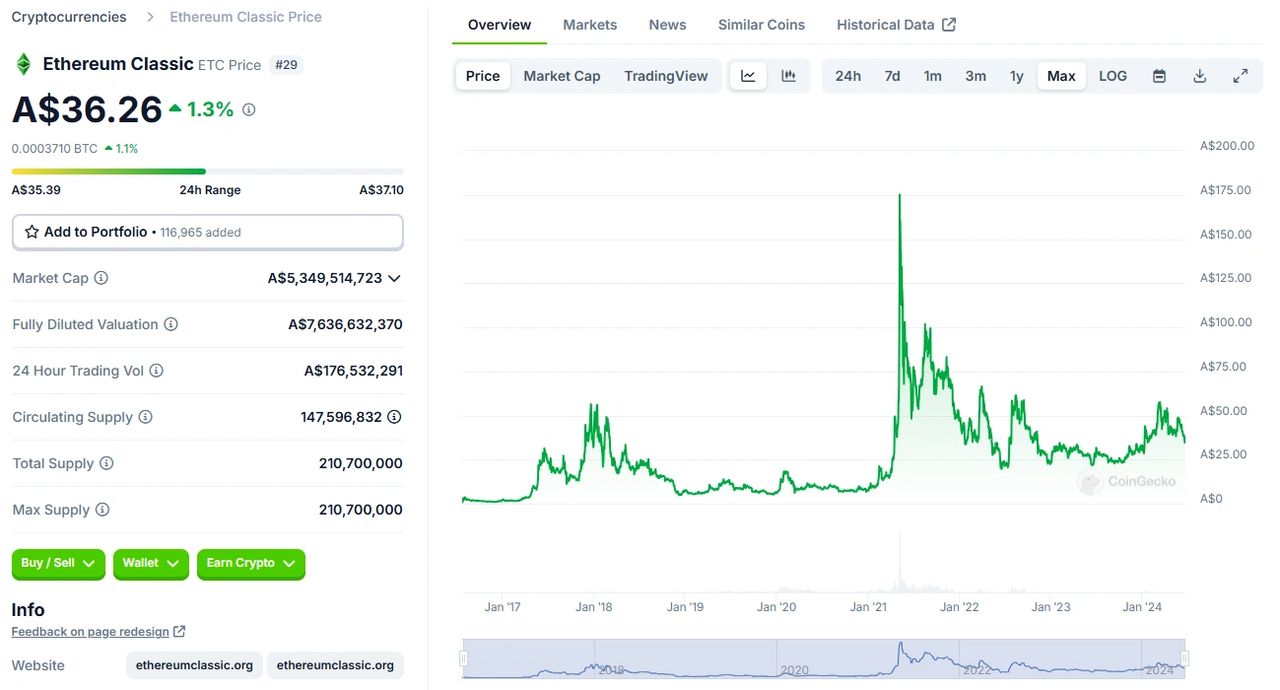
ETC is still sitting above its previous pre bull run value and is performing better than many other coins. ETC is down around 5% over the past 7 or so days while the general crypto market is down around 2% so it is slightly underperfoming the wider market but is not that far off the pace. It is still up 4308% from its all time low in July 2016 but down 83% from its All Time High (ATH) from 3 years ago which was almost $215 AUD.
What I like about ETChash and ETHash mining is that beside ETH (back in the day) and ETC there are a bunch of other coins on the same algo that you can mine, so the day your miner can no longer mine ETC (due to the DAG file size being too large), you can simply switch to mine another suitable coin and keep on going, and who knows…. some of those small obscure coins one day may just be worth something.. I also like the fact that you can still mine it on smaller rigs and even on the larger ASICS the power usage is much smaller on average than many of the other coins.
I would recommend mining with the iPollo or Jasminers for home mining we can assist you with the right model to suit your budget. With rigs from $1000 this coin can be mined by beginners very easily.
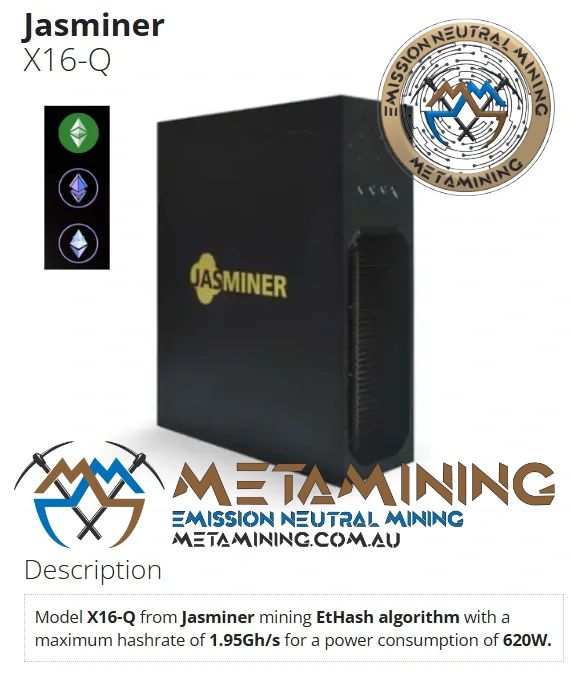
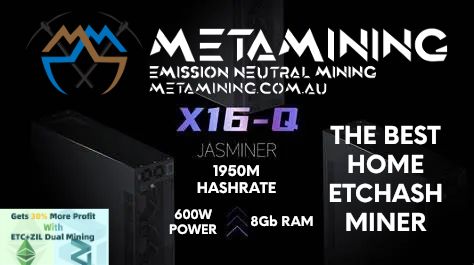
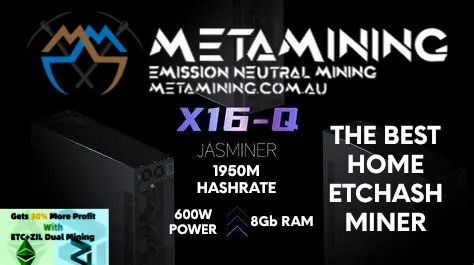
The Jasminer X16Q is an ideal home mining rig. An almost silent home miner and very low wattage pumping out 1950M of hashrate. 7 of these rigs will churn you out just over 1 ETC per day pool mining. Bear in mind that wattage adds up and you would total over 400w of home mining with that. However, if I refer back to the GPU mining rigs that we were mining full on back in the day for ETH they were generally between 1200w and over 2000w each. and we used to have HEAPS of them going! So when you look at it that way and compare 7 or 8 ETH GPU rigs at 2000x each (14-16000w total), then a total of 4300w is really not that bad. Also when you think that our GPU rigs were costing us between $6500 and $22000 each then 7 of these for aroudn $5500 each is not too bad. Now I am not suggesting that you run out and buy 7 or 8 of these but it is definitely a miner worth considering if you are keen to mine at home and utilize your solar feed in. I mine at home and feed nothing back to the grid as the rate they pay the feed in at is simply not worth it. I ramp up my home mining during the day and wind it down slightly at night. You just have to find the balance that works for you.
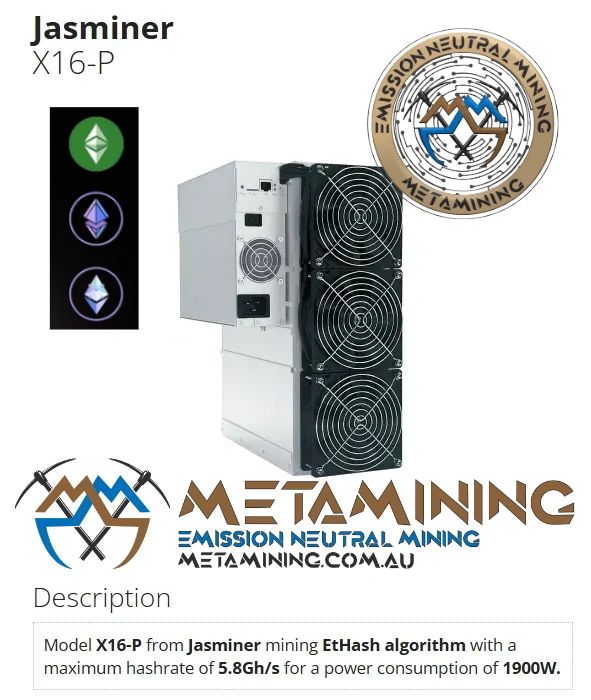
The Jasminer X16P is a much larger miner that we can host in our farm, it is just under three times the price of the X16Q home miner but it is 3 times the hashrate as well. At 5800M three of these units will easily mine you one ETC per day pool mining.
With this unit only using 1900w it is a super-efficient ETC miner. Again, when you consider we were mining on rigs that were as expensive as this or more but only producing 2000M or maybe 3400M hashrates but were using more power when we were mining ETH. What I love about these miners is that you can not only mine a variety of coins but you can mine ETC and Zil and that is what makes them so very worthwhile.
ETC is the original Ethereum before the hard fork – again I have written about it in previous blogs Here is one about ETC and Zil mining. There are others around the time of the ETH merge that I covered off various things around ETHash and ETChash mining as well so feel free to check them out to gain a little more understanding of ETH and ETChash mining. https://minerstat.com/dag-size-calculator ETC mining should be profitable with the right equipment until after 2038 so get mining!

History of Ethereum Classic
Initially, the Ethereum blockchain was established as a single network where transactions were facilitated by using the cryptocurrency ether or ETH. The new network quickly became popular for initial coin offerings, as different teams used the platform to launch their own tokens. Ethereum’s popularity really took off and ICO’s were all the rage. From 2016 through to 2018 ICO’s were booming off the back of Ethereum’s initial success.
One of the most successful ICOs was The DAO (Decentralized Autonomous Organization), a decentralized venture fund where investors would vote on assets to invest in. The DAO quickly accumulated more than 11 million ETH, from over 18,000 investors, before unknown hackers discovered a smart contract bug allowing them to withdraw about a third of The DAO’s accumulated ether.
Due to the scale of the hack, many investors proposed reversing the Ethereum blockchain to rescue the affected investors, while others argued that doing so would set the precedent for future bailouts. After a hastily-arranged poll, 97% of the community voted to restore the lost funds through a hard fork.
As a result, the Ethereum blockchain split into two separate networks. The newer network inherited the name Ethereum and uses ETH or Ether as its cryptocurrency. The older one, known as Ethereum Classic, uses ETC. This is the splinter network that emerged from the 2016 hard fork, after the hack in which $60 million ETH was stolen from one of the earliest decentralized autonomous organizations (DAO) on the Ethereum network. https://en.wikipedia.org/wiki/Ethereum_Classic
Goals of Ethereum Classic
Since the split, there have been many upgrades and improvements to the Ethereum Classic project. The goal of the project continues to be working toward becoming a global payment network using smart contracts that can function without centralized governance.
As with other cryptocurrencies, Ethereum Classic will likely continue to strive to be a digital store of value, meaning it can be saved and exchanged while retaining its value. The digital store of value for crypto includes its purchasing power that can be quickly turned into cash or used to buy another asset, similar to money.
What Is Ethereum Classic (ETC)?
Ethereum Classic is an open-source, decentralized blockchain that runs smart contracts.
Reading above you know it’s a fork of the original Ethereum blockchain, which was created in 2015. Ethereum Classic came into existence in 2016 after a hard fork following the hack of the DAO. Both chains share the same history up until the point of the fork. However, after the fork, they diverged. ETH continued with the changes made by the hard fork, while ETC retained the original blockchain. As a result, ETC has become known as the “original” Ethereum blockchain. While ETH is more widely known and used, ETC has a small but dedicated community of supporters who believe in immutable blockchain technology. Consequently, ETC is often referred to as “Ethereum’s true form.”

What is the future for ETC
It’s impossible to predict the future, but Ethereum Classic does have some things working in its favour. For starters, having launched in 2016, it’s one of the more established cryptocurrencies now. It also has a strong community of developers and supporters. However, Ethereum Classic does face some challenges. For example, it has a reasonable market cap when compared to other major cryptocurrencies and any coin sitting safely within the top 50 coins or thousands is obviously doing something right and has a decent enough base and following.
Ethereum Classic remains a viable option for investors and users who are looking for an alternative to Ethereum and who are looking for a coin that is significantly cheaper than Ethereum. Some experts believe that ETC could continue to rise in value (and there are several reasons for this optimism), potentially even reaching an average price level of $300 USD or more within the next few years. Will we see it surpass its previous ATH on this next bullrun? Many believe that Ethereum Classic will be one of the most prominent cryptocurrencies in the near future. If we take a look at BTC and BCH (who I feel share a similarity in someway to ETH and ETC – BCH has been performing exceptionally well. If that is anything to go by then maybe we will see a similarity with ETC rising to new heights. I personally think its chart looks pretty good and certainly shows some good resilience. Many have suggested that ETC could reach somewhere near $160 USD ($250 AUD) in this next Bullrun and then go on to reach closer to $900 USD by the following Bullrun cycle. Check out this article highlighting my point about BCH and ETC.
Beefing Up ETC’s Worldwide Presence
In a significant advancement for Ethereum Classic (ETC) users, Alchemy Pay has joined forces with ETC Grants DAO (EGD) to offer a seamless fiat on-ramp service. The partnership is ultimately designed to ease access to ETC by enabling fiat purchases with Visa, MasterCard, mobile wallets, and banking account payments. The combination of services should automate purchases, while guaranteeing compliance and user productivity. The world-recognized fiat payment gateway services of Alchemy Pay guarantees that customers all over the world are able to facilitate their fiat currency into cryptocurrencies. With this partnership, Alchemy Pay services will be able to be integrated on a variety of high-profile community platforms, such as etcgrantsdao.io and ethereumclassic.org. Furthermore, the initiative will enable direct ETC buys on the Alchemy Pay Ramp website.
The cooperation formed by Alchemy Pay and ETC Grants DAO demonstrates common value for promoting blockchain accessibility and decentralization. Then also there is Ethereum Classic, which is staying true to decentralization and immutability as a core value set, the blockchain which is often hoisted as the original Ethereum blockchain where “Code is Law!” Leading this partnership is not only an expansion of ETC’s applications and its accessibility to a global audience but aligns with the ethos of ETC that continues to cherish immutable, decentralized blockchain interactions.
In addition, what Alchemy Pay plays is more than just a payment gateway. As a result, boasting a global license in the UK, USA, Canada, Indonesia, Lithuania, and completing the necessary logical layout for users to easily transfer to domestic countries. These are credentials of great importance, as necessary to drive cryptocurrency adoption at scale, while at the same time ensuring comprehensive security for both end-users and partners.
While ETC Grants DAO is hard at work moving the Ethereum Classic ecosystem forward. Funded by major industry players such as BITMAIN, ANTPOOL, and the ETC Cooperative, the DAO works to support the ETC related infrastructure and the longevity of ETC. ETC Grants DAO is fundamental in the development of the ETC ecosystem, it serves as the backbone of ETCs efforts to support developers and enthusiasts of the community.
There is a lot to like about this latest development and one that restores some faith in ETC mining, as one of the OG’s of the crypto space with a proud history of being the original Ethereum and a loyal following much like that of Bitcoin I can see ETC is one of the coins like LTC and Doge that will hang around forever. It is a coin that we mine and one to be honest that we should be putting more hashrate into. It may not be quite as profitable as some of the newer crypto’s but when you look past all the KASPA miners the next most profitable miners are Scrypt and ETC miners and those coins and the associated miners have reliably been in that upper mix cycle after cycle. This is certainly one crypto worth considering in your mining portfolio.
Happy Mining
Rusty Rigs

Disclaimer: The content on this site and in this communication should not be considered investment or financial advice. Any investing or crypto mining is speculative. When investing your capital is at risk, please do your own research and invest and make your decisions wisely. Mining profits are not guaranteed and may vary over time depending on the market performance and network hashrates.