
Fractal Bitcoin

Bitcoin remains the only true crypto, however – there are some that come close and some that surpass the technical specs of Bitcoin while holding fairly true to the original ethos of BTC. But BTC remains the truest as it is not “run” by anyone and almost everything else is, and Ether has gone away from those early Satoshi principles into the realm of technical and governance oligarchy.
Human intervention, especially in matters financial, is not known to end well for the masses, so what about Fractal Bitcoin? Where does that fit in the scheme of things? Is Fractal similar to BCH – a fork of Bitcoin? Where does it sit considering the likes of Ethereum and the changes that have been brought about moving it from the original consensus mechanism and then forking it. It wasn’t too bad originally and was quite successful (Ethereum Classic – ETC remains the original version of Ethereum), but how about the changes since Ether went to the PoS consensus mechanism? The rolling development of Ether could potentially put it at risk with every modification. Tweaks can either enhance or wreck the business model. The laws of unintended consequences, that of Murphy, Finagle, O’Toole’s and Waldo’s cannot be ignored or underestimated. Breaking the business model is easily done, especially when you carry dogma along with you. Let me give you an example of a dangerous ETH dogma. Monetary deflation is good and adds value. Sounds obvious doesn’t it…
But how about Gresham’s Law? “Bad money drives out good.” That means inflated money kills the usage of deflationary or stable money. That’s not good news for a deflationary Ethereum.
No, no, no, crypto natives cry, Gresham is wrong, good money, i.e. Bitcoin drives out bad, i.e. dollars. That is a brave claim and when you see the success of stablecoins in term of crypto market cap, you can see bad money definitely has its charms even in the realm of crypto’s hard money posturing.
So Ethereum’s developers’ potentially flawed attempt at making ether deflationary may just have been a blunder and the reason for its less than worthy performance recently. Meanwhile, inflationary Solana has stormed up the market cap charts and so too have a few other projects with new blockchain tech that have more efficiency and scalability. There is no doubt that Ethereum has been slightly underwhelming since the merge to PoS and there is no doubt that the money markets are very controlled and manipulated. The Bad money seems to have such a stranglehold on everything but is that time – the time of the Fiat currency control coming to an end? Is there change on the horizon and is that change very much a change within the digital space and cryptocurrency?
There is certainly a growing interest in crypto and the Blockchain and crypto space, there is a surging wave driving that digital tech forward and it is very appealing and very much fits inline with all the technological changes and our very much computer driven society. There are some amazing advantages with Blockchain and there are some extraordinary developments within the Blockchain sector that are revolutionizing traditional sectors and especially the financial markets.
We have emerging Ai Tech and Blockchain developers are constantly looking for new solutions to improve transaction speeds, improve security and improve the useability of cryptocurrency. New projects, new side chains and new consensus mechanisms will emerge in an attempt to create a new and revolutionary blockchain and crypto assets. Some of these newer concepts are actually very well crafted and have some absolutely amazing potential, take Kaspa for example – the protocols for Kaspa are phenominal and its a massive leap forward in tech compared to BTC. So where does Fractal Bitcoin fit into this landscape and what is its likely impact. It’s a pretty cool concept and a great addition for Bitcoin miners. It could also revolutionize Bitcoin and encourage and bring about more Bitcoin usage and overall network revenues.
There is no doubt that Bitcoin has been the best performing asset of the past 15 years. While the idea of cryptocurrency has been around for around 40 years, its 15 year trading journey has been one amazing ride and BTC is now the most valuable and well known cryptocurrency. It has a certain status and level of trust and with that it holds an amazing amount of real, tangible value. Gold is currently also extremely strong, I’m not ready to sell up my Eth or Alts just yet because while Gold used to be Baby Boomer Bitcoin, now Boomer Gold is Bitcoin and Bitcoin and the crypto market has a long way to go in its climb to the top of this cycle.
What is Fractal Bitcoin?
Fractal Bitcoin is a new side chain designed to extend the capabilities of Bitcoin by leveraging advanced cryptographic techniques and unique consensus mechanisms. It is an innovative blockchain expansion solution based on recursive virtualization technology that enhances Bitcoin’s scalability by creating a multi-layer network structure while maintaining a secure connection with the main network.
A side chain is a separate blockchain linked to a main chain (in this case, Bitcoin) through a peg-in system. Other side chains offer two-way peg-ins like Rootstock and its pow-peg method or a one-way peg like the Liquid Network.
The peg-in system allows Fractal Bitcoin users to peg in Bitcoin and assets created using meta protocols like BRC-20 tokens or Runes. This allows the token metadata to be transferred between the main chain and the side chain, effectively enabling new features and functionalities without altering the core protocol of the main chain.
Its architecture promises reduced block confirmation times to 30-60 seconds and efficient network load management.
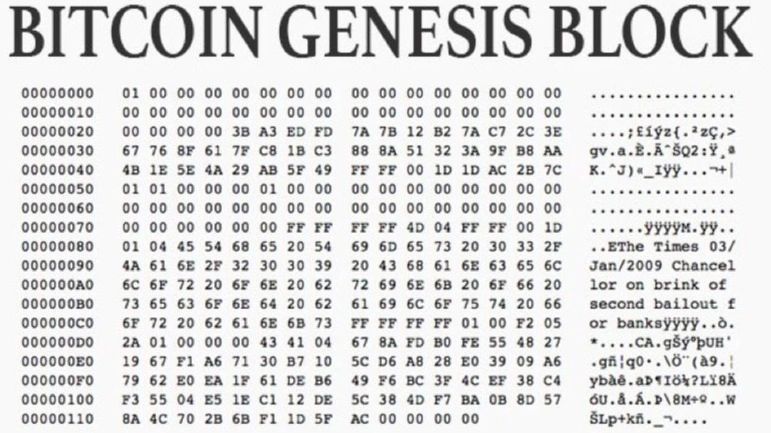
As a nod to the base chain and orange washing the new network, the genesis block of Fractal carries the same message found in Bitcoin’s first block:
“The Times 03/Jan/2009 Chancellor on brink of second bailout for banks.”
It feels like nearly a lifetime ago now that Ordinals were making headlines and stirring up all sorts of arguments about how to use block space; while the debates raged on for a brief moment in time, fees were astronomically high, making the base chain unusable for the average person.
If you wanted to spend Bitcoin, you were relegated to side chains or the Lightning network, and even then, you still might have issues since the price to peg into a side chain or establish a Lightning channel would make for an expensive startup cost.
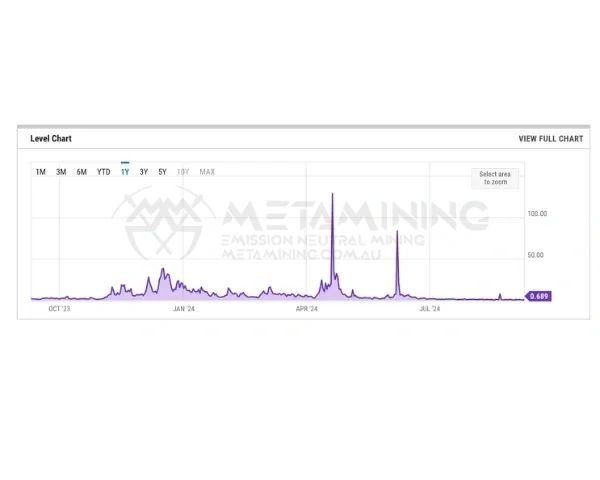
As standard transactions were pushed to other layers, the base chain was filled with NFTs, BRC-20 token minting, transfers and more of these meta-protocol transactions. It left these Ordinal users competing with each other for block space, and wow, did they run up a bill with miners absolutely loving the premiums they were netting. Our mining profits were increasing massively over that initial rush.
But manias don’t make a market, and eventually, the bidding war for block space slowed down, leaving many speculators spending thousands on Bitcoin fees only to be left with useless metadata with no bid to sell into; the cycle rugging was complete.
Since then, it’s been pretty quiet on the Ordinals front as the market seeks out a new narrative to drum up excitement and liquidity. Out of that desperation, we’ve seen so many self-proclaimed L2 projects rolling out the red carpet for the next round of speculation. We see this on the ETH network constantly and likewise on Solana and most of these can be utter garbage. So how does Fractal Bitcoin differ from the rest and what makes it stand out?
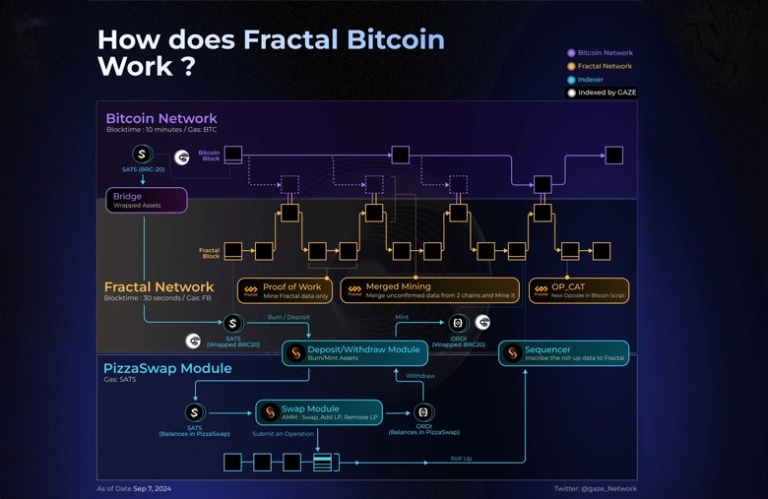
Fractal Bitcoin is a new Bitcoin “side chain” that recently deployed its mainnet on the 9th September 2024. Fractal Bitcoin is an innovative blockchain expansion solution based on recursive virtualization technology that enhances Bitcoin’s scalability by creating a multi-layer network structure while maintaining a secure connection with the main network.
Fractal Bitcoin is best classified as a sidechain rather than a Layer 2 solution. As it operates by creating multiple independent layers that run as separate instances while remaining anchored to the Bitcoin main network. This architecture allows Fractal Bitcoin to disperse transaction loads effectively, enabling each layer to handle a significant number of transactions simultaneously without compromising the core principles of the Bitcoin blockchain.
Each layer in the Fractal Bitcoin ecosystem functions as an independent instance, which means it has its own miners and nodes. While Fractal Bitcoin operates as a sidechain, it maintains a connection to the Bitcoin mainnet. Fractal Bitcoin introduces a unique anchoring mechanism that connects its multi-layered architecture back to the Bitcoin mainnet.
Fractal is a scaling solution for Bitcoin, gradually extending the Bitcoin blockchain into a scalable computing system without breaking consistency with the Bitcoin main chain. FB uses the same SHA256d mining algorithm as BTC, allowing the use of the same mining machines. By utilizing Bitcoin’s core code, Fractal Bitcoin introduces a unique merged-mining mechanism called Cadence Mining, which could potentially provide miners with an additional revenue stream.
Cadence Mining, combines two methods: Permissionless Mining and Merge Mining.
- Permissionless Mining: This method allows anyone with the appropriate tools and hardware to mine Fractal blocks, similar to traditional Bitcoin mining. This inclusive approach encourages broader participation in the mining process, enhancing decentralization.
- Merge Mining: Specifically designed for Bitcoin miners, this technique enables them to mine both BTC and Fractal blocks simultaneously without requiring additional computational power. This dual mining capability maximizes the efficiency of existing mining operations and incentivizes miners to support the Fractal network.
Cadence Mining allows miners to simultaneously mine both Bitcoin and Fractal Bitcoin using the same hardware. This means that miners can continue to secure the Bitcoin network while also participating in the Fractal Bitcoin ecosystem. However, the introduction of Fractal Bitcoin’s BRC-20 token standard and faster, cheaper scaling could potentially reduce network fees from non-fungible tokens on the Bitcoin network, which have been a significant source of revenue for miners since this years April 2024 halving.
Fractal Bitcoin employs the same Proof of Work (PoW) consensus mechanism as the original Bitcoin, allowing miners to transition seamlessly to mining Fractal blocks using their existing hardware, such as ASICs and GPUs.
The creation of Fractal Bitcoin stems from the emergence of the Ordinals protocol and related applications in 2023. For security reasons, Bitcoin has imposed restrictions on opcodes and block storage space in its iterations. When the Bitcoin chain ecosystem develops rapidly, there are limitations in on-chain computing power and block space, so developers have proposed the concept of Fractal Bitcoin, hoping to solve the shortcomings of the Bitcoin network.
As the mainnet launch approached, Fractal Bitcoin continued to engage with its community and develop its ecosystem. According to Okx, the testnet phase saw experimentation with various features, and the project was collaborating with wallet providers to support its growing network of protocols and decentralized applications (DApps). Additionally, the introduction of a voting system through the native FB token will enable transparent decision-making for transaction fees, node access, and ecosystem management.
Fractal Bitcoin’s activation of BRC-20 tokens on the mainnet and the launch of the PizzaSwap decentralized exchange are expected to drive further adoption and growth. With BitTera announcing NFTs that can mine the native FB token, even those without mining equipment can participate in the Fractal Bitcoin ecosystem. As the project continues to evolve and attract more participants, it has the potential to make a significant impact on the future of Bitcoin scaling and miner profitability.

Merged Mining
Merged mining is an old concept that dates back to 2011’s Namecoin, but it was most popularized by Doge and Litecoin (scrypt mining – as mentioned above). With merge-mining, a crypto miner commits hashes to two different blockchains simultaneously from the same machine, allowing them to extract block rewards from both chains while producing work from one machine.
Fractal is a merge-mined sidechain built by the team at Unisat where miners can produce a valid hash for either Bitcoin or Fractal and receive block rewards from both networks (in Fractal’s case, new issuance of $FB).
The spiel from Unisat is that this is pretty much just a faster, somewhat more functional Bitcoin. Structurally, Fractal looks almost identical to Bitcoin Core, but it will include a few opcodes that Bitcoin Core lacks (OP_CAT, for example) for additional functionality. There are also some design differences, such as Fractal’s 30 second block times.
But the biggest difference, though, lies in a concept that Fractal calls “Cadence Mining.” Under this system, miners produce one out of every three Fractal blocks via the merge-mining process, but this means that two in every three blocks on Fractal is mined from hashrate pointed solely at Fractal.
The wider adoption of Fractal will be beneficial, and it is encouraging how many miners have taken it up since its launch earlier this month.
Tokenomics
Fractal Bitcoin’s tokenomics is designed to ensure sustainability and incentivize participation within its ecosystem. The total supply of the Fractal token (FB) is set at 210 million, with allocations structured as follows:
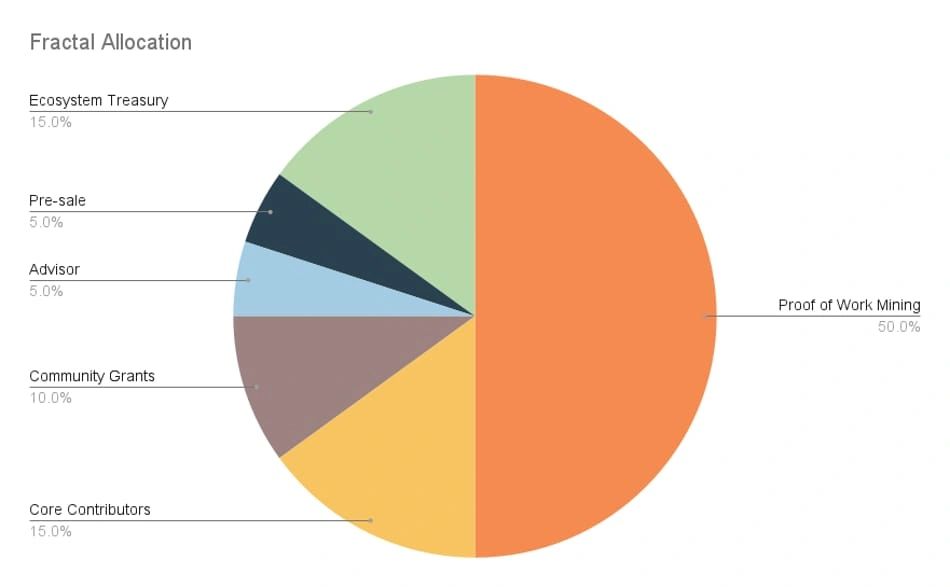
- Proof of Work Mining (50%): Half of the total token supply is dedicated to Proof of Work mining.
- Ecosystem Treasury (15%): This portion is reserved for funding initiatives that enhance the Fractal ecosystem, including core improvements and community engagement programs.
- Pre-sale (5%): A small allocation for early investors, with a lock-up period of six months followed by a linear release over the next six months. This ensures that early participants are committed to the long-term growth of the network.
- Advisor (5%): Tokens set aside for advisors who provide strategic guidance and support for ongoing development.
- Community Grants (10%): This allocation is aimed at fostering partnerships and liquidity programs, encouraging community-driven initiatives that enhance network engagement.
- Core Contributors (15%): Tokens allocated to the core development team to ensure ongoing improvements and attract top talent to the project. This allocation supports the stability and growth of the Fractal network.
The vesting schedule for the pre-sale tokens ensures that participants are incentivized to support the network’s long-term health, while the community-focused allocation emphasizes decentralization and user engagement.
Technical architecture features of Fractal Bitcoin:
1. Shorten the block time of Bitcoin from 10 minutes to 30 seconds, confirm transactions more quickly, greatly improve user experience, increase the overall throughput of the network, and support a wider range of complex applications that require high transaction volume.
2. A unique hybrid mining method is adopted. Two of every three blocks are mined without permission, and the other is jointly mined with Bitcoin. The powerful computing power of Bitcoin is used to enhance security, while allowing individual miners to freely participate in two-thirds of the block production, encouraging decentralization.
3. Fractal implements Turing-complete smart contracts on a Bitcoin-based platform, a feature that provides possibilities for advanced DeFi protocols, complex NFT mechanisms, and other decentralized applications that were previously limited to the Ethereum platform.
4. Maintains 100% compatibility with Bitcoin standards such as BRC-20 and Ordinals.
5. Allows different applications to run their own network layers, and games and DeFi can operate separately on different independent network layers.

The Team
Fractal Bitcoin was developed by the Unisat team, which is known for creating tools and services that enhance the Bitcoin ecosystem, particularly in relation to the Ordinals protocol and the BRC-20 standard. The concept of Fractal Bitcoin emerged in 2023, driven by the need to address Bitcoin’s inherent limitations in scalability and on-chain computing power.The Unisat team recognized the growing interest in Bitcoin’s application potential, especially with the rise of Ordinals, and sought to innovate a solution that would expand Bitcoin’s processing capacity without compromising its core principles.
Future Roadmap
Fractal Bitcoin is committed to fostering a robust ecosystem by encouraging developers to build applications on its platform. The project plans to launch with foundational applications, including the UniSat Wallet for secure transactions, a block explorer for tracking blockchain data, and a decentralized exchange (PizzaSwap) to drive liquidity.
Fractal Bitcoin’s roadmap for the second half of 2024 and into 2025 focuses on expanding its ecosystem and enhancing user experiences. Following the mainnet launch that occurred earlier this month, the team plans to roll out additional features and improvements based on community feedback and usage patterns. This includes refining the mining algorithm and deploying independent nodes to further decentralize the network.

Why will Bitcoin expansion become the next focus in the blockchain industry?
Blockchain technology continues to advance. As the earliest and most widely accepted cryptocurrency, Bitcoin still plays an important role worldwide.
However, with the popularity of its network, scalability issues have gradually become prominent, and bottlenecks such as slow transaction confirmation and limited processing capacity have become challenges that need to be urgently solved. To understand why Bitcoin expansion has become the next focus of the blockchain industry, you need to understand the historical background of the discussion on Bitcoin expansion. In 2017, the Segregated Witness (SegWit) soft fork aimed to increase Bitcoin’s block capacity, followed by the controversial Bitcoin Cash hard fork as another expansion method. Since 2018, more and more attention has turned to second-layer solutions, such as the Lightning Network. In this ongoing exploration of Bitcoin’s scalability and functional enhancements, more and more unique perspectives on the long-term expansion challenges have gradually emerged in the market.
Especially as the crypto market enters 2025, the high requirements for network scalability of the Inscription Protocol and a number of new protocols that have rapidly emerged based on the Bitcoin network, such as brc20 and brc420, determine that Bitcoin expansion will still be the next focus of the industry. New expansion technologies need to achieve this goal by creating independent blockchains that can interoperate with the Bitcoin main network. It is necessary to support two-way anchoring, allowing the functionality of Bitcoin to be enhanced without changing the main network, experimenting with new features and applications, moving transactions off the main blockchain to solve scalability issues, and supporting multiple use cases such as smart contracts and decentralized applications, thereby broadening the utility of Bitcoin and promoting innovation within its ecosystem.
As a major innovation in scaling technology in this new cycle, Fractal’s mainnet was officially launched at 00:00 UTC on September 9, 2024. After the launch, the strong appeal of this scaling technology to the market was demonstrated. Within just 24 hours of the mainnet launch, Fractal’s joint mining accounted for more than 40% of Bitcoin’s total computing power, and free mining on Fractal accounted for 2% of Bitcoin’s computing power. The rapid adoption of miners also shows the market’s high confidence in Fractal’s technology and its potential.
The success of Fractal Bitcoin will depend on its ability to gain further adoption with the Ordinals community as its base and later try to attract those who have been degen trading and memecoin shilling on other smart contract chains and that can be a pretty fickle audience to target and one that tends to chase liquidity rather than functionality. If the Fractal team can cater to the market well and build something that caters to the Bitcoiners and broader market with a high level of functionality then it may just be a project that sticks around and if that is the case it will certainly add some extra value to Bitcoin mining and the Bitcoin network. Much like LTC, Doge and Bel are merge mined and have added value for Scrypt mining this could well add some extra value for BTC mining on Sha256.
Comparison of Fractal Bitcoin with other scaling solutions
Unlike other Bitcoin Layer 2 solutions, the wallet address on Fractal is exactly the same as the mainnet address. This design provides Ethereum-like convenience, where users can access different layers by simply switching networks in UniSat or OKX wallets. Unlike other Bitcoin Layer 2 solutions that require a separate EVM wallet address, Fractal allows users to continue using the Bitcoin mainnet address in Layer 2 activities. As of now, major wallets such as OKX Wallet and UniSat Wallet, which serve most active Bitcoin DeFi and collectibles users, fully support Fractal Bitcoin and there is no doubt that more will follow.
How it compares to some major alternatives:
1. EVM-compatible Layer 2: Some projects have attempted to create EVM-based second-layer solutions for Bitcoin. While these solutions are relatively easy to implement and launch, they face significant challenges in terms of acceptance by the Bitcoin community. In contrast, Fractal takes a Bitcoin-native approach that may be more in line with the philosophy of Bitcoin purists and may lead to better integration and adoption in the existing Bitcoin ecosystem.
2. Bitcoin Cash (BCH): Bitcoin Cash emerged as a hard fork of Bitcoin, aiming to improve scalability through a larger block size. This approach has led to divisions within the Bitcoin community and forced users to choose between two competing visions of Bitcoin. In contrast, rather than creating a separate chain or forcing users to make a choice, Fractal embraces Bitcoin as the mainnet and seeks to natively scale it. Fractal’s architecture allows for the creation of multiple instances to scale together, potentially providing unlimited scalability without sacrificing the security or decentralization of the base layer.
3. Lightning Network: The Lightning Network excels in fast, low-cost payments and high privacy, but its smart contract functionality is limited and it faces channel liquidity issues. In contrast, Fractal provides comprehensive smart contract support, does not require channel management, and provides a simpler user experience.
In general, Fractal Bitcoin maintains the basic security and reliability of the Bitcoin network and increases scalability. Create multiple independent layers on the Bitcoin blockchain. Each layer runs as an independent instance, but is still anchored to the main Bitcoin network. This layered architecture allows Fractal Bitcoin to distribute transaction loads, with each layer being able to handle a large number of transactions simultaneously. To manage these layers, Fractal Bitcoin implements a dynamic load balancing system. This system is able to flexibly allocate resources and distribute transactions based on fluctuations in transaction demand, preventing any single layer from becoming a bottleneck. To enable cross-layer asset transfers, Fractal Bitcoin uses a rotating multi-party computation (MPC) signature system. This system allows efficient and secure asset transfers without the need for users to wrap their tokens, maintaining the integrity and availability of assets within the ecosystem.
In actual applications, Fractal Bitcoin creates dedicated instances for specific purposes. For example, it creates a dedicated instance for ordinals, ensuring 100% compatibility and optimizing the processing of these assets. This dedicated instance uses a mechanism to lock and map specific satoshis on the main chain to the instance, allowing ordinals to circulate seamlessly within the instance while ensuring that they retain the original inscription when they return to the main chain.
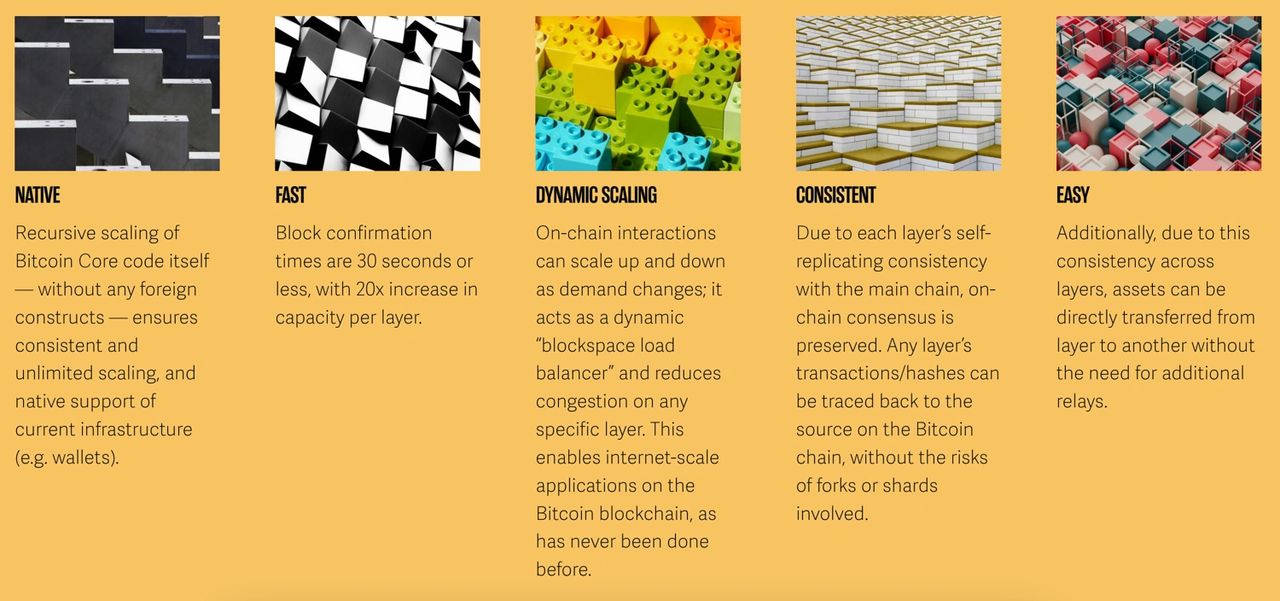
Fractal Bitcoin offers several core features that distinguish it from other scaling solutions:
- Native Scaling:
Fractal Bitcoin is an innovative scaling solution that utilizes the Bitcoin Core code to create multiple recursive layers on the Bitcoin blockchain. This unique approach allows Fractal Bitcoin to maintain full compatibility with the existing Bitcoin infrastructure while enhancing transaction processing capacity and speed. By leveraging the native code of Bitcoin, Fractal Bitcoin ensures that all layers are consistent and compatible, avoiding the complications and security risks associated with integrating foreign constructs from other blockchain systems.
The recursive structure of Fractal Bitcoin forms a tree-like architecture where each layer can independently process transactions. This design not only increases the overall throughput of the network but also preserves the integrity of the Bitcoin consensus mechanism. Each layer remains anchored to the main Bitcoin chain, enabling seamless tracing of transactions back to the original blockchain. This self-replicating consistency ensures that any transaction processed on a secondary layer adheres to the same security protocols and rules as those on the main chain, thereby enhancing both security and usability for developers and users alike.
- Dynamic Scaling:
The platform features a dynamic “blockspace load balancer” that allows on-chain interactions to scale up or down based on demand. This flexibility helps reduce congestion on specific layers, enabling applications to operate efficiently even during peak usage times
The dynamic load balancer operates by monitoring transaction volumes and network activity. When demand increases, the system can automatically deploy additional layers to accommodate the surge in transactions. Conversely, during periods of lower demand, it can scale back the number of active layers. This flexibility is crucial for maintaining a seamless user experience, as it prevents bottlenecks that could lead to slow transaction speeds or increased costs. By distributing transactions across multiple layers, Fractal Bitcoin ensures that no single layer becomes overwhelmed, thus enhancing overall network efficiency and responsiveness.
- Fast Transactions:
Fractal Bitcoin boasts block confirmation times of 30 seconds or less, significantly improving transaction speed compared to Bitcoin transactions. This enhancement is crucial for applications requiring rapid processing, such as gaming and DeFi
- Cross-Chain Transfers:
The architecture of Fractal Bitcoin allows for easy asset transfers between layers without the need for additional relays. This feature simplifies user interactions and enhances the overall experience of using the platform
In Summary
Unlike other solutions, Fractal Bitcoin doesn’t try to reinvent the wheel. It uses the same Bitcoin core code — the very foundation of Bitcoin itself — to offer a way for the network to grow without limits. It certainly ticks a great deal of boxes. Fractal Bitcoin isn’t another quick fix slapped onto Bitcoin. It gives Bitcoin room to breathe without compromising the network’s core strengths and functions.
Some scaling solutions can feel like they’re tacked on, like adding an extension to your house that doesn’t match the original architecture. Instead, Fractal Bitcoin is like expanding the original blueprint of Bitcoin itself, staying true to its foundation while making it ready to handle whatever the future brings. Fractal Bitcoin’s recursive nature is intriguing. Recursive structures are self-similar, meaning that each new layer mirrors the structure of the layer below it. This allows the network to scale infinitely, while each layer retains the original Bitcoin chain’s security, traceability, and consensus features.
This kind of Bitcoin scaling makes sure that every new layer remains consistent with Bitcoin’s original security features, so you’re not sacrificing safety for speed. These layers don’t just make protocols run faster — they add scalability. Transactions that usually take minutes on Bitcoin’s blockchain can zip through in about 30 seconds on Fractal, all while working perfectly with existing Bitcoin wallets and tools. Fractal Bitcoin is designed with the different types of community members in mind. It simplifies asset transfers between layers, eliminating the need for complex relays. This ease of use makes the system more accessible, even for those who might not be blockchain experts.
Whether you’re a developer, miner, or community member, Fractal Bitcoin brings various advantages.
Developers – Opportunity for innovation
Fractal Bitcoin allows developers to build decentralized applications (DApps) and experiment with new protocols on its scalable framework.
Getting started
You can contribute to Fractal’s development by accessing resources on the project’s GitHub page and by engaging with the community. This involvement allows you to influence how Fractal evolves and expands.
Miners
– Cadence mining
Miners can simultaneously mine Bitcoin and Fractal blocks through this method, improving the hash rate and potentially boosting their earnings.
– Flexible mining
Switching between Bitcoin and Fractal mining offers flexibility to adapt to market conditions. Miners can maximize efficiency and profitability with this approach. Detailed information on starting with Fractal mining can be found on the mining page.
Community members
Enhanced experience
As a community member, you benefit from faster block confirmations and reduced congestion thanks to Fractal’s scaling features. This means a smoother and more efficient experience on the Bitcoin network.
Engagement
For those who may not have mining equipment, BitTera has announced NFTs that can mine Fractal’s native token FB.
Fractal introduces a recursive structure, allowing infinite scaling while maintaining compatibility with Bitcoin’s existing infrastructure.
With 30-second transaction times, dynamic block management, and smart contract support, Fractal Bitcoin improves speed and scalability without compromising Bitcoin’s core principles. The project also involves the community through governance tokens and participation in development. This makes it a forward-thinking solution that stays true to Bitcoin’s foundation.
Happy Mining
Rusty Rigs

Disclaimer: The content on this site and in this communication should not be considered investment or financial advice. Any investing or crypto mining is speculative. When investing your capital is at risk, please do your own research and invest and make your decisions wisely. Mining profits are not guaranteed and may vary over time depending on the market performance and network hashrates.