
2024 Complete Crypto Tax Guide – Australia


If you’ve engaged in any sort of cryptocurrency transaction over the last year, it’s highly likely that you’re going to have to report it in your tax return. Transactions include, but are not limited to, buying, selling, trading, mining, staking, giving and/or receiving cryptocurrency.
This applies whether the transaction happened in Australia, America or some nameless tax haven in the middle of the Pacific. Basically, if you used crypto, the Australian Tax Office (ATO) wants to know about it.
Despite cryptocurrency’s elusive status as an unregulated and decentralised asset class, and numerous warnings about its volatility, it does not escape the certainties of tax time.
With recent Roy Morgan investment-based research finding that more than a million Australians now own at least one cryptocurrency, it’s important to brush up on the tax requirements for this asset class. Therefore, I will be taking a more in-depth look at the necessary tax information for crypto investments.

Do you really have to pay Tax on your Crypto in Australia?
You must pay tax on your crypto if you hold it as an investment. In crypto investors’ ideal world, taxes wouldn’t apply to digital currency; however, as the federal government considers your crypto investments to be assets, they fall under the Capital Gains Tax (CGT) umbrella. Transactions such as disposal, exchange or swap are all considered by the ATO to be a CGT event: a fact that is often overlooked, according to senior tax manager at online tax return service, Etax.com.au, Liz Russell.
“I find a lot of people don’t realize that exchanging one type of crypto for another, for example using Bitcoin to purchase Ethereum is also considered a capital event by the ATO,” Russell says.
“So, in this case, the price difference of Bitcoin when you bought it versus when you used it to buy Ethereum is treated the same way from a tax point of view as it would be if you sold the Bitcoin for Australian dollars.”
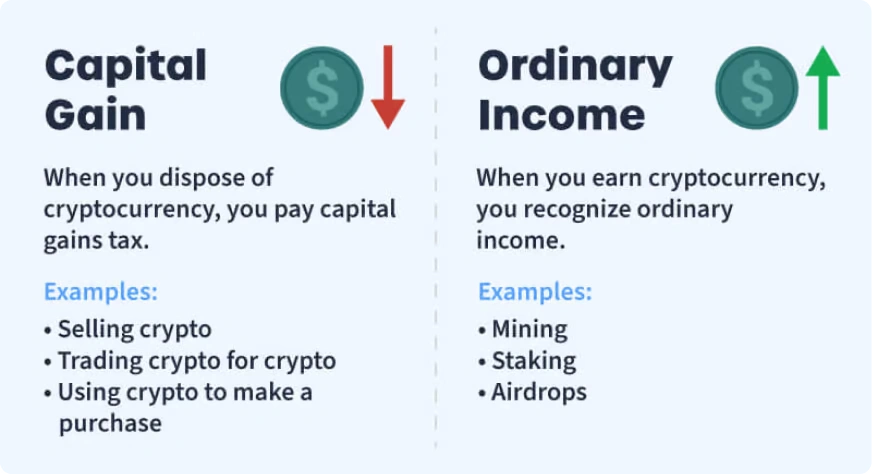
As the Australian Government is yet to declare crypto an official currency or legal tender, it is currently categorised as an asset. This was reaffirmed in the recent Budget, in which the Albanese government noted that cryptocurrencies will not be regarded as a foreign currency for tax purposes, appearing to signal that Australia will not be following El Salvador in declaring Bitcoin to be legal tender.
Therefore, as you would with any asset, if you sell your crypto for a profit, you have made capital gains and are required to pay tax on this profit.
It is important to note that CGT is simply a title; any net gains your investment makes falls under the assessable income for your income tax. So what is the rate of the capital gains tax on your crypto? It is the same rate as your income tax rate.
However, there are some variations in the way that your tax is calculated, depending on whether you are classed as a trader or an investor. The details of these variations are slightly more nuanced and can be confusing for beginners. Actually working out your cryptocurrency tax can be difficult and there are a lot of different facets you need to consider when preparing your tax return.
Yet with the ATO keeping Australian crypto investors squarely in their spotlight, it’s more important than ever that you know what you’re doing and how to report your tax obligations correctly.

Can the ATO track my cryptocurrency?
The ATO introduced a data-matching program in 2019 — which allows the agency to access data from cryptocurrency designated service providers like Binance and CoinJar. As a result, it’s likely that the ATO already has information about your cryptocurrency capital gains and income.
The ATO’s assistant commissioner has been quoted saying, “There isn’t a game of hide and seek. We have got that information and all we are asking people to do is follow the rules.”
What should I do if I get a warning letter from the ATO?
In 2023, the ATO sent thousands of warning letters to crypto investors. If you received one of these letters, you should make sure to accurately report your capital gains and income from the current as well as prior tax years.
It’s important to note that in the past, the ATO has sent warning letters as a blanket notice to crypto investors. It’s possible that you may not have any cryptocurrency tax liabilities — however, you should double-check your transactions to make sure this is the case.
All you need to know
Well, with all that said and to help you on your way, here is a comprehensive guide to the current rules surrounding cryptocurrency and tax in Australia.
While this guide is based on the latest information from the ATO, the information in this article is for general information only. We at Metamining are not a financial or legal advisers and the information you’ll find below shouldn’t be considered as financial or legal advice, the information here is general in nature and intended as a guide, please see the ATO links within this blog and seek specialist independent tax advice from a certified accountant.
If you need more specific guidance, you should consider seeking independent financial or legal advice. Further information can be found here Crypto asset investments | Australian Taxation Office (ato.gov.au)

How to Report Crypto Taxes to ATO
To report CGT on crypto assets in your tax return, you have the option to do it online using myTax or on a paper form. Reporting your cryptocurrency taxes to the ATO involves a few key steps:
- Record Keeping: Ensure you have detailed records of all your cryptocurrency transactions, including dates, amounts, and the nature of each transaction.
- Calculate Gains and Losses: As mentioned earlier in the blog, calculate your capital gains and losses for each transaction, I’ll discuss this further later in the blog.
- Complete Relevant Sections: On your tax return, you’ll need to report these gains or losses in the relevant sections. Generally, these are reported in the capital gains section of your tax return. The ATO provides a video guide on how and where to enter your capital gains.
When to Report Your Cryptocurrency Taxes in Australia
In Australia, the financial year runs from 1st July to 30th June the following year. You must report your cryptocurrency taxes as part of your annual tax return. This means you’ll need to have all your records ready and your calculations done in time for tax filing deadlines, typically by 31st October each year, unless you are using a registered tax agent who may have extended deadlines.
What tax rate do I pay on my cryptocurrency in Australia?
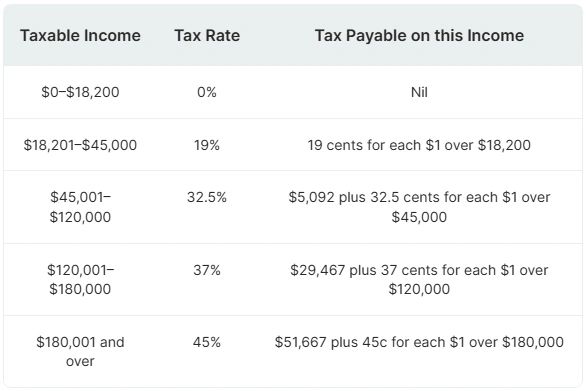
The tax rate you pay on your capital gains and ordinary income varies based on your income bracket. Here are Australia’s tax rates for the 2023-2024 financial year.
Income earned from disposing of cryptocurrency held longer than 12 months is eligible for a 50% discount. That means that only half of your capital gain will be considered taxable income.
Do I pay the same tax rate on all of my income?
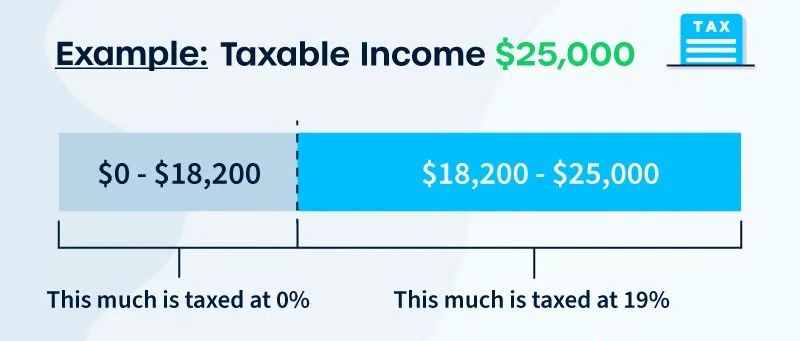
It’s important to remember that you won’t pay the same flat tax rate on all of your income. Instead, you’ll pay the marginal tax rate based on each income tax threshold.
For example, let’s imagine that you made $25,000 in income in a given financial year. Here’s how much tax you’ll pay on each individual portion of your income.
Taxable Events and Transactions
In Australia, several key events or transactions involving cryptocurrencies are considered taxable. It’s important to understand these events as they form the foundation of how crypto taxes are applied. Some of these taxable events include:
- Selling or trading cryptocurrency
- Converting cryptocurrency to fiat currency (like AUD)
- Purchasing goods or services with cryptocurrency
- Earning cryptocurrency through mining or staking
- Gifting crypto assets
What is Capital gains tax (CGT)
Capital gains tax occurs when you dispose of your cryptocurrency. This happens when you sell it, trade it for another cryptocurrency, gift it, or use it for a purchase.
Your capital gain is simply the difference between the AUD value of the cryptocurrency at the time you disposed of it minus the AUD value of the cryptocurrency at the time it was acquired.

It’s important to remember that relevant exchange fees and blockchain network fees can be added to your cost base or subtracted from your gross proceeds. This can reduce your capital gains tax in a disposal event.
Cost Basis and Valuation of Cryptocurrencies
When it comes to crypto taxation, understanding the cost basis and the valuation of your cryptocurrencies at the time of the transaction is crucial. The cost basis is essentially the original value of the crypto for tax purposes, usually the purchase price plus fees. Proper valuation is vital for accurately calculating any capital gain or loss when a taxable event occurs.
Short-Term and Long-Term Capital Gains Tax Rates
The tax rate applied to your crypto gains depends on the duration for which you held the cryptocurrency before disposing of it. Gains from crypto held for less than 12 months are considered short-term and are taxed at your regular income tax rate. However, if you hold your crypto for more than 12 months, you may be eligible for a long-term capital gains tax discount in Australia, typically 50% for individuals.
Long-term CGT Discount
The Australian Government would prefer it if we weren’t all day-trading on the share/crypto markets and so have implemented what’s known as the long-term CGT discount.
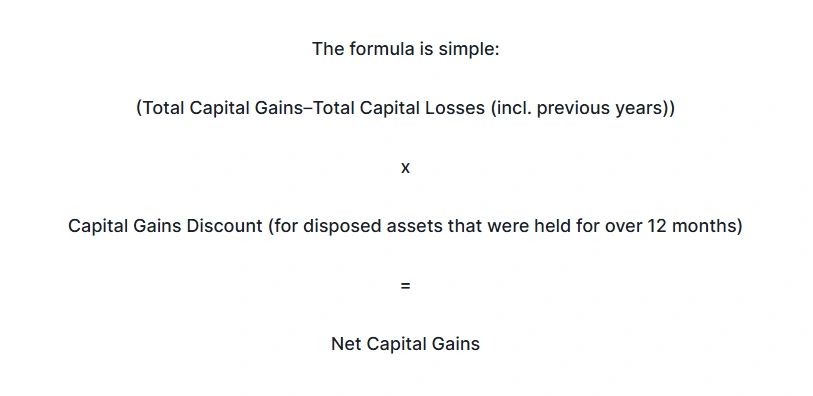
Basically what this means is that if you hold an asset for longer than 12 months then you only have to pay tax on the below % of any capital gains you make from that asset once you deduct any capital losses.
-50% for resident individuals (including partners in partnerships)
-33.33% for complying super funds and eligible life insurance companies, hence the reason many more people are now mining crypto via their SMSF
-50% discount is removed or reduced on capital gains made after 8 May 2012 for foreign resident individuals
Returning to the example above, if you are an Australian resident, bought 1 Bitcoin at $7,000 and sold it a year-and-a-half later for $10,000, then your capital gain will only be considered $1,500 rather than $3,000, given that you didn’t have any capital losses.
If you had a $1000 capital loss then your capital gain will be $1,000 rather than $2,000. This, it probably goes without saying, can make a big difference to your tax bill.
Income tax
Income taxes apply for cryptocurrencies that you have earned — whether that is through a job, mining, staking, or other means. Your income is determined based on the fair market value of your cryptocurrency at the time of receipt.

Tax-free transactions in Australia
Not every cryptocurrency transaction is subject to tax. Here are a few examples of tax-free transactions in Australia.
- Holding cryptocurrency
- Transferring cryptocurrency between wallets you own
- Receiving a cryptocurrency gift
How to lower cryptocurrency taxes in Australia
Here are a few strategies that can help you reduce your cryptocurrency taxes.
- Report cryptocurrency losses: Cryptocurrency losses can offset your capital gains for the year. A net loss can be rolled forward to future tax years.
- Hold for the long term: If you hold your cryptocurrency for longer than 12 months, you’ll receive a 50% tax discount on your capital gains.
- Donating cryptocurrency: Cryptocurrency donations to registered charities can be deducted based on the fair market value of your crypto at the time of the donation.
- Gas fees/transaction fees: Gas fees and transaction fees related to acquiring cryptocurrency can be added to your cost base. This can reduce your capital gain in a disposal event.
- Deduct the cost of tax prep: Any costs you incur for accountants and tax software like CoinLedger can be deducted as ‘expenses you incur in managing your own tax affairs’.
Taxation of Different Crypto Transactions

Cryptocurrency transactions come in various forms, each with its own tax implications under Australian law. This section explores the taxation of different types of crypto transactions, providing clarity on how they are treated by the Australian Taxation Office.
Crypto Trading Tax in Australia
Profits made from buying and selling cryptocurrencies are subject to capital gains tax. If you’re trading cryptocurrencies as a business activity, the profits may be considered business income instead.
Tax Implications of Crypto to Crypto Trades
Trades between different cryptocurrencies including stablecoins are considered taxable events. Each trade represents a disposal of one cryptocurrency and an acquisition of another, potentially resulting in a capital gain or loss.
Staking Taxes in Australia
Rewards earned from staking cryptocurrencies are generally considered taxable income at the time it is received. The value of the staked crypto is also subject to CGT upon disposal.

Taxation of Crypto Mining in Australia
Mining as a hobby: Coins received as rewards are rather not considered income. Upon disposal of the coins received, they will be subject to Capital Gains Tax.
Mining as a business: Rewards from mining cryptocurrencies are taxable as income at the time it is received. The mined cryptocurrency’s value at the time of receipt forms the cost basis for CGT calculations upon disposal.
Airdrops and Their Tax Implications
Airdrops are generally considered taxable income at the market value of the cryptocurrency when received. They are also subject to CGT upon disposal.
There is a particular exception for initial allocation airdrops. According to the Australian Taxation Office, these airdrops are not deemed as ordinary income when received, and thus are tax-free. The cost basis for these tokens is the amount you paid for them, or zero if you acquired them for free.
Hard Forks Taxation in Australia
Coins acquired as a result of a hard fork are not subject to Income Tax. The cost basis for the new coins obtained from a hard fork is considered to be zero. In the event of selling or swapping, the coins are subject to CGT.
Taxes on Crypto Payments
Using cryptocurrencies for payments for goods or services can trigger a CGT event, as it’s considered a disposal of the cryptocurrency.
Taxes on Crypto Gifts in Australia
Gifting cryptocurrency can be a CGT event for the giver, potentially resulting in a capital gain or loss. The recipient’s cost basis is the market value of the crypto at the time of the gift.
Taxes on Crypto-Donations
Donating cryptocurrency to a qualified charity can qualify for a tax deduction.
NFT Taxes in Australia
Non-fungible tokens (NFTs) are subject to similar tax treatments as cryptocurrencies. Profits from buying and selling NFTs can incur CGT.
Tax Implications on Transferring Crypto
Transferring crypto between your own wallets does not trigger a CGT event. However, transfers to others can be considered disposals.

DeFi Taxation in Australia
Lending Taxes
Interest earned from lending cryptocurrencies is treated as income and is taxable the time you receive it. Additionally, any increase in the value of the lent cryptocurrency is subject to CGT upon disposal.
Liquidity Mining Taxes
Rewards earned from liquidity mining are subject to income tax. The fair market value of the rewarded tokens at the time of receipt, forms the basis for income tax calculations.
The following events are subject to Capital Gains Tax:
- Adding liquidity to liquidity pools
- Removing liquidity from liquidity pools
- Disposal of the tokens received from liquidity mining
Check out these links below for more information:
Decentralised finance and wrapping crypto | Australian Taxation Office (ato.gov.au)
DeFi Tax Australia | Ultimate 2024 Guide | Koinly
Am I a trader or an investor?
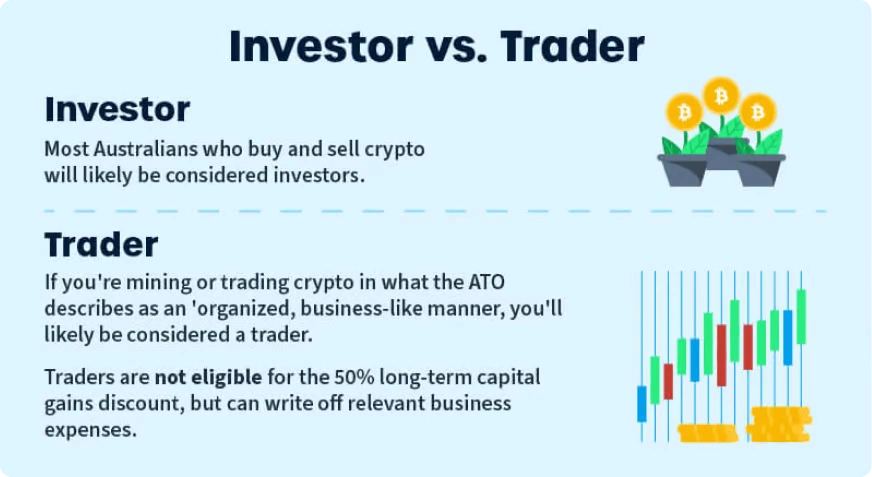
It’s important to remember that your cryptocurrency will be taxed differently based on whether you are considered to be an investor or a trader.
Here’s a breakdown of the differences between investors and traders as per the ATO’s guidelines.
Investor: Investors typically buy cryptocurrencies for the long-term and are primarily interested in building up their wealth over time.
An investor is someone who is primarily buying and selling cryptocurrencies as a personal investment tool. In this case, your income will be derived primarily from long-term capital gains, as well as staking, forks and airdrops.
The vast majority of people who engage with cryptocurrencies will be considered investors and their cryptocurrency transactions will be subject to Capital Gains Tax (CGT).
Trader: If you’re mining or trading cryptocurrency in what the ATO describes as an “organized, business-like manner”, you may be considered a trader. Here are a few signs that you may fall into this category:
- A significant capital investment
- A focus on generating profits in the short-term
- A large volume of trades on a daily or weekly basis
- Documentation and assets that suggest business-like activity such as revenue projections, an Australian Business number, and dedicated office space
A trader is someone who is conducting a business with the primary purpose of earning income from the buying and selling of cryptocurrency. Rather than assessing each transaction as a capital gains event, traders treat their profits as business income instead.
Becoming a trader isn’t simply a question of trading frequency or volume. It requires actions on your behalf that suggest you, either explicitly or implicitly, see your trading as a business, as well as an assessment from the ATO to the same effect.
You can find more information about the requirements and consequences of becoming a cryptocurrency trader here. COINJAR Blog
Of course, the lines between what constitutes a “trader” and an “investor” can get fuzzy at times. Even after reading this blog and clicking on all the links and trawling the ATO website if you’re not sure which category you fall under, you should consult a tax professional. Small scale mining may not be considered mining in an “organized business like manner”, hobby mining, home mining and hosting a few mining machines may still be considered investor. But when you are talking about much larger investments in crypto mining machine capital it may very well be deemed so. I suggest to all our clients that they are best to seek independent legal and financial advice and consult with a competent tax professional.
Are traders taxed differently than investors?
While traders and investors are both subject to tax requirements, there are some differences in how the two groups are taxed.
Traders are not eligible for the 50% long-term capital gains discount. However, any relevant costs can be deducted as expenses.
Investors are eligible for the 50% long-term capital gains discount, but cannot deduct relevant expenses.
Can you be both a trader and an investor?
In certain scenarios, it is possible to be both a trader and an investor. For example, a businessperson that owns a crypto mining business but also has personal crypto investments would most likely fall into this category.
If you are both an investor and a trader, you will need to report all your transactions as an investor and all your transactions as a trader separately. This means that it’s important to keep your trading and investing wallets separate to prevent confusion when it’s time to lodge your tax return.

Calculating Crypto Gains in Australia
Navigating the complexities of cryptocurrency taxation can be challenging, but understanding how to calculate your crypto gains and losses is a fundamental aspect of being a responsible investor. In Australia, the approach to calculating these figures follows specific guidelines set by the Australian Taxation Office.
How to Calculate Crypto Gains and Losses
Calculating gains and losses on cryptocurrency transactions is a critical step in fulfilling your tax obligations. The fundamental formula for calculating a gain or loss is relatively straightforward:
Capital Gain/Loss = Selling Price − Cost Base
Capital Gain/Loss = Selling Price − Cost Base
Where the selling price is the value of what you receive when you dispose of the cryptocurrency, and the cost basis is the original value of the cryptocurrency when you acquired it. This calculation must be done in Australian dollars, requiring conversion if the original transaction was in another currency.
Comparative Example
Let’s consider a comparative example to understand this better:
Example 1: You bought 1 Bitcoin for AUD 10,000. Later, you sold it for AUD 15,000. Your capital gain is AUD 5,000.
Example 2: In another scenario, you bought 1 Bitcoin for AUD 10,000 but sold it later for AUD 8,000, incurring a capital loss of AUD 2,000.
These examples illustrate the basic principle of how gains and losses are calculated for cryptocurrency transactions.
It is also worth noting that Capital gains and losses will come from all angles of investing, so any shares that you own will be subject to CGT and any trades on those shares are deemed CGT events. Any Gains or Losses form all forms of investing are subject to CGT and this can be beneficial as you can carry over those losses. You can carry over losses indefinitely.
When capital losses exceed capital gains, you can claim a deduction of up to $3,000 or the total net loss, whichever is less. If the net capital loss exceeds the $3,000 limit, you can carry it forward to offset potential gains in future years. However, it’s essential to strategically manage asset sales to minimize tax burdens when gains are realized. You can find more info here at the ATO
When it comes to calculating your net capital gains, the ATO doesn’t differentiate between different types of asset, so the profits you make from selling crypto, shares, property or any other asset are all bundled in together and so too are any losses.
FIFO vs. HIFO vs. LIFO
Now we are not talking about Fly In Fly Out here when we say FIFO, Australia is a large mining and oil and gas country with many FIFO workers but when it comes to tax FIFO means first in first out. When it comes to calculating taxes on cryptocurrency transactions, the methods used to determine the cost basis of your assets can significantly impact your reported gains or losses. The ATO allows us to choose between different methods:
- FIFO (First-In, First-Out): This method assumes that the first assets you purchased are also the first ones you sell. In a rising market, this often leads to higher tax liabilities as older, lower-cost assets are sold first.
- HIFO (Highest-In, First-Out): Under HIFO, the assets with the highest cost basis are sold first. This method can minimize tax liabilities in the short term, as it typically results in lower realized gains.
- LIFO (Last-In, First-Out): LIFO assumes that the most recently acquired assets are sold first. This can be beneficial in a declining market, as it might result in lower taxable gains or even a tax loss.
It’s important to choose tax software that allows you to choose.

Crypto taxes in other countries
Cryptocurrency taxation varies significantly across different jurisdictions. Let’s briefly explore how crypto is taxed in some other countries.
Crypto Taxes in the US
In the United States, cryptocurrencies are treated as property for tax purposes. This means that they are subject to capital gains tax and income tax, depending on the nature of the transaction. The IRS requires taxpayers to report all cryptocurrency transactions.
Crypto Taxes in Canada
In Canada, the Canada Revenue Agency (CRA) treats cryptocurrencies as a commodity. Transactions involving crypto can be taxed as business income or as a capital gain, depending on the circumstances.
Crypto Taxes in Germany
Cryptocurrency regulation in Germany can be complex. Notably, if you hold a cryptocurrency for more than one year, any gains from its sale are tax-free. Short-term gains are subject to your personal income tax rate, with specific exemptions available.
Crypto Taxes in the UK
There is no specific Bitcoin tax or cryptocurrency tax in the UK. Instead, your crypto will either be subject to Capital Gains Tax or Income Tax. The crypto tax you’ll pay depends on the specific transactions you’re making with your crypto. If you’re seen to be making an income, you’ll pay Income Tax. The rulings for the UK are slightly different that Australia. Check out this guide here.

Optimizing your Crypto Tax Liability in Australia
In Australia, the tax system provides certain avenues through which investors and traders can reduce their tax burden associated with crypto transactions. Here are seven strategies that can help you reduce your tax bill:
- Hold Cryptocurrencies Long-Term: By holding your cryptocurrencies for more than 12 months, you may be eligible for the 50% Capital Gains Tax discount.
- Offset Gains with Losses: If you have made losses on some of your crypto investments, these can be used to offset capital gains made on others. This process, known as ‘loss harvesting’, can significantly reduce your overall taxable gains.
- Utilize Tax-Free Thresholds: For certain small transactions, you might not owe any tax. For instance, personal use asset exemption in Australia might apply if the cost of your cryptocurrency is AUD 10,000 or less.
- Choose Your Cost Basis Method Wisely: Deciding between different cost basis methods (FIFO, LIFO, HIFO) can impact your realized gains and losses. Choose a method that aligns with your investment strategy and tax situation.
- Consider a Self-Managed Super Fund (SMSF): Investing in cryptocurrency through an SMSF can offer tax benefits, as earnings within an SMSF are taxed at a concessional rate.
- Keep Detailed Records: Accurate record-keeping of all your transactions can help you track acquisition costs, disposal proceeds, and the duration of holding, which are all crucial for calculating your potential tax liability.
- Seek Professional Advice: Due to the complexities of crypto taxation, consulting with a tax advisor who specializes in cryptocurrency can provide you with tailored strategies to minimize your tax obligations.
Understanding and managing crypto taxes in Australia can be a complex task, but with the right information and tools, it becomes much more manageable. For those looking for an efficient way to track and manage their crypto taxes, the CoinTracking software offers a comprehensive solution. It simplifies record-keeping, calculates gains and losses, and helps in preparing reports for tax filing, making it a valuable asset for any crypto investor or trader in Australia.

The Best Crypto Tax Software 2024
As the crypto industry has grown significantly throughout the 2020s, more Australians than ever have digital assets in their portfolio. With this increased interest has come greater scrutiny from the Australian Tax Office (ATO) on crypto-related investments. Ensuring you meet all of your tax obligations come EOFY can save headaches in the long run. However, managing crypto tax can be a little complex – which is why using automated tax software can be a lifesaver. I have been using koinly for my personal crypto tax preparation for years, but that is not to say there aren’t better options. With some of the software reviewed here scoring an impressive 4.8 Stars maybe it’s time for me to look at an alternative for this years Tax…

- Koinly – Best overall
- Crypto Tax Calculator – Best for DeFi
- CoinLedger – Best for NFTs
- Syla – Best value
There are several elements for Aussies to consider when selecting the best crypto tax software for their needs.
- Costs. Small-time investors won’t want to spend too much on accounting software, so budgeting is always an important consideration when it comes to any product.
- Local tax guidelines. There’s no point using tax software if it only abides by US tax regulations. We’ve handpicked platforms that are designed to meet all ATO guidelines.
- Customer service. Tax-time can be confusing even for the experienced, so having strong customer support is always a must for any accounting-based software.
- User interface. All of the software represented on this list boasts intuitive, easy-to-use interfaces that make it a breeze to integrate platforms and generate tax reports.
- Integrations. Having everything automated leaves less room for error when filing your taxes. The more integrations a tax software supports, the better, as this means it will automatically update and sort your transactions as soon as they happen. The less spreadsheets the better!
Here is a summary of the best 4….

Koinly
Koinly is an online crypto tax service platform for regular and retail investors. The company’s software manages your connected crypto portfolios and monitors all transactions. By generating regulatory tax reports on each transaction, it helps you create accurate and timely tax reports come EOFY. Koinly rates 4.7 out of 5 Stars on Trustpilot
Whenever you are trading, mining or lending, anything happening on your connected wallet(s) will be tracked by Koinly. The software provides detailed reports on every event and calculates the exact tax obligation – including any deductible losses like fees. Koinly’s API can be integrated with local exchanges like Swyftx, further automating and simplifying the tax-time process for crypto investors.
Features
- Offers Australian-focused tax reports to ensure all ATO obligations are met
- Koinly can be integrated with 850+ wallets and exchanges, include Australian-based platforms like Swyftx
- The software excels at recording more complex crypto events, such as DeFi transactions and leveraged trading
- Simple user interface to quickly see portfolio performance, unrealised gains and potential capital gains through different timeframes
- A free trial version with basic features for small-time investors
Cost
- Free Plan: $0/year
- Newbie Plan: $49/year
- HODLER Plan: $99/year
- Trader Plan: $199/year
Koinly Review 2024: Crypto Tax Made Easy! – Coin Bureau

Crypto Tax Calculator Australia
Crypto Tax Calculator is an “Australian-made and owned” accounting solution for cryptocurrency investors. The team is partnered with Coinbase Ventures and MetaMask, and has an impressive 4.8/5 score on TrustPilot, suggesting excellent customer service.
Transactions can be easily imported from a variety of local exchanges, as well as wallets and DeFi platforms. Data from blockchains themselves can be imported too, making it an excellent option for users with a lot of on-chain activity.
Crypto Tax Australia’s Main Points
- Australian Made and Owned
- Great interface
- Well Priced
Features
- Support for 300k+ altcoins with historic pricing data, ensuring accurate tax reporting for even the most obscure degen tokens
- Integration with DeFi platforms like UniSwap, Sushiswap and AAVE
- Least Tax First Out algorithm helps keep taxes low
- Excellent and intuitive user interface which quickly shows portfolio gains, losses, deposits and more
- Customisable transactions to ensure all data is correct and neatly sorted
Cost
- Rookie Plan: $49/year
- Hobbyist Plan: $129/year
- Investor Plan: $249/year
- Trader Plan: $399/year
Crypto Tax Calculator Review 2024: Crypto Tax Streamlined! (coinbureau.com)

CoinLedger
CoinLedger is one of the oldest crypto tax companies in the industry, having started out as CryptoTraderTax back in 2018. The software has over 500,000 users and supports investors from around the globe – including Australia. The team is one of the most trusted brands in the community and has an excellent reputation for stellar customer service and reliable tax reports. Rated an impressive 4.8 out of 5 Stars on Trustpilot with over 1200 reviews the team at CoinLedger are obviously doing something right
Like most tax software, investors can link their exchange accounts, wallets and dApp activity to input transaction data. CoinLedger can also import historical data from lesser-known sources such as support for NFTs and staking platforms. The platform allows wallets from hundreds of blockchains, meaning complex DeFi transactions won’t be left out of your annual tax report.
CoinLedger’s Main Points
- Excellent Trustpilot rating and high number of reviews
- Been around for a quite a few market cycles
- Great for miners and traders with a lot of transactions
Features
- One of few crypto tax software options that allow unlimited transaction processing, perfect for high-frequency/volume traders
- CoinLedger is renowned for its NFT support, with dedicated integration for OpenSea and other Ether-based NFT platforms
- An in-built portfolio tracker which shows current gains/losses, as well as past performance on a yearly, monthly or weekly basis
- Integrations with hundreds of wallets, blockchain ecosystems and exchanges, including Aussie platforms like Swyftx
- A free plan for traders that just want to try out crypto tax software before parting with their hard-earned money
Cost
- Free Plan: $0/year
- Hobbyist Plan: USD $49/year
- Investor Plan: USD $99/year
- Pro Plan: USD $199+/year (investors can buy support for additional transactions if required)
Syla
Syla is an Australian company that provides an AI-powered solution for managing crypto-related tax obligations. The service is specifically designed to satisfy the ATO’s stringent tax laws, letting Aussie customers rest easy. Whether you’re an individual, SMSF, Trust or Company, you can easily generate an ATO tax report that is optimized to save you tax. Syla rates 4.3 out of 5 Stars on Trustpilot, however only has 7 reviews. Syla, the crypto tax software, has been around for a while now. It’s designed specifically for Australian investors and traders. With features like AI-powered tax calculations, real-time trade updates, and efficient portfolio management, Syla simplifies crypto tax reporting. Syla was originally founded by Tax Professional, Maryna Kovalenko and Product Engineer, Nick Christie, to solve one of the largest problems that affects every Australian crypto investor and their accountant — tax.
Syla’s Main Points
- value for money on the Budget plan,
- built exclusively for Australian tax,
- advanced tax optimisation.
Features
- Smart Classification technology to ensure all transactions and disposal events are sorted properly
- Integration with over 500 platforms, including major exchanges such as Binance, Swyftx and Coinbase
- Doubles up as a portfolio tracker with accurate data showing performance based on historic and recent trades
- Support for up to 100,000 transactions for active traders and bot trading.
- Live chat for customer support during regular business hours (9am to 6pm)
- Proprietary Lowest Tax First Out (LTFO) sorting method that can make tax obligations lower than other reporting formats
- The team recently rolled out a private wealth suite specifically to address unique investors like SMSFs, Trusts, and businesses
Cost
- Budget Plan: $59/year
- Assurance Plan: $149/year
- Tax Saving Plan: $249/year
- Private Wealth Plan: $389/year
Syla Review 2024: Low-Cost Crypto Tax Software (cryptonews.com.au)
It is best to find the package and platform that you trust and one that fits with your budget and volume of trades, swaps or entries. With your mined crypto it may be best not to set auto payout to your wallet addresses from your pools but to simply take a manual payout each month to more easily keep a track of blocks of crypto and have less transactions with your mined crypto. This is a strategy that I have spoken about on multiple occasions through different blogs. It is best to find the strategy that best works for your individual mining and also for your investing and then match the right software package to suit. It’s vital your chosen crypto tax tool supports everything you need it to, otherwise, you’ll end up needing to create CSV files to manually import your data – and in this regard, Koinly wins as it supports more integrations overall, particularly crypto exchanges, than CryptoTaxCalculator. Koinly supports more integrations overall, particularly with various crypto exchanges. CryptoTaxCalculator claims to support 2934 integrations, but many of these are DeFi protocols that are supported via wallet addresses. Excluding these, it actually supports just over 600 integrations, however if you are heavily into DeFi it may just be the best one for you.
Both Koinly and CoinLedger work on the same ‘freemium’ model. While it’s free to import and track transactions, you need a paid plan to download a tax report. That’s how all of the crypto tax calculators work. The big difference is what you get on Koinly’s free plan, versus CoinLedger’s. Koinly stands out with its extensive integrations, automatic data import, and detailed portfolio tracking. Syla offers a simpler free plan but lacks some features compared to Koinly. I have had issues with Koinly in the past where there are errors importing transaction history and I have had to input manual transactions. I like that fact that Syla is Australian company and that it is optimized for Australians and so too are Crypto Tax Calculator Australia.
Remember that the best choice depends on your preferences, the complexity of your transactions, and the level of support you need. I suggest you explore each platform further to make an informed decision. Tax time doesn’t need to be so daunting and with these applications you can use them through one full tax cycle/tax year, so it may actually pay to get one earlier in the season and enable you to track more closely how you are performing throughout the year.
For further tax advice and support check out a few of these Crypto Tax Accountants. Tax On Chain They are unique from other accounting firms with their team of dedicated specialist crypto accountants, all of whom are deeply invested in the cryptocurrency and Web3 spaces. With their extensive knowledge of all things crypto, they offer tailored tax, accounting and CFO solutions for clients that are involved in all aspects of crypto – DAOs, DeFi, NFTs, Mining and all things in between. They have also established themselves as one of Australia’s leading crypto SMSF providers. FullStack is a full cryptocurrency tax management institution. One of the first crypto tax handling agents in Australia and caters for Miners, Traders and Serious Investors to Casual Investors. CryptoTax was founded in 2017 as Australia’s first cryptocurrency based accounting and taxation advisory firm. This company was founded by experts in the crypto blockchain system. CryptoTax has a dedicated team lead by Andrew Bragg, a crypto professional and a technically astute practitioner who delivers quality outcomes to his clients. CryptoTaxAus is a proactive Cryptocurrency Taxation advisory platform. CryptoTaxAus was founded in 2017 and has its Certified Practicing Accountants work closely with clients to find the best solution for improving an individuals’ Tax circumstances.
Well, there you have it, your full arsenal of crypto tax info….. are you ready to tackle your crypto tax yet? I certainly hope that I have helped to educate and clear up any confusion you may have had regarding what qualifies as taxable income, what is taxed and how it is taxed. Please speak with your own accountant and if they do not fully understand crypto tax then please ensure that you double check with another firm. Do not pay too much for your crypto tax accounting and please use the software tools to assist you in organizing your crypto tax prior to visiting your accountant.
All the best with Tax season, we are only a few weeks away from the end of financial year – if you haven’t already then now is a great time to review your investments, gains and losses as well as double check your approximate tax position – you may need to spend some money to reduce a tax bill, avoid a tax bill or maximize a claim. Now is a great time to pick up miners for home hobby mining or professional hosted crypto mining. With BTC halving next in 2028 and LTC halving next in 2027 now is a great time to pick up BTC miners and Scrypt miners and get a great stash of coins under your belt prior to the next block reward halving. With Scrypt mining halvings only affecting LTC and having no impact on Doge mining it makes scrypt mining more resilient to halvings and therefore we see a more consistent revenue stream from scrypt miners over the long-term. CKB – Nervos Network is halving next in Nov 2027 so that too also gives a great run up toward the next cycle for mining. Now is a great time in the market cycle to buy these units while prices have dipped prior to the next phase where we will start to see that progressive climb toward the peak of the Bull Run.
Happy Mining
Rusty Rigs




Disclaimer: The content on this site and in this communication should not be considered investment or financial advice. Any investing or crypto mining is speculative. When investing your capital is at risk, please do your own research and invest and make your decisions wisely. Mining profits are not guaranteed and may vary over time depending on the market performance and network hashrates.